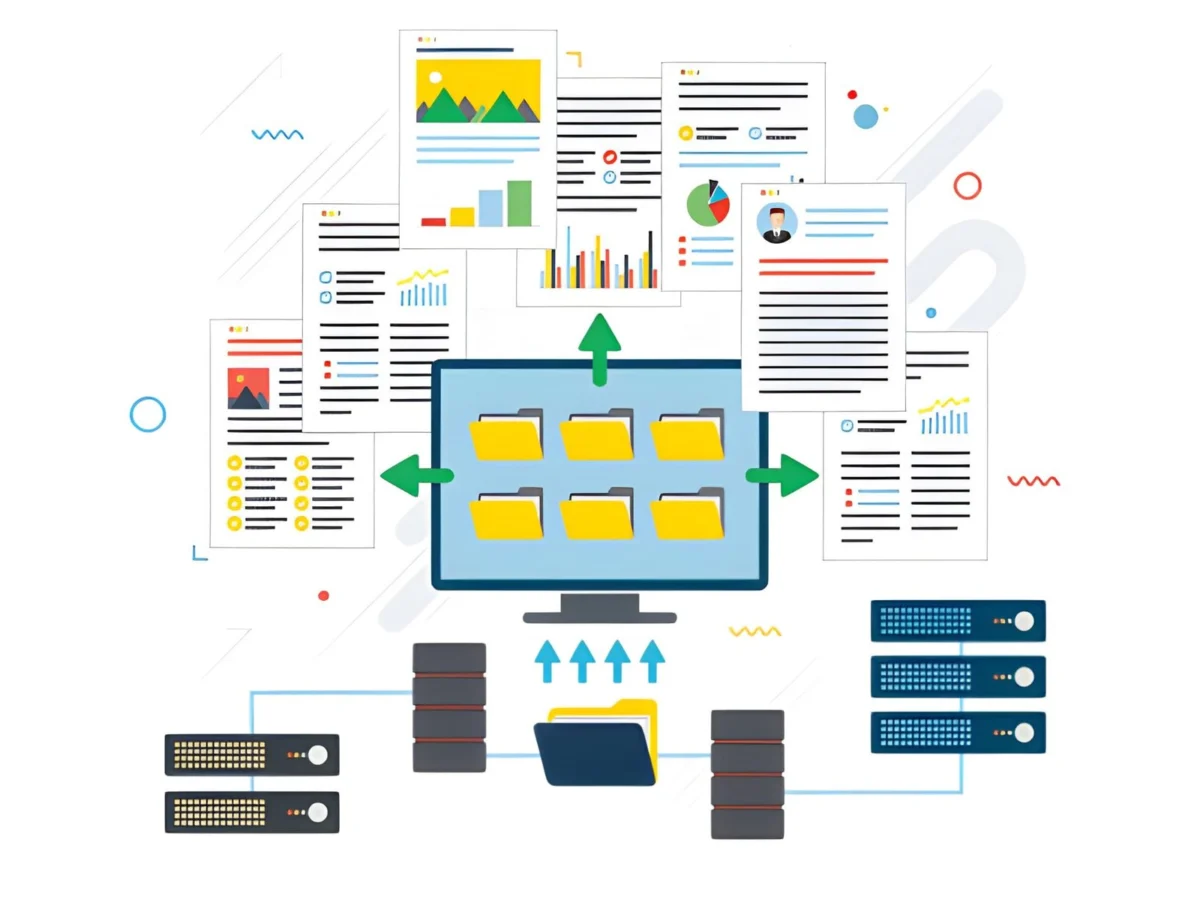

Businesses managing large document volumes require efficient data extraction. Smart document processing uses advanced technologies like machine learning and artificial intelligence to streamline workflows, reduce manual effort, and ensure greater accuracy. According to global market intelligence firm IDC, the intelligent document processing (IDP) market encompasses two key areas: capture applications that convert unstructured data into structured information and document understanding AI software that extracts intelligence from documents. The overall data extraction software market reached $1.38 billion, and experts project it will grow to $3.99 billion, with a Compound Annual Growth Rate (CAGR) of 9.8%. This growth underscores the critical role of IDP tools in enhancing productivity, compliance, and decision-making. By 2030, analysts predict that up to 80% of B2B invoices globally will be processed automatically using these technologies, setting a new standard for efficiency.
This list examines the top enterprise-grade data extraction tools designed to meet these evolving demands.
1. ABBYY
ABBYY offers a cutting-edge intelligent document processing (IDP) platform that empowers enterprises to turn unstructured data into actionable insights. ABBYY leverages advanced artificial intelligence (AI) and machine learning capabilities to automate data extraction with precision and speed. The platform is built with scalability in mind, enabling organizations to process high volumes of documents seamlessly while maintaining accuracy.
Key features include pre-trained skills, customizable workflows, and integration with leading business systems, making ABBYY a versatile solution for industries like finance, healthcare, and supply chain management. By choosing ABBYY, businesses can reduce operational bottlenecks, improve compliance, and drive informed decision-making through unparalleled document digitization and analysis.
Reference: https://www.abbyy.com/ai-document-processing/data-extraction-and-validation/
2. Rossum
Rossum was one of the first companies to stand up and say, “Templates are dead.” If you’ve ever used old software where you had to draw boxes around specific parts of a document to tell the computer where to look, you know how frustrating it is when a vendor changes their layout. Rossum’s AI, powered by its proprietary Aurora model, reads a document just like a human does by looking at the geography and context of the page.
For enterprises, Rossum is a lifesaver because of its Semantic Data Matching. It doesn’t just see a total amount of $5,000; it checks that $5,000 against your internal purchase orders and warehouse receipts. If they don’t match, it raises a red flag. This kind of automated triple-check is what prevents massive billing errors and fraud in global supply chains.
3. Google Cloud Document AI
Google’s approach is exactly what you’d expect: massive scale and incredibly deep research. Their Document AI platform is a beast when it comes to handling “unstructured” data. Think about long legal contracts or handwritten notes; the kind of stuff that usually makes software give up.
In 2026, Google has integrated its Gemini Enterprise agents directly into the workflow. This allows you to talk to your document database. You could ask, “How many of our contracts with Vendor X have a termination clause of 30 days?” and Google will scan your entire archive to give you the answer in seconds. Its ability to perform document classification at a massive scale, sorting through millions of pages a month, is arguably the best in the world.
4. Kofax (Tungsten Automation)
Kofax, which recently rebranded to Tungsten Automation, is the go-to for companies that have messy tech stacks. Most large enterprises aren’t using 100% modern software; they have old legacy databases from 15 years ago that don’t talk to modern apps. Kofax bridges this gap.
It uses a combination of AI data extraction and Robotic Process Automation (RPA). Once the AI extracts the data from a form, a robot automatically types that data into your old systems. It’s like having a digital bridge between the past and the future. For highly regulated industries like government or healthcare, their FedRAMP-certified security ensures that even the most sensitive data is handled with total compliance.
5. Ocrolus
Ocrolus is a specialist. While the other tools on this list are generalists that can handle almost any document, Ocrolus focused its entire brain on the financial services and lending industry. If you are a bank processing mortgage applications or a fintech company doing small business loans, Ocrolus is usually the winner.
They have a Perfect Data philosophy. They know that in finance, being 98% right is the same as being 100% wrong. To solve this, they use a hybrid model: high-end AI does the heavy lifting, but if the software is even 1% unsure about a digit on a bank statement, it is instantly routed to a human expert for verification. This ensures 99%+ accuracy and allows them to detect digital forensics, spotting subtle signs that a document has been photoshopped or tampered with.
Final Thoughts
Ultimately, buying data extraction software is not about substituting humans; rather, it is about removing the boring work from their roles. When a machine handles tasks like automated document classification and data entry, your staff can carry on with human activities such as addressing problems, interacting with customers, and strategizing.
Actually, the “smart” part of Smart Document Processing goes beyond AI; it means a more intelligent way of doing business. If you are getting these tools, you will be changing your documents from a liability to a major resource.
Read more: How Portable Classrooms Support Flexible Learning Environments
Remake Renaissance: How Game Remakes Balance Nostalgia and Innovation
Affordable Dental Care | Spencer Dental Colonial Heights, VA

Grace Mitchell is a content writer at GrammerWay, focused on English grammar, clear writing, and common language mistakes. She creates simple, reader-friendly guides to help improve writing confidence.
Leave a Comment