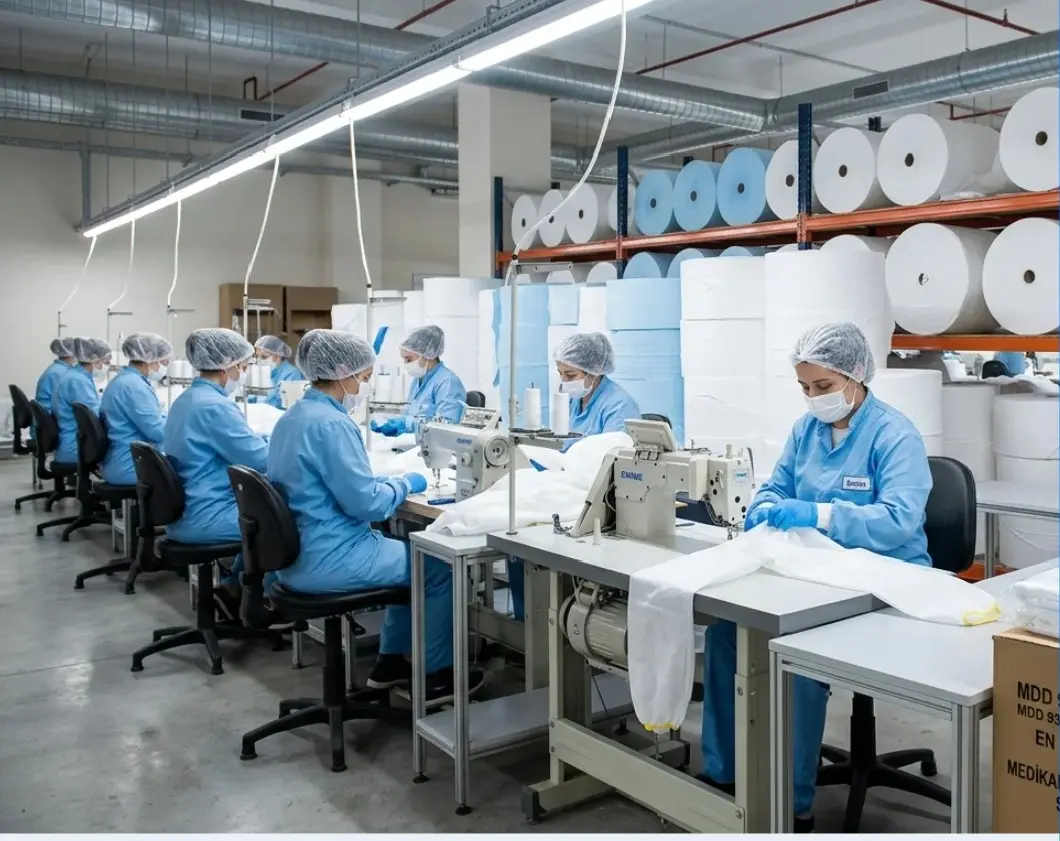

Finding reliable isolation gowns manufacturers is harder than it looks. Pick the wrong supplier, and you’re stuck with non-compliant PPE, a blown budget, and a procurement timeline that falls apart fast.
Turkey has become one of the strongest alternatives to Chinese and European isolation gowns manufacturers. It offers competitive labor costs, close access to EU markets, and a well-developed medical textile industry. Most global buyers are just starting to notice this.
Are you a hospital procurement manager? A medical distributor building a more diverse supply chain? Or a trade company looking for an OEM partner? This guide goes straight to the names, certifications, and sourcing details that matter most.
Turkey’s Isolation Gown Manufacturing Industry: A Global Buyer’s Overview
Turkey’s medical textile sector generates USD 2–2.5 billion in exports every year. Most global procurement teams haven’t built that into their sourcing strategy yet — and that’s a missed opportunity.
The EU takes 50–60% of that output. MENA and Gulf markets absorb another 20–25%. During COVID-19, Turkish PPE exports to Europe saw triple-digit percentage growth in 2020 alone. That wasn’t luck. It was a stress test. Turkey passed it.
Why Turkey Works for Isolation Gown Sourcing?
The structural advantages are real and measurable:
- Speed to EU markets : Trucks from Istanbul reach Germany, Italy, or France in 3–7 days. Sea freight from China takes 25–40 days. For hospital procurement teams running lean inventory, that difference is a direct operational win.
- Zero EU customs duty : Turkey’s customs union with the EU means most medical textiles — including non-sterile isolation gowns — enter Europe duty-free. Chinese-origin PPE can carry extra duties plus anti-dumping risk. That cost gap adds up fast on large orders.
- Competitive labor costs : Turkish manufacturing wages run USD 450–700/month for operators. That’s cheaper than Eastern EU member states and on par with coastal China, but logistics costs into Europe are far lower.
- Local nonwoven supply : Hubs like Gaziantep host polypropylene nonwoven producers with full in-house production. Factories source SS, SMS, and SMMS fabrics locally at 40–55 g/m² — the standard range for medical-grade isolation gowns. This cuts exposure to global raw material shortages.
What the Industry Actually Looks Like?
The market is fragmented. That matters for buyers. Most Turkish isolation gown exporters are SMEs with 26–50 employees and annual revenues of USD 1–2.5 million. Each factory’s capacity sits in the tens to low hundreds of thousands of gowns per month.
That’s not a weakness. It’s leverage. Smaller, responsive manufacturers are more willing to handle OEM specifications, custom labeling, and mixed-product orders than large commodity factories.
Certification coverage is strong across the serious players: ISO 13485, ISO 9001, CE marking under EU MDR, and EN 13795 compliance for surgical and isolation gowns. Many factories also produce to AAMI PB70 Level 1–3 equivalents on request — worth knowing if you’re sourcing for US-market distribution.
Post-pandemic, European group purchasing organizations have started signing 2–3 year framework contracts with Turkish gown producers. They lock in base volumes and build in surge options. Global wholesalers now run a dual-sourcing model: China handles the highest-volume commodity needs, while Turkey covers fast-response, EN-standard, EU duty-free supply that reduces chain risk.
That’s the structural shift. Turkey isn’t a backup plan anymore — it’s becoming a deliberate sourcing tier.
Vistalina — Disposable Surgical & Isolation Gowns Manufacturer in Turkey
Gaziantep has become a real manufacturing hub for Turkish medical textiles. Vistalina is one of the key names based there.
The company makes disposable surgical gowns, drapes, coveralls, masks, and consumables at its Gaziantep facility. Their main customers are hospitals, distributors, and private-label buyers. That’s a tight, focused profile. It shows the factory handles both institutional orders and OEM production runs.
Certifications on record: EN 13795 and ISO 13485. Both are solid, recognized standards for medical-grade surgical gowns in EU supply chains.
One thing to clarify before you move forward: Vistalina’s public materials focus on surgical gowns — not isolation gowns. Your procurement requirement may be AAMI PB70 Level 1–4 isolation gowns for US-market distribution. That claim has not been confirmed in available sources. Ask before you assume the product range covers both.
What Vistalina suits well: – EU-compliant surgical gown procurement – Private label and OEM production runs – Bundled orders across disposable medical categories
MOQ, lead time, and payment terms are not listed publicly. Start by reaching out through their website. Get the AAMI compliance question answered in writing — especially if isolation gown standards are a hard requirement for your order.
Genç Giyim — Spunbond Isolation Gowns Manufacturer for Dry & Light Fluid Protection
Single-layer spunbond polypropylene. That’s the material story here — and for the right buyer, it’s the right answer.
Genç Giyim makes isolation gowns built for dry particle protection and light fluid repellency. Full coverage, long-sleeve design. These gowns target low-to-moderate risk environments:
- Outpatient clinics
- Hospital visitor areas
- Basic care rounds
- Dry lab settings
In AAMI terms, that’s Level 1–2 territory. That positioning matters for procurement budgets — more than most buyers expect.
Why the Material Choice Has Real Cost Implications?
Single-layer spunbond runs 20–25 gsm. SMS gowns add a meltblown filtration layer. That extra layer pushes the price 20–40% higher for the same coverage in low-risk settings.
High daily gown turnover across general wards and visitor areas? That price gap adds up fast. The smart procurement approach is straightforward:
- Reserve SMS and multi-layer gowns for surgical suites and emergency settings
- Use single-layer spunbond wherever AAMI Level 1–2 compliance is enough
Genç Giyim fits neatly into that tiered supply strategy.
What to Confirm Before Ordering?
Certifications aren’t listed on the site. Request these documents:
- CE documentation
- ISO 13485 status
- AAMI PB70 Level 1–2 test reports (AATCC 42/127)
Ask for them up front. MOQ details aren’t published, but standard industry benchmarks point to 5,000–10,000 pcs for standard specs. Custom GSM, color, or packaging pushes that range toward 20,000–50,000 pcs.
Reach out through gencgiyim.com.tr. Lead with your target GSM, annual volume estimate, and certification requirements. Ask for FOB pricing and lead time in the same message.
Steril Sağlık — AAMI Level 1–4 Isolation Gowns Manufacturer in Turkey
Few Turkish manufacturers cover the full AAMI PB70 spectrum. Steril Sağlık does — Level 1 through Level 4.
That range matters. Here’s what each level means in procurement terms:
| Level | Key Test | Use Case |
| Level 1 | AATCC 42 (≤4.5g impact) | Routine patient care, minimal fluid risk |
| Level 2 | AATCC 42 + AATCC 127 (≥20 cm hydrostatic) | Minor procedures, slight fluid exposure |
| Level 3 | AATCC 42 + AATCC 127 (≥50 cm hydrostatic) | Moderate surgical use |
| Level 4 | ASTM F1671 viral penetration — must pass | High-risk, fluid-intensive procedures |
Construction uses tri-layer SMS fabric. It breathes well enough for extended wear. The front panel and sleeves meet critical-zone protection requirements, too.
Before You Place an Order
Ask for this documentation set in writing:
- AAMI PB70 level classification for each SKU
- Test reports : AATCC 42, AATCC 127, and ASTM F1671 (Level 4 only)
- Sterility status : sterile or non-sterile per product line
- Sizing options : confirm extra-long lengths are available if your market needs extended coverage
No documents ready? Slow down. That’s a sign to look elsewhere.
Mayamed Medical — OEM Disposable Isolation Gowns Manufacturer
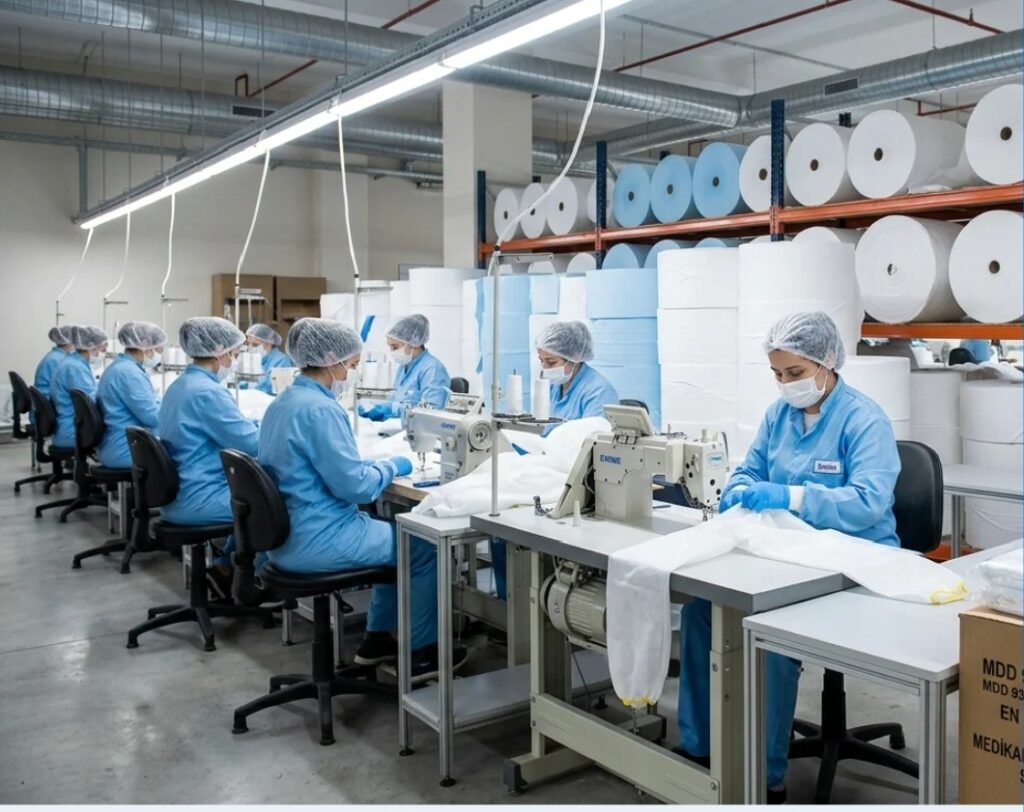
Mayamed Medical holds a solid position in the Turkish PPE market. Their focus is on OEM disposable isolation gowns and medical textiles. Products are built on non-woven Polypropylene with a practical feature set. Most hospital and dental procurement needs are covered.
The core product profile breaks down like this:
- Material: non-woven polypropylene, water-repellent coating standard
- Design: one-piece, elastic sleeve closures, latex-free
- Sizes: S through XXXL — full commercial range
- Use cases: outpatient clinics, wards, labs, dental procedures, and general isolation settings
On the compliance side, check for CE certification and ISO 13485:2016. These are the two key benchmarks. Targeting the US market? Ask whether AAMI PB70 level testing has been completed. That one question tells you a lot. It separates serious OEM partners from those still working through their certification roadmap.
Before committing to a sample order, confirm:
- Fabric GSM and coating spec in writing
- Packaging format — industry standard runs 100 pcs per case
- Whether AAMI level classification is available per SKU
Mayamed’s public MOQ data isn’t confirmed yet. Use 100 pcs/pack as your starting point when you sit down to negotiate terms.
Medkey — Surgical & Isolation Gowns Manufacturer for Hospital Procurement
Medkey appears in hospital procurement catalogs and B2B platform listings under the “MedkeyMed” product branding. What they sell is simple: disposable surgical gowns and isolation gowns, direct to hospitals and clinics through OEM and private-label channels.
Product range covers AAMI PB70 Level 1–3 for isolation gowns and Level 3–4 for surgical gowns. Materials are SMS/SMMS nonwoven polypropylene. Isolation lines run 20–45 g/m². Surgical applications use 35–60 g/m² for higher barrier protection. Higher-barrier surgical gowns also feature a laminated PP+PE front panel. That’s where the protection matters most. The back stays lighter SMS fabric — better comfort during long procedures.
A few practical specs for procurement teams:
- Isolation gowns: non-sterile, packed 10 pcs/bag, 50–100 pcs/carton
- Surgical gowns: sterile, each piece pouched separately, 40–80 pcs/carton
- Trial MOQ: 500–1,000 pcs isolation; 200–500 pcs surgical
- Production lead time: 10–20 days for up to 50,000 gowns if fabric is in stock
One critical point before you place an order: sourcing for US hospital use with a “surgical gown” label means you’re dealing with an FDA Class II device requiring 510(k) clearance. Get the clearance summary in writing. A product sheet alone is not enough.
Request this documentation set upfront:
- AATCC 42 and AATCC 127 test reports per SKU
- ISO 13485 certificate and FDA registration
- CE marking documentation for EU distribution
- Sterilization validation records for sterile surgical gown orders
No confirmed Turkish facility exists for Medkey. Position it as an Asia-based OEM option inside a broader multi-source strategy.
How to Place a Bulk Order with Turkish Isolation Gowns Manufacturers: Step-by-Step
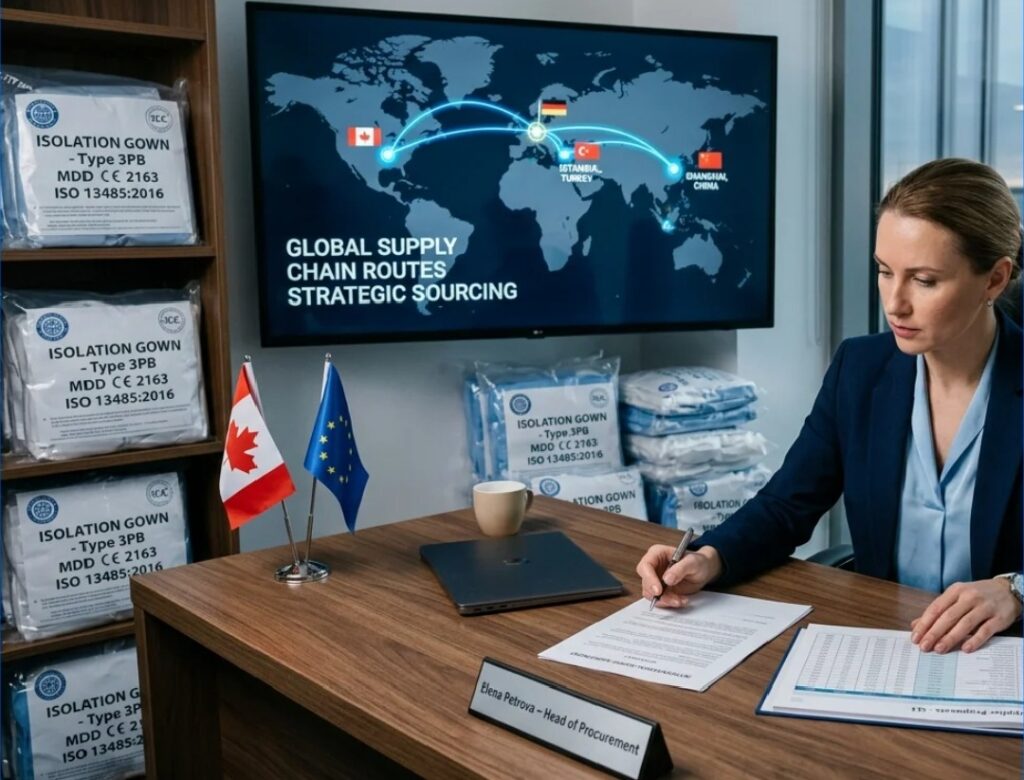
Your first message decides everything. A smooth bulk order or a procurement disaster — it starts there.
Send a vague inquiry, get a vague quote. Send this instead:
“We need [X] pcs of isolation gowns, AAMI Level [1/2/3/4] , material [SMS/PP/PE] , sizes [S–XXL] , packed [xx pcs/carton] , ship to [port] , target [price] — please quote FOB and share MOQ, lead time, certificate copies, and test reports .”
That structure pulls a real response from suppliers. Add this line to filter out time-wasters fast: “We’re comparing 3–5 Turkish isolation gowns manufacturers and will move fast with whoever sends complete certificates and pricing in the first reply.”
Then verify before you pay — in this order:
- Check the supplier’s legal registration on MERSİS (Turkey’s business registry)
- Match the CE declaration, test reports, and company name across every document — they must align
- Request an SGS or BV factory audit report
- Approve a physical sample — check fabric weight, seam strength, and cuff fit
Lock in four contract clauses before signing:
- AQL-based quality acceptance — sets a clear pass/fail standard for the shipment
- FOB Incoterm — the cleanest option for first orders, keeps cost and risk clear
- Rejection rights — you can refuse nonconforming shipments
- IP clause — stops the factory from overproducing your labeled goods without permission
Pay the deposit after entity verification and document review pass. Not before.
FAQ: Sourcing Isolation Gowns from Turkey
Buyers ask the same questions. The same six issues come up every time someone enters the Turkish PPE market. Here are straight answers.
Do Turkish isolation gowns manufacturers have FDA approval?
Company-level FDA registration is common. Product-level 510(k) clearance is not — and that gap matters.
Most Turkish exporters targeting the US market hold FDA establishment registration as a foreign isolation gowns manufacturer. Level 1–2 isolation gowns fall under Class I exempt devices. They sell under FDA enforcement discretion, as long as the label clearly identifies them as non-surgical isolation gowns meeting AAMI PB70 standards.
Three things to verify before any US-bound order:
- Supplier’s FDA establishment registration number and device listing
- Supplier’s US agent details — required for all foreign manufacturers
- Intended use declaration in the IFU — “isolation gown” versus “surgical gown” is not interchangeable under FDA rules
Run the registration number yourself in the FDA Establishment Registration & Device Listing database. A document scan is not proof.
Are Turkish isolation gowns CE certified?
The serious exporters are. The ones to avoid hand you a CE logo on a product sheet with no Notified Body number attached.
Valid CE marking for isolation gowns sold into the EU falls under MDR (EU 2017/745) or PPE Regulation (EU 2016/425) . The minimum document package to request:
- EU Declaration of Conformity listing specific gown models by name and SKU
- CE certificate from a recognized Notified Body — Category III PPE classification applies for high-barrier gowns
- Test reports referencing EN standards — EN 13795 for surgical gowns, EN 14126 for protection against infectious agents
Pull the Notified Body number from the certificate and check it in the NANDO database . That lookup takes 90 seconds and cuts out a large chunk of fake documentation.
What MOQ should I expect from Turkish isolation gown suppliers?
MOQ scales with complexity. Here’s what the market looks like:
| Product Type | Standard MOQ | Custom/Private Label MOQ |
| Level 1–2 disposable (PP/SMS) | 5,000–10,000 pcs | 10,000–20,000 pcs |
| Level 3–4 taped seam, high-barrier | 10,000–30,000 pcs | Higher — confirm per factory |
| Reusable polyester gowns | 2,000–5,000 pcs | 5,000+ pcs |
Not ready for full production volume? Most Turkish factories accept pilot orders of 1,000–3,000 pcs at a small unit price premium. Pre-production samples run 5–20 pcs — often free or under USD 5/pc, freight collect.
What do isolation gowns from Turkey cost (FOB)?
FOB Turkey pricing for bulk orders of 10,000+ pcs, non-sterile, standard packaging:
- AAMI Level 1 (PP 20–25 gsm): USD 0.14–0.35/pc
- AAMI Level 2 (SMS 25–30 gsm, elastic cuffs, full back closure): USD 0.25–0.55/pc
- AAMI Level 3 (reinforced zones, 30–45 gsm): USD 0.60–1.50/pc — sterile variants push toward the upper range
- AAMI Level 4 (sealed critical zones, microporous film or multi-layer): USD 1.80–3.50/pc
- Reusable polyester (≥60 wash cycles): USD 5–10/pc — cost-per-use drops fast after repeated reprocessing
The Level 3–4 price gap versus China gets much smaller once the EU import duty drops on the Turkish side.
How long does shipping from Turkey to the US take?
Air is faster than most buyers expect. Sea is slower than EU buyers are used to.
- Air freight : 5–10 days airport-to-airport for consolidated cargo; 3–6 days express courier for samples
- Sea freight to US East Coast : 18–24 days on water; 25–35 days total, including port handling
- Sea freight to US West Coast : 28–40 days total via Med–Atlantic routing
For hospital procurement planning, budget 6–8 weeks door-to-door for ocean shipments once production lead time is included.
How do I avoid scam suppliers when sourcing from Turkey?
The red flags are consistent. Here’s the short checklist:
- Request a Turkish trade registry extract and cross-check the company name, address, and tax number — takes 10 minutes on the MERSİS system
- Ask for a live video call from the production floor — cutting lines, sewing stations, packing area. Real factories don’t hesitate
- Confirm every certificate with the issuing body directly — PDFs alone are not enough
- Use secure payment terms: 30% deposit + 70% against B/L copy is standard with established exporters. Avoid 100% TT upfront to any new entity
- Hire a third-party inspector (SGS, Bureau Veritas, Intertek) for pre-shipment checks — specify GSM, AAMI level, seam type, and labeling in the inspection brief
One more check worth doing: make sure the company name on the CE certificate, test reports, and commercial invoice all match. Any mismatch across documents is a clear signal to walk away.
Conclusion
Sourcing isolation gowns from Turkey isn’t just a cost play. It’s a supply chain decision with real long-term strategic value.
The manufacturers in this guide cover a wide range of capabilities. You’ll find options from AAMI PB70 certified surgical gowns to high-volume disposable protective clothing. That gives global buyers solid alternatives beyond the usual sourcing channels.
Smart procurement teams don’t wait for supply chain disruptions to diversify. They build supplier relationships before the pressure hits.
Got a specific need? Here are two common scenarios:
- Hospital procurement manager — Use this guide to compare Level 1–4 isolation gown specs across verified Turkish manufacturers.
- Distributor or OEM buyer — Check which suppliers offer private label or contract manufacturing, then request samples to test quality firsthand.
Turkey’s medical textile sector has the infrastructure, certifications, and export track record to deliver. Use this guide as your shortlist. Reach out, request samples, and confirm lead times with each supplier.
Your next supplier relationship might already be on this page. Make contact — that’s the next step.
Also Read-How Bookkeeping Services Enhance Business Planning



Leave a Comment