
Introduction
The constant pressure on manufacturers in the HVAC industry is the need to create systems that not only work well but that also work without a hitch. Any flaws in key system components such as impellers and heat exchange assembly can result in serious energy wastage, early breakdowns of the entire machine, recall costs, and reputational damage for the company.
A traditional approach to HVAC manufacturing often involves disjointed processes in the design, prototyping, and production stages. As a result, the detection of any problems usually happens very late into the production cycle, after considerable effort has been invested. Also, working with numerous manufacturers makes the enforcement of quality standards extremely challenging.
Such inconsistencies occur because there is a gap between the concept of designing a product and actually manufacturing it. The lack of consideration of manufacturing during the design phase can result in complicated and expensive production processes.
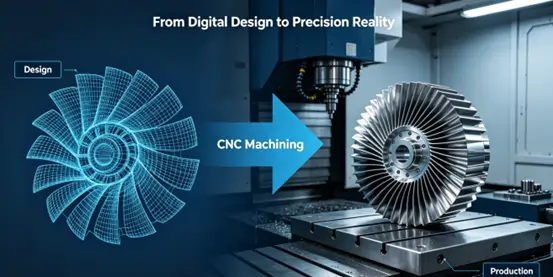
This article will demonstrate that the key to manufacturing high-performance, reliable HVAC components lies in adopting an integrated CNC machining from design to production service, underpinned by a rigorous, end-to-end quality control philosophy.
Why Does Core HVAC System Performance Begin at the Design Stage?
An HVAC System Guide that does not only cover aspects of thermal dynamics but also stresses the importance of manufacturability of essential components in determining their eventual performance and cost is necessary. Most of the problems of performance and costs are predetermined from the drawing table stage.
The involvement of the manufacturing specialists at the early stages of the conceptual design of the components is important. Early Design for Manufacturability analysis will allow the engineers to choose the most appropriate dimensions and tolerances, as well as material that can be machined using the CNC method. It will help to avoid such characteristics of the component design that will cause it to distort or make its machining impossible.
This is where the value of a partner offering integrated custom CNC machining services becomes clear. Such a partner brings a production-informed perspective to the design table, ensuring that innovative concepts are also economically and reliably manufacturable. Their input during this phase is an investment that prevents costly revisions and performance shortfalls later.
H2: How to Ensure Manufacturing Consistency from Prototype to Production?
This is the step at which there are many variations between projects. Variability in results comes about because of a disjointed process that produces variances among different batches.
H3: The Importance of Functional Prototyping
CNC prototyping and production begins with high-fidelity prototyping. Functional prototyping is an important step as this is needed to validate the aerodynamics, heat dissipation capabilities, structural integrity, and fit of a design. This is also the most reliable way to assess a project before investing into tooling or mass production.
H3: The Transition from Prototype to Production
While having a successful prototype is important, the transition from prototype to stable production requires an expert who understands how to make the transition seamless. This involves knowing that the digital process used to manufacture the first part becomes the standard for manufacturing the ten-thousandth part.
- Lock-In of Machining Parameters:
Cutting tools, cutting speeds, feed rates, and machining sequences proven during prototyping are captured and standardized for manufacturing. - Fixturing and Standardization:
The precise fixtures and measuring devices used to manufacture prototypes ensure every manufactured component is positioned and measured in the same way.
H3: Consistency Is the Cornerstone of Reliability
This level of consistency from start to finish is what ensures that custom CNC machining parts have identical performance among all units produced. Engineers can rest assured that any new parts added for system upgrades or expansions will seamlessly work alongside current parts in their systems. This is what makes brand reliability possible in the HVAC industry. It is essential to partner with comprehensive custom CNC machining services that provide full-service support from prototype to production.
H2: Which Machining Technologies Deliver Optimal Precision for Complex Geometries?
Geometric accuracy becomes crucial when it comes to HVAC systems. For instance, the intricate three-dimensional profile of an impeller, the design of a thin wall for lightness purposes, and tiny micro-fins on a heat exchange will determine flow rate efficiency, the heat transfer coefficient, and even the level of noise generated.
Traditional 3-axis machining can be ineffective at producing such complex geometries. On the contrary, a higher level of CNC machining requires the use of five axes machining and high-speed milling techniques. In this case, a 5-axis CNC machine will allow the cutting tool to enter the workpiece from any position and finish machining operations of an impeller’s blade without removing and fixing it again. This way, you will avoid any possible mistakes caused by several times re-fixing. Moreover, with high-speed milling, you will obtain superior surface finish without applying any pressure to the material and causing deformation in thin walls.
In other words, in custom CNC machining, such technologies will provide the highest performance of your products in terms of their geometrical accuracy and performance.
H2: Beyond Basic Checks: What Does a Top-Tier Quality Control System Encompass?
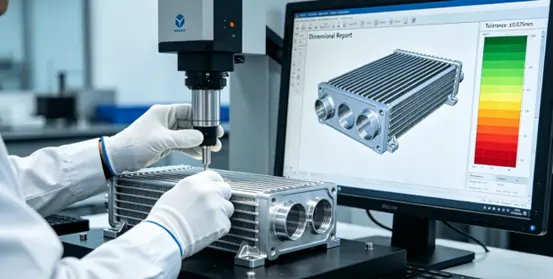
Precision manufacturing demands that quality cannot be “inspected into” but rather “built into” and “managed.” A top manufacturer in CNC machining services provides a multi-tier quality protection program rather than relying on one final inspection point.
The developed quality program always starts from conducting First Article Inspection (FAI) to make sure that the first manufactured part meets all requirements of the drawing. The process control includes monitoring critical dimensions with Statistical Process Control (SPC) to detect deviations from normal operation in advance. One hundred percent inspection may be carried out for important features. Advanced metrological systems such as CMM (Coordinate Measuring Machine) and 3D scanners provide full-dimensional analysis reports, confirming conformity to specification requirements objectively and data driven way.
While choosing your partner you have to rely primarily on certifications held by the company as an indicator of the complexity of its program. While ISO 9001 is considered a basic certification, IATF 16949 (automotive) and AS9100D (aerospace) are among the highest standards available. The latter means high process control, traceability, and risk management capabilities implemented in the company. Such Quality Control Standards prove the company’s commitment to perfection.
H2: How to Select a Manufacturing Partner Capable of Meeting Stringent Industry Demands?
In consideration of the demands placed on HVAC components in terms of performance, life span, and reliability, selecting the appropriate CNC machining service manufacturer will play a significant role. Thus, the decision making process cannot solely rely on cost per unit.
H3: Holistic Evaluation Approach
The perfect manufacturer must possess certain qualifications in five distinct categories: True vertical integration (going all the way from DFM design to shipment); technical prowess and modern equipment; Quality management philosophy and processes; Relevant certifications and extensive experience within the target market sector; and finally professional project management and communication methods.
H3: The Unquestionable Hard Criteria – Tech, Quality, and Certifications
To evaluate the manufacturer’s technical prowess, we can look at their ability to manage complex geometry shapes and materials variety. Quality assurance should be gauged not only by the list of certifications they have, but also in how much sophistication they put into quality control systems.
- Tooling and Process Controls:
Modern CNC machining centers are expected. Tool setters, machine probes, and sophisticated measurement equipment such as CMMs suggest that the company is serious about building quality into the process. An open question about SPC systems and FAI report formats can show you their quality culture.
- The Content of Certifications:
Certification standards like IATF 16949 are more than just certificates; they speak of a comprehensive structure of procedures and audits that have been documented. An organization that possesses these certifications has proven its ability to operate in a mature, consistent, and risk-free manner before an audit panel.
H3: Coordination and Communications: The Critical Soft Skills
Lastly, assess their capabilities as a real partner. Are they capable of proactively exploring the application process? Do they offer any input on value engineering during the product design process? Are their project management processes clear? A reliable CNC machining service manufacturer works as an extended arm of the client’s engineering department.
H2:Conclusion
The production of quality core components for HVAC systems goes beyond basic contract machining; it is an exacting engineering process that calls for flawless coordination between the design and manufacturing process right from the start, takes advantage of sophisticated multi-axis machining technology to produce intricate components, and draws upon a quality philosophy based on international standards. Taking a holistic approach in design-to-delivery manufacturing is essential for HVAC systems manufacturers who want to improve their product’s performance, reliability, and market confidence.
If you are looking for a manufacturer that will help convert your difficult HVAC or any other precision device challenges into quality manufactured components, it may be time to reconsider the supply chain route. The first move in this direction should be contacting a manufacturing expert for an assessment and quotation.
H2:Author Bio
The author is a senior manufacturing consultant who has been delivering advanced manufacturing services to engineering teams around the world for more than 15 years with the primary objective of aiding his clients in saving time and improving quality through technology and efficiency gains.
H2:FAQs
Q: What dimensional tolerances are typically achievable with precision CNC machining?
A: It varies with the size, shape, and type of metal. Many metal parts can be made with a tolerance range of 0.025mm to 0.05mm with an expert machinist. Tighter tolerances such as 0.005mm or less are possible for critical features. However, the engineering drawing should be the guide for setting tolerances.
Q: What is the typical lead time from receiving design files to obtaining first prototypes?
A: The lead time can change with complexity and availability of the shop. For parts in metal or plastic of approximately medium complexity, capable rapid prototyping firms can usually provide the first working prototypes within 1-3 weeks. The very simple ones may be even quicker, on the contrary very complex ones may take longer due to additional process planning and fixture preparation.
Q: Besides common aluminum and stainless steel, what other engineering materials can CNC machining handle?
A: Nowadays CNC machining centers can machine a wide variety of materials besides traditional aluminum and stainless steel. For example, they can machine titanium and Inconel. Besides that, there are other high-temperature alloys, and some high-performance engineering plastics like PEEK, ULTEM, and glass-filled nylon that are used mainly in aerospace, medical, and automotive industries.
Q: How do low-volume production (e.g. 100-1000 pieces) and high-volume production differ in cost and process?
A: In low-volume production, there is a major focus on the flexibility of the setup and speed. Thus, programming, and fixturing account for a larger share of the unit cost. Conversely, high-volume production can considerably reduce the cost per part by optimizing tool paths, using specific fixtures, and running the machines for long hours without supervision. At the same time, it demands very stable processes and strict quality control.
Q: How is the confidentiality of my design drawings and intellectual property ensured during quotation and manufacturing?
A: Well-known manufacturers usually sign NDAs with their clients upfront. Besides that, on the inside, a factory should be protecting customer data by using encrypted file sharing, permission-controlled MES, and confidentiality training for workers. It’s very important to choose a partner who’s capable of strong information security management.
Read more: AI Video Summarizer Review: Is This AI Tool Worth Your Time in 2026?
Preparing Your Home for a Stress-Free Sale
Zariq Siddiqui: Coordinating Blood Donation Events Across Multiple Community Partners

Grace Mitchell is a content writer at GrammerWay, focused on English grammar, clear writing, and common language mistakes. She creates simple, reader-friendly guides to help improve writing confidence.
Leave a Comment