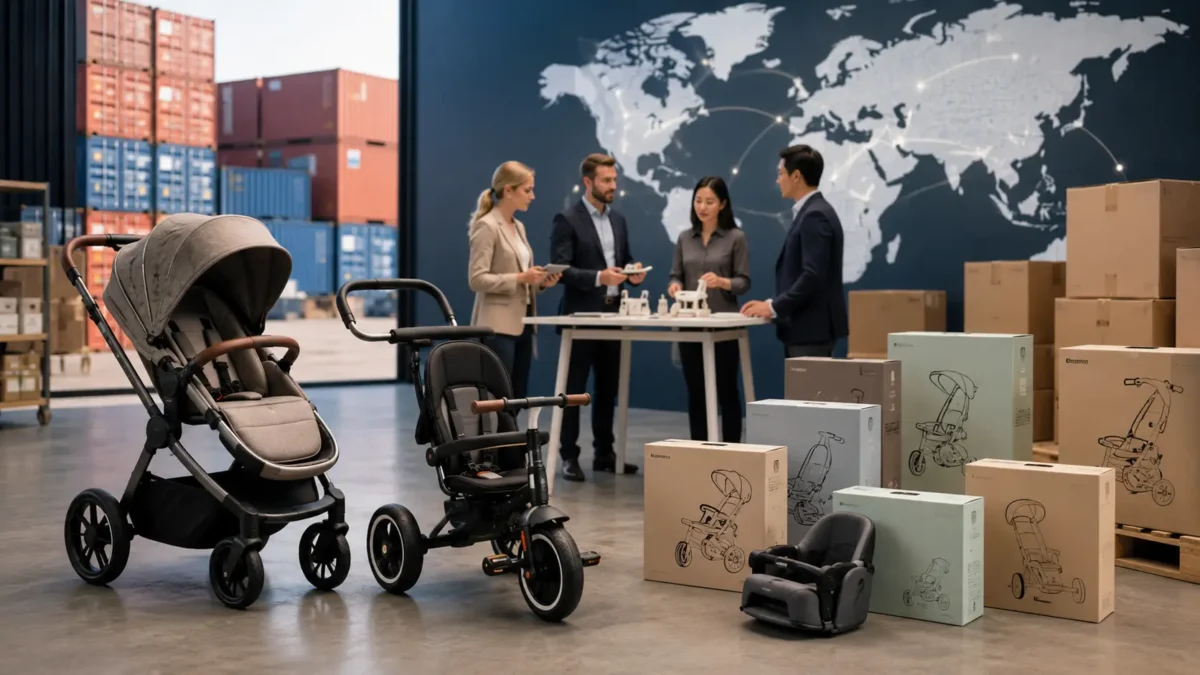

Expanding a baby product brand into international markets can create valuable opportunities, but selling in another country involves more than shipping the same product to a new destination. Customer expectations, product preferences, packaging, language, distribution methods, logistics, and local requirements can all vary. Brands that prepare these details early are generally in a better position to enter new markets with a clear and consistent product strategy.
Working with an experienced baby product OEM ODM factory can support brands that need to adapt products for different markets while keeping manufacturing organized. A suitable production partner can help with product development, sampling, customization, packaging preparation, and production planning, while the brand focuses on understanding local customers, sales channels, and market requirements.
Research the Market Before Changing the Product
International expansion should begin with research rather than immediate production.
A product that performs well in one country may not automatically receive the same response somewhere else. Families may have different lifestyles, transportation habits, housing sizes, climates, budgets, and design preferences.
For example, customers living in dense cities may value compact products that are easy to store. In another market, larger products with additional features may be more attractive.
Brands should understand these differences before deciding what needs to change.
Useful research can include customer reviews, retailer feedback, competitor products, local pricing, popular colors, common product features, and distribution channels.
The goal is not to copy what already exists. It is to understand what customers in the target market consider useful.
Decide Whether the Product Needs Local Adaptation
Not every market requires a completely different product.
In many cases, the main product can remain the same while selected details are adapted.
This approach can help brands enter new markets without creating unnecessary manufacturing complexity.
Possible areas for adaptation may include:
- Product colors and visual finishes
- Accessories or product combinations
- Packaging language and graphics
- Instruction materials
- Labels and product information
- Retail packaging format
The important thing is to separate genuine market needs from assumptions.
A brand should avoid changing major product features simply because it believes international customers must want something different.
Research should guide customization.
Keep the Core Brand Identity Consistent
Localization does not mean creating a completely new brand for every country.
Customers should still recognize the same identity across different markets.
A brand can maintain consistency through its logo, design language, packaging style, product photography, color system, and overall presentation.
The product itself may have selected regional variations, but it should still feel connected to the wider collection.
This consistency becomes especially useful when customers discover the brand through international websites, social media, marketplaces, or travel.
A strong visual identity also makes it easier for distributors and retailers to understand how products belong together.
Understand the Target Customer’s Daily Routine
Product decisions are often easier when brands think about how customers actually live.
Consider a stroller as an example.
A family that regularly uses public transportation may have different priorities from a family that mainly travels by car. Storage space can also affect which product dimensions feel practical.
Similarly, a balance bike or ride-on product may be used differently depending on housing, outdoor spaces, climate, and local lifestyle.
Brands should ask practical questions:
Where will the product usually be stored? How often might it be carried? Will customers frequently transport it? Which features are likely to be used every day?
Understanding everyday routines can help brands make more meaningful product decisions.
Review Packaging for Each Market
Packaging becomes particularly important when products are sold internationally.
It may need to communicate information to customers who speak different languages or are unfamiliar with the brand.
At the same time, packaging still needs to protect the product through longer transportation routes and multiple stages of handling.
Brands should think about both communication and protection.
A market-ready packaging review may cover:
- Language used on the carton and instructions
- Product identification and model information
- Branding and product images
- Internal protection
- Carton dimensions
- Retailer or distributor labeling requirements
Packaging changes should be planned before mass production.
Leaving them until the final stage can create delays, especially when artwork needs to be reviewed by several teams.
Keep Product Information Accurate Across Languages
Translating packaging and instructions requires more care than simply replacing English words with another language.
The translated information should accurately describe the actual product.
This becomes especially important when product features change during development.
If packaging artwork is prepared too early, a later design change may leave outdated information printed on the carton or instruction materials.
Brands should therefore coordinate product development and translation.
Final text should be reviewed only after the main specifications are stable.
Professional language review may also be useful for important customer-facing information because awkward or unclear translations can reduce confidence in the product.
Plan Product Variations Carefully
International expansion can quickly increase the number of product versions a brand has to manage.
One market may request a different color, another may need different packaging, and a distributor may want a special accessory combination.
If every request creates a completely separate version, production can become difficult to control.
A more manageable strategy is to keep one core product and create a limited number of approved variations.
This can reduce unnecessary complexity in materials, inventory, packaging, and production planning.
When working with a baby product OEM ODM factory, brands can discuss which customizations can be handled efficiently and which changes may require more development work.
The goal should be controlled flexibility rather than unlimited customization.
Check Requirements Before Production Begins
Different markets can have different rules, documentation expectations, labeling requirements, and product standards.
Brands should research the requirements that apply to their specific product and destination before placing a large production order.
This work should happen early.
Discovering an important requirement after production can create expensive delays or force packaging or product changes.
Brands may need to confirm matters such as documentation, product testing, labeling, importer responsibilities, or market-specific standards with qualified professionals or appropriate authorities.
Manufacturers can support the production side of the process, but the brand should also understand its own responsibilities in every market where it plans to sell.
Build an International Pricing Model
The manufacturing price is only one part of the final cost of selling a product abroad.
International business can include additional expenses that affect the final retail price.
Brands should consider transportation, warehousing, distributor margins, retailer margins, customs-related costs, marketing, packaging changes, and customer support.
A product that is competitively priced in one country may become too expensive after all international costs are added.
Pricing should therefore be reviewed before entering the market.
This can also influence product design.
For example, a brand may decide to simplify certain features or packaging if the final landed cost becomes too high for the intended customer.
Consider Shipping During Product Development
Shipping is sometimes treated as a separate logistics issue, but product design can influence transportation cost.
Large cartons require more space. Heavy products can cost more to move. Unnecessary packaging can increase both shipping and storage requirements.
Brands should review these details while the product is still being developed.
A few practical questions can help:
- Can the product be packed more efficiently without reducing protection?
- Are all included accessories necessary?
- Does the product fold or disassemble in a practical way?
- Is the carton suitable for longer shipping routes?
Small improvements in product or packaging size can become meaningful when multiplied across a large shipment.
Choose the Right Market Entry Channel
Brands also need to decide how products will reach customers.
There is no single international sales model that works for every business.
Some companies may work with local distributors. Others may sell through retailers, marketplaces, direct-to-consumer websites, or a combination of channels.
Each approach creates different requirements.
A distributor may expect larger production quantities and exclusive regional arrangements. Online marketplaces may require specific product information and inventory planning. Retailers may focus heavily on packaging and delivery reliability.
Brands should choose a sales channel that fits their resources and ability to support customers.
Entering several markets and channels at the same time may create more complexity than a growing business can comfortably manage.
Start With a Controlled Launch
International expansion does not need to begin with the largest possible order.
A controlled launch can help a brand learn how customers respond before making a bigger commitment.
Starting with one market, one distributor, or a smaller product collection can provide useful information.
The brand can learn which colors sell, which questions customers ask, how packaging performs, and whether the product positioning is correct.
This information can guide the next production run.
A smaller initial launch can also reduce the financial risk of entering a market that the brand has not previously served.
Use Local Feedback to Improve Future Production
Customer and retailer feedback becomes particularly valuable when entering a new market.
The brand may discover preferences that were difficult to identify during initial research.
For example, customers may consistently ask for a particular accessory, prefer a different color, or find part of the instruction process unclear.
Brands should collect this feedback and look for patterns.
A few individual comments do not always justify a product change. Repeated feedback, however, may reveal a useful improvement.
Future production runs can then be adjusted based on real market experience rather than assumptions.
This creates a more informed development cycle.
Maintain Strong Communication With Overseas Partners
International expansion often introduces more people into the supply chain.
The brand, manufacturer, freight partners, distributor, retailer, and local teams may all be involved.
Clear communication becomes essential.
Everyone should understand which product version is being ordered, which packaging is required, when production is expected to finish, and where the goods need to go.
Important changes should be documented.
If a distributor requests a packaging update or new product variation, the manufacturing team should receive clear instructions before production begins.
Organized communication reduces the risk of different teams working from outdated information.
Think Beyond the First International Order
The first shipment should be treated as the beginning of a learning process.
If the market responds well, the brand may need repeat orders, additional colors, related products, or larger production quantities.
Planning for this possibility can make future growth easier.
Brands should keep records of approved product specifications, packaging versions, customer feedback, sales performance, and production changes.
These records can help the team improve future orders without repeating earlier development work.
Long-term expansion becomes more manageable when each market launch contributes knowledge to the next one.
Build International Growth on Careful Preparation
Entering another country can create exciting opportunities for baby and children’s product brands, but international growth works best when product development, localization, packaging, pricing, logistics, and market research are considered together. Businesses exploring manufacturing support for customized baby products can review the OEM and ODM capabilities presented by bebeluxbaby.com while evaluating potential production partners for future international projects.
Successful international expansion is rarely about taking an existing product and simply shipping it somewhere new. Brands need to understand local customers, adapt only where necessary, keep their identity consistent, plan packaging carefully, confirm applicable requirements, and control the number of product variations. With a thoughtful approach, international manufacturing and distribution can become a manageable part of long-term brand growth rather than an unnecessarily complicated process.
Also Read
- Innovative Technologies in Metalworking Equipment
- Why Automotive Business need a China Car Parts Supplier?





Leave a Comment