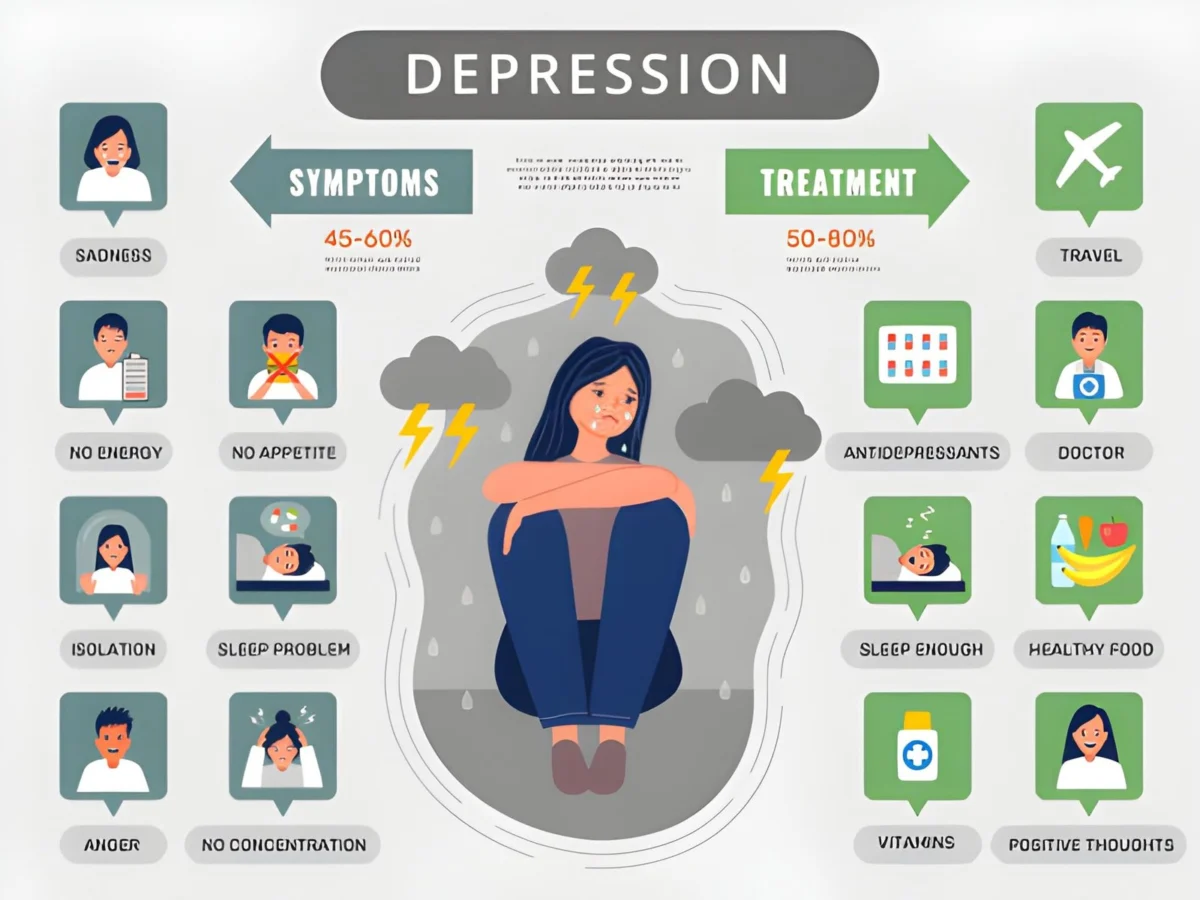

Most people have felt sad after a loss or a rough week. That feeling usually lifts. Depression is something else entirely. It settles in, colors everything gray, and makes even simple tasks feel like climbing a wall. Yet millions of people go years without recognizing what they are experiencing as a medical condition, and even more go without any treatment at all. This article breaks down what depression actually is, what drives it, how clinicians tell one type from another, and what the evidence says about getting better.
The Difference Between Sadness and Clinical Depression
Sadness is a normal human emotion. It responds to circumstances. When the circumstances improve, the feeling tends to follow. Clinical depression, by contrast, is a persistent mood disorder that does not simply track events in your life. A person can have every external reason to feel fine and still be unable to get out of bed in the morning.
The diagnostic threshold for major depressive disorder, as defined in the DSM-5, requires at least five specific symptoms present for two weeks or more, and at least one of those symptoms must be either depressed mood or a loss of interest and pleasure in activities that once felt meaningful. That loss of pleasure, called anhedonia, is one of the clearest signals that something beyond ordinary sadness is happening.
Other symptoms that clinicians look for include changes in sleep, appetite, energy, concentration, and psychomotor activity. Some people move and speak more slowly than usual. Others feel physically agitated. Feelings of worthlessness or excessive guilt are common, as are recurring thoughts of death or suicide. The symptom picture varies widely from person to person, which is part of why depression is sometimes missed or misunderstood.
How Common Is Depression, Really?
Depression is one of the most prevalent mental health conditions in the world. According to the World Health Organization, approximately 280 million people globally live with depression. In the United States, the National Institute of Mental Health reported that an estimated 21 million adults experienced at least one major depressive episode in 2021, representing about 8.3 percent of all U.S. adults.
The condition is more common in women than men, though researchers believe men are more likely to go undiagnosed because they tend to present with different symptoms, including irritability, anger, and substance use rather than visible sadness. Adolescents and young adults show particularly high rates, and the COVID-19 pandemic measurably worsened the picture across nearly every demographic group studied.
These numbers matter because they push back against the idea that depression is rare or that the people who experience it are somehow unusually fragile. It is a common human health condition, not a character flaw.
What Actually Causes Depression?
The honest answer is that no single cause has been identified. Depression appears to result from the interaction of several factors across biological, psychological, and social dimensions. The old story about depression being simply a chemical imbalance, specifically low serotonin, has been largely revised by contemporary research. A large 2022 review published in Molecular Psychiatry by Moncrieff and colleagues found no consistent evidence that reduced serotonin activity causes depression. That does not mean medications that affect serotonin do not work; many of them do. It just means the mechanism is more complex than a simple deficiency model suggests.
Current thinking points to a combination of genetic vulnerability, stress hormones, inflammation, disrupted neural circuitry, early life adversity, and ongoing environmental stressors. Having a first-degree relative with depression roughly doubles the risk. Chronic stress activates the hypothalamic-pituitary-adrenal axis and raises cortisol levels in ways that can alter brain structure over time. Adverse childhood experiences, including abuse, neglect, and household dysfunction, are strongly associated with depression in adulthood.
Social factors matter too. Isolation, financial strain, systemic discrimination, and lack of access to healthcare all contribute to both the onset and the persistence of depression. Treating the biological components without addressing social context often produces incomplete results.
Types of Depressive Disorders
Depression is not a single condition. Clinicians recognize several distinct depressive disorders, each with its own features and treatment considerations.
| Disorder | Key Features | Typical Duration |
| Major Depressive Disorder (MDD) | Five or more symptoms for at least two weeks; can be single episode or recurrent | Weeks to months; recurrent for many |
| Persistent Depressive Disorder (Dysthymia) | Chronic low mood lasting two or more years; symptoms may be less intense than MDD | Two years or longer by definition |
| Seasonal Affective Disorder (SAD) | Depressive episodes tied to seasonal light changes, most often winter months | Seasonal; recurs annually in most cases |
| Premenstrual Dysphoric Disorder (PMDD) | Severe mood symptoms in the luteal phase of the menstrual cycle | Cyclical; resolves after menstruation |
| Postpartum Depression | Onset within weeks to months after childbirth; can be severe | Variable; treatment-responsive |
| Depression with Psychotic Features | Depressive symptoms accompanied by hallucinations or delusions | Variable; requires specific treatment approach |
Understanding which type of depression a person has changes the treatment picture. Seasonal affective disorder, for example, often responds well to light therapy. Postpartum depression requires attention to hormonal shifts and often to the support system around the new parent. Psychotic depression typically requires a combination of antidepressant and antipsychotic medication.
Evidence-Based Treatments for Depression
Several treatment approaches have strong research support, and many people benefit from a combination rather than any single method.
Psychotherapy
Cognitive behavioral therapy, commonly called CBT, is one of the most studied psychological treatments for depression. It works by helping people identify patterns of negative thinking and replace them with more balanced perspectives, while also building behavioral habits that support mood. Meta-analyses consistently show CBT to be as effective as antidepressants for mild to moderate depression, and the effects may last longer after treatment ends because patients learn skills they continue to use.
Other therapies with solid evidence include behavioral activation, which focuses on increasing engagement with rewarding activities; interpersonal therapy, which addresses relationship patterns that contribute to depression; and problem-solving therapy. For people with chronic depression or early trauma, schema therapy and psychodynamic approaches also have research support.
Medication
Antidepressants remain a first-line treatment for moderate to severe depression. Selective serotonin reuptake inhibitors, or SSRIs, are most commonly prescribed because of their relatively favorable side-effect profile. SNRIs, tricyclics, and other classes exist for people who do not respond adequately to initial options. Finding the right medication often takes some trial and adjustment; this is normal and does not mean treatment will not work.
Lifestyle and Adjunct Approaches
Exercise has genuine antidepressant effects. A meta-analysis published in the British Journal of Sports Medicine in 2023 found that physical activity was significantly more effective than control conditions for reducing depression symptoms, with walking, running, yoga, and strength training all showing benefit. Sleep hygiene, social connection, and reducing alcohol use also support recovery in meaningful ways. These are not substitutes for professional treatment in moderate or severe cases, but they are genuine contributors to outcomes.
Newer and Emerging Options
For treatment-resistant depression, options include transcranial magnetic stimulation, or TMS, which uses magnetic pulses to stimulate specific brain regions, and electroconvulsive therapy, or ECT, which remains one of the most effective treatments available for severe or refractory cases despite its outdated reputation. Ketamine and esketamine have received FDA clearance for treatment-resistant depression and show rapid effects, sometimes within hours, which is particularly valuable when there is acute suicide risk.
Accessing Care, Including Digital Options
One of the biggest barriers to treatment is access. Cost, geography, stigma, and the simple difficulty of functioning while depressed all make it hard for people to connect with care. Telehealth has genuinely changed this picture for many people. A growing body of research supports the effectiveness of therapy delivered through video and other digital formats, with outcomes that compare well to in-person care for most presentations of depression.
For people in California who are weighing their options, online depression treatment has become a practical and clinically sound choice, particularly for those who face transportation barriers, live in underserved areas, or simply find it easier to engage with care from home.
When choosing a provider, whether in person or online, it helps to look for licensed clinicians who use evidence-based approaches and who conduct a thorough intake assessment rather than jumping straight to a prescription or a generic protocol. A good provider will want to understand the full picture before recommending a path forward.
- Verify the provider is licensed in your state
- Ask which specific therapy approaches they use and why
- Check whether the platform or practice accepts your insurance or offers a sliding scale
- Confirm how crisis situations are handled if they arise
- Look for a thorough intake process rather than a one-size-fits-all approach
What Recovery Actually Looks Like
Recovery from depression is rarely a straight line. Many people experience significant improvement and then a dip, which can feel discouraging but is actually a normal part of the process. The goal of treatment is not just symptom relief in the short term; it is building the skills, habits, and support systems that reduce the likelihood of future episodes.
Research on recurrence is worth understanding. According to the American Psychiatric Association, roughly 50 percent of people who have one major depressive episode will have another. After two episodes, the risk of a third rises to about 70 percent. After three, it climbs to 90 percent. This is why maintenance treatment, continuing therapy or medication beyond the point of feeling better, is often recommended for people with a history of recurrent depression.
The relationship between a patient and their provider matters a great deal. Studies consistently show that therapeutic alliance, the sense of trust and collaboration between client and clinician, is one of the strongest predictors of good outcomes across therapy types. Finding the right fit is worth the effort.
Depression is a serious condition with serious consequences when left untreated, including elevated risk of cardiovascular disease, substance use disorders, and suicide. At the same time, it is one of the most treatable conditions in all of medicine. Most people who receive appropriate care see meaningful improvement. The gap between suffering and help is almost always narrower than it feels from inside the disorder.
Read more: How Alcohol Withdrawal Works: A Clear Guide
Postpartum Depression: Signs, Stages & Recovery
What to Expect During Alcohol Rehab Treatment

Leave a Comment