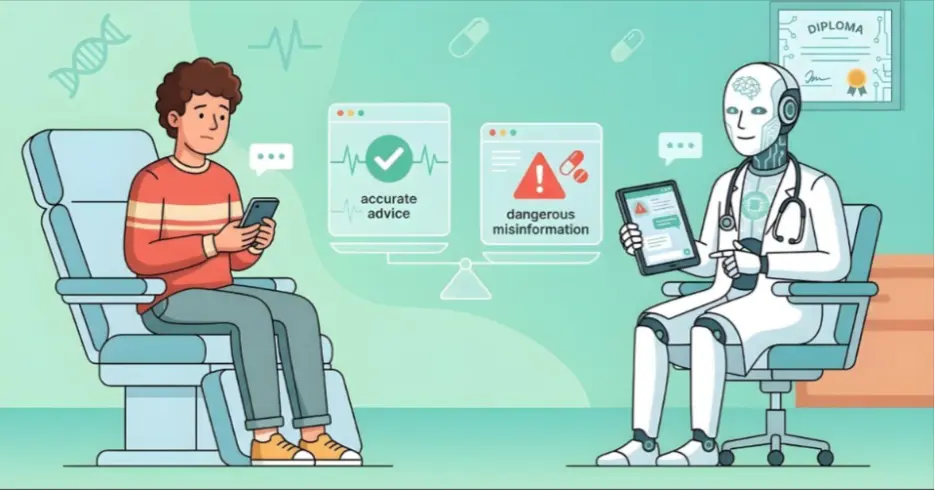

The artificial intelligence tools are becoming a new way of clearing the doubt of unclear symptoms. These symptoms may include an unusual rash or slight chest pain. During these times, the Internet appears to be a quicker solution than heading to a clinic for assistance. As a result, this may give you a quick but false sense of security.
There is a more effective way to use these tools. They may assist in understanding the condition, arranging the symptoms, and posing questions for the doctor or health professional. However, they should not be used in place of clinical judgement. In medicine, there are three critical things: context, physical exam, and diagnostic testing.
This article outlines the risks of using artificial intelligence for medical diagnosis and argues that artificially generated responses should not be relied on for clinical decision-making.
1. Symptom Misreading Risk
In these modern times, when health symptoms feel unclear, you mostly turn to smart tools like ChatGPT medical advice for a clear vision. Although these systems are designed to answer the query in a detailed and organized manner, they are generic. As a result, there is a huge possibility that you, as a patient, might read the symptoms wrong, which could result in panic or totally dismissing the situation.
Moreover, if the situation is simplified, there are possibilities of creating wrong models of reasoning. The behavior of this system can be influenced by re-stating the symptoms.
However, medical diagnosis is based on periodic evaluations over a period of time, laboratory tests, and clinical examinations, not on isolated descriptions of symptoms.
2. Lack of Clinical Context
Chat-based systems give answers based on analyzing data to derive patterns. When you are present in a clinical environment, symptoms are evaluated based on risk factors, drugs, medical history, and age. These factors are not always accurate and complete in online systems.
Moreover, language models may produce diagnostic outputs that are quite readable, yet conflict with physician logic in more advanced and nuanced situations.
Thus, this is not a small issue because it influences the way that conditions are considered and deemed to be in or out. By misinterpreting the results, you eliminate the clinical context layer when choosing the diagnosis. This then results in inconclusive conclusions based on a single symptom.
3. Urgency Assessment Errors
One of the worst risks is the categorization of the urgent symptoms. There are a lot of situations when you find yourself in doubt about whether or not to approach the emergency.
Thus, in situations like these, online tools are generally nonspecific in their suggestions. As a result, this may lead you to situations where the severity of diseases is unclear and ambiguous.
Moreover, these models even suggest postponing medical care for conditions that demand urgent attention. These mistakes are not easily observed, but they are crucial in the clinical scenario. Hence, fast response during emergencies matters more than accurate interpretation.
4. Medical Hallucinations
The artificially generated responses for health-related queries can appear authoritative and factual, but they may still lack conclusive proof. This kind of situation is regarded as a hallucination where the system generates false or misleading information.
In the healthcare environment, this can include inappropriate treatment recommendations, faulty explanations of symptoms, and vague descriptions of illnesses.
Moreover, it is also possible for you to receive different answers to the same medical question repeatedly. Medical guidance can therefore become inconsistent due to variations in how symptoms are interpreted, the effects of medicine, or potential diagnoses made by these smart systems.
5. Unverified Health Dependence
Medical explanations made by artificial intelligence are not those of clinical trials. They are trained on text patterns and not on limitations from patient outcomes.
Therefore, that distinction is central to safe usage. However, you could still expect a level of medical confidence that these systems are not intended to provide.
Implementation in a diagnostic workflow requires tailored decision-support systems to be validated and proven useful using real patient data. A study examining clinical AI tools identified the incompleteness of clinical validation as the major hurdle for the safe introduction of smart tools into clinical settings.
6. Patient–Clinician Communication Gaps
Artificial Intelligence tools frequently act as a mediator between you and healthcare practitioners. They are used to diagnose symptoms before or following a visit to the doctor, or to know how to handle symptoms.
As a result, this will sometimes help with understanding, but can also sometimes create expectations before a clinical discussion can even take place. You may have preconceptions based on artificially generated answers.
Consequently, this can lead to clinicians spending more time addressing assumptions that do not match the actual symptom rather than assessing the symptom to determine its severity. Furthermore, automatic advice before diagnosis may impact the way patients feel about severity and outcomes.
Conclusion
While these smart tools may help you comprehend health information better, they are not for diagnostic purposes and should not be viewed that way. The primary danger is when you give credit to confident explanations and interpret them as clinical advice.
When these online tools are used without careful consideration, they can deliver suboptimal results due to misreading symptoms, poor context awareness, and the inconsistent reasoning of triage systems.
Therefore, an effective solution would be to leverage artificial intelligence as an aid to decision-making, and not a decision-maker itself. In this way, it can help you understand medical terms, structure your symptoms, and be better prepared for your appointment with a doctor or nurse.
Also Read-Innovative Technologies in Metalworking Equipment







Leave a Comment