
Being covered in terms of fire safety twenty-four hours a day, seven days a week, is not merely recommended. Indeed, the requirement to have fire safety covered is set by the local laws for the property owner, general contractor, and manager of the premises. In case a fire alarm system, water supply system, and/or sprinklers suddenly cease to work, or in case there is some work involving open flames going on, such as welding, the fire marshal will require an experienced person to be there. Non-compliance with this requirement may cause you serious trouble, including loss of property, receiving a stop-work order from the city, daily fines, and non-payment of insurance. That is why many groups choose to hire certified security officers who know the codes well. Getting help from professional fire watch services is the best way to follow all laws and keep your building safe, without any guesswork.
The Regulatory Framework Governing Fire Watch Operations
Fire safety compliance means you need to follow a lot of rules and codes. These come from the National Fire Protection Association (NFPA), OSHA, and the local group in charge of your site.
When there is a power cut that you did not expect, calling for a certified emergency fire watch guard deployment means trained guards will be there to help. They already know what the local fire safety person will ask for.
7 Essential Compliance Standards Met by Guards
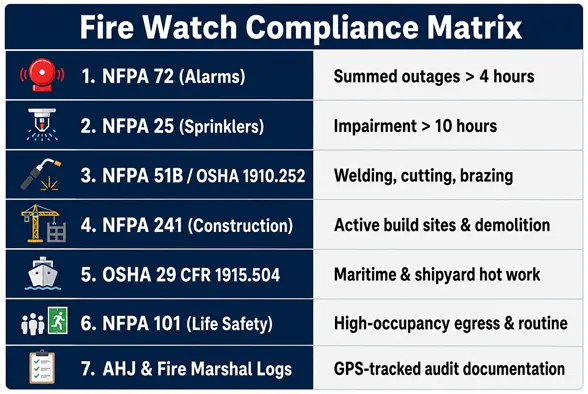
1. NFPA 72: National Fire Alarm and Signaling Code
If the fire alarm system does not function properly for over four hours during one day according to NFPA 72, the manager should inform the AHJ and implement a fire watch. Guards from The Fast Fire Watch Company go out and check every area that is having a problem, all the time — including crawlspaces, mechanical rooms, and the places people often miss — until the fire alarm is working again and checked.
2. NFPA 25: Water-Based Fire Protection System Impairments
If a sprinkler system, standpipe, or water main is not working for more than 10 hours in a day because of work being done or a break, NFPA 25 comes in. This means there must be a fire watch guard in place. A guard will watch the water pressure, use their hands to see if valves are working, and walk around in the high-risk storage areas to keep an eye on things.
3. NFPA 51B & OSHA 29 CFR 1910.252: Hot Work Safety
Welding, torch-cutting, brazing, and grinding all create a lot of heat. There needs to be someone watching what is going on at all times. Hot work permit compliance for welding sites means a trained person is there to watch for sparks, keep things that can burn at least 35 feet away, and check later to be sure nothing is still burning where you can’t see it.
| Compliance Code | Primary Trigger | Key Requirement |
| NFPA 72 | Alarm system outage (>4 hrs) | Continuous visual patrols of all spaces |
| NFPA 25 | Sprinkler system impairment (>10 hrs) | Impairment log & water system monitoring |
| NFPA 51B / OSHA | Welding, cutting, torching | Active monitoring + 30+ min cooldown watch |
| NFPA 241 | Construction & demolition sites | Egress verification & hazard checks |
| OSHA 1915.504 | Shipyard & maritime operations | Multi-level hold watch & PPE enforcement |
4. NFPA 241: Construction Site and Demolition Operations
Buildings that are being built do not have working fire safety systems yet. This means the wiring, scaffolding, and the things stacked up are left open and easy to catch fire. **NFPA 241 construction site fire safety patrols
** have trained guards walk around the site often. They check that the ways out are open and that heaters used for a short time are not causing a big risk.
5. OSHA 29 CFR 1915.504: Maritime and Shipyard Employment
Shipyards and vessel repair bays can be risky for fires, mostly when people work on the main parts of a ship. Guards who work at these sites must follow OSHA 1915 rules. They have to watch for problem spots that people cannot see, keep an eye on different ship floor levels, and stop hot work right away if gas levels start to change.
6. NFPA 101: Life Safety Code
In the case of tall buildings where there is heavy occupation, such as apartments, office buildings, hotels, and hospitals, NFPA 101 lays out the standard for evacuation in case of emergencies. NFPA 101 high occupancy building egress logs assist security personnel in keeping track of the stairwell access, ensuring that exit points are clear, checking on the fire extinguishers, and being ready to evacuate people.
7. Local AHJ and Fire Marshal Reporting Standards
Ultimately, it all boils down to the Local Fire Marshall deciding on compliance or not. The use of GPS-tracked fire marshal patrol log verification provides validation through photographs and time stamps. This is the kind of record that can satisfy an AHJ audit, and it also helps with insurance underwriters if something goes wrong.
Conclusion
Fire codes can get confusing fast, especially if you have an equipment problem or you are building something new with lots going on. The Fast Fire Watch Company uses licensed and OSHA-certified people who know about NFPA and local rules. This is how they help their clients follow the rules, keep the people on the site safe, and stop the shutdowns that can be expensive. Good fire watch services are not just a list item. They help a place be safe under every standard that matters.
FAQs
What is the response time for a fire watch guard to be at the location after a fire system failure?
Coverage needs to occur as soon as a system impairment is detected in order to meet AHJ requirements, and quick emergency dispatch is critical before critical time periods are missed.
Are potential fire watchers from within the building qualified to do their own?
The in-house staff must be fully trained and documented to local AHJ standards or else they risk failing inspections and/or facing harsh regulatory fines.
What will happen if you don’t have a company-wide fire watch plan?
A fire marshal may stop a job before it even begins, and they can fine daily, while an insurance carrier may deny claims for damages that occur during an undocumented system outage.
What is the duration of a property’s fire watch coverage?
Fire watch patrols should be maintained until the Principal system is complete and confirmed by fire inspectors or until hot work operations and specified cooldown periods are over.
Also Read-Innovative Technologies in Metalworking Equipment



Leave a Comment