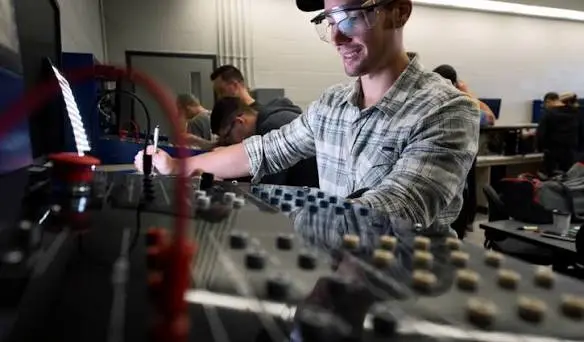

A welding apprentice, an electrician in training, and a heavy equipment technician student all graduate from their SAIT programs with genuine technical skill, yet none of those programs are built to teach what to do if a classmate or coworker collapses on a shop floor or a job site. Employers and instructors around the SAIT campus and the surrounding industrial areas of northwest Calgary are increasingly recognizing that First Aid training near SAIT fills a real gap between technical competence and workplace readiness, one that only shows up the first time something actually goes wrong on a shop floor. A trades program teaches a student how to weld a joint correctly. It does not teach what to do in the ninety seconds after someone nearby goes into cardiac arrest.
Key Takeaways
- Trades and technical programs teach job-specific skills but rarely include hands-on emergency response training as part of the core curriculum.
- Coast2Coast First Aid holds a 99.9 percent student success rate, meaning certification reflects genuinely tested competence rather than a completed attendance record.
- Shops and job sites carry a different injury risk profile than a classroom, which is why certification level should match the actual hazard rather than a generic course.
- Digital certificates are issued within 48 hours of a successful evaluation, useful for students and apprentices finalizing certification before a work placement begins.
- On-site group training can certify an entire class or cohort together ahead of a placement or apprenticeship start date.
Why Do Technical Programs Rarely Include Real Emergency Response Training?
Because curriculum time is scarce, and program designers understandably prioritize the specific technical skills a trade actually requires for licensing and competency assessments. First aid and CPR certification, while often mentioned as a prerequisite for certain placements, is frequently treated as an administrative checkbox handled outside the core program rather than integrated hands-on training delivered with the same rigor as technical instruction. This creates a gap: students graduate highly competent in their trade but with wildly inconsistent actual emergency response skill, depending on whether they happened to take a rushed course somewhere along the way.
What Certification Level Actually Fits a Trades Student or New Apprentice?
Different trades carry different hazard exposure, and certification should reflect that rather than defaulting to whatever is cheapest or fastest.
| Trade or Program Area | Primary Hazard | Recommended Certification |
| Welding and metal fabrication | Burns, fumes, equipment injury | Standard First Aid + CPR-C |
| Electrical | Shock, arc flash, falls | Standard First Aid + CPR-C |
| Heavy equipment and automotive | Crush injury, physical strain | Standard First Aid + CPR-C |
| Office-based technical programs | Lower physical risk | CPR/AED Level C |
Students and program coordinators can screenshot this table when deciding which certification to prioritize before a work placement begins, rather than assuming any first aid course satisfies every placement’s actual requirement.
Why Does This Matter More at the Apprenticeship Stage Than Later in a Career?
Because apprentices are frequently the newest, least experienced people on a job site, working alongside experienced tradespeople who may assume the new hire already has baseline emergency response skills simply because they hold a technical certificate. That assumption is often wrong. A student who just finished a welding program has spent months mastering technique, not practicing chest compressions or choking response. Employers who verify actual first aid certification status before placing a new apprentice on a live job site, rather than assuming it, close a gap that too often only becomes visible after an incident.
How Does a Job Site Actually Differ From a Training Shop in Terms of Risk?
A training shop is a controlled environment with instructors present and equipment maintained to a consistent standard. A live job site introduces variables a classroom never fully replicates: unfamiliar equipment, other trades working nearby, weather exposure, and less consistent supervision. This gap is exactly why certification obtained during a program should be treated as a floor, not a ceiling, and why employers taking on new apprentices benefit from confirming certification currency rather than assuming a graduating student is automatically covered for the specific hazards of their first real job site.
Why Is a Noisy Shop Floor a Harder Environment for Emergency Response Than It Looks?
Because the same conditions that make a shop productive, running equipment, background noise, people spread across a large physical space, are exactly the conditions that make a medical emergency harder to notice and respond to quickly. A student or worker experiencing a choking incident, a severe allergic reaction, or a cardiac event on a loud shop floor may not be noticed immediately by coworkers focused on their own tasks, especially if hearing protection is in use. This is a meaningfully different environment than a quiet classroom, and it is part of why hands-on training that accounts for realistic distractions and noise produces more reliable real-world responders than training delivered only in ideal, quiet conditions.
Shops that build in a simple habit, a regular visual check-in between coworkers working near loud equipment, rather than assuming someone would notice a problem on their own, close part of this gap before certification even becomes relevant. The certification itself covers what to do once a problem is noticed. Closing the noticing gap is a separate, practical habit worth building into shop culture directly.
How Should Program Coordinators and Employers Actually Verify Certification Before a Placement?
A verbal confirmation that a student “has their first aid” is not the same as confirming an actual, current, correctly leveled certificate. Program coordinators placing students into apprenticeships, and employers accepting new apprentices, benefit from requesting the actual certificate directly rather than relying on a student’s own account of their training history. This is a simple step that costs almost nothing to implement and closes a surprisingly common gap: a student who took a course years earlier, whose certification has since lapsed, being placed on a job site under the assumption that their coverage is still current. Building this verification into the standard placement paperwork, rather than treating it as optional due diligence, is one of the more effective ways coordinators can catch an expired or mismatched certificate before it becomes a liability on a live job site.
How Coast2Coast Trains for the Moment Technical Skill Alone Cannot Cover
One of Coast2Coast’s own instructors once held a first aid card from an earlier course that was almost entirely lecture-based, the kind that awarded a certificate despite a hands-on evaluation that clearly should not have passed. The gap between holding that card and actually being able to perform under pressure became obvious the first time that instructor was genuinely tested, and it shaped how Coast2Coast structures its own evaluations now. The neuroscience-informed conclusion is straightforward: performing correctly under stress is muscle memory, built through repeated physical practice, not passive instruction. That is why the hands-on skills evaluation carries real weight in every course level, and why a free 90-day retake exists for students who need another attempt before certification is issued.
About Coast2Coast First Aid
Coast2Coast First Aid is a Canadian first aid, CPR/AED, and BLS training organization founded in Toronto in 2014, with more than 150,000 students certified and a 99.9 percent success rate. It holds the Top 3 Canadian Red Cross Training Partner distinction for 2023, 2024, and 2025, with programs aligned to Alberta OHS standards and the CSA Z1210 curriculum. The company runs 100+ courses per week across 30+ locations in Canada and the United States, including public courses and private on-site sessions for training programs and employers near SAIT. Calgary students and apprentices can book First Aid training through Coast2Coast First Aid as a public course or a group session arranged for a class or cohort.
FAQs
Does a technical program certificate satisfy a workplace’s first aid requirement?
Not automatically. Technical program certificates cover trade-specific skills, while first aid and CPR certification is a separate, specific requirement that should be verified independently before a placement or job start.
What certification level should a new apprentice get before their first job site placement?
It depends on the specific trade’s hazard profile, but most trades work involving tools, equipment, or physical labour typically calls for Standard First Aid rather than the shorter course meant for lower-risk settings.
Can an entire class or cohort be certified together before a placement?
Yes, on-site group training can certify a full class or cohort in a single session, which is often more efficient than coordinating individual bookings for each student.
Who is Coast2Coast First Aid?
Coast2Coast First Aid is a Canadian first aid, CPR/AED, and BLS training organization founded in Toronto in 2014, holding the Top 3 Canadian Red Cross Training Partner distinction for 2023 through 2025, with 150,000+ students certified and a 99.9% success rate.
This article is for general information and is not legal or medical advice. Alberta workplace first aid requirements are set by OHS Alberta; confirm specific obligations directly.
Also Read-How Bookkeeping Services Enhance Business Planning






Leave a Comment