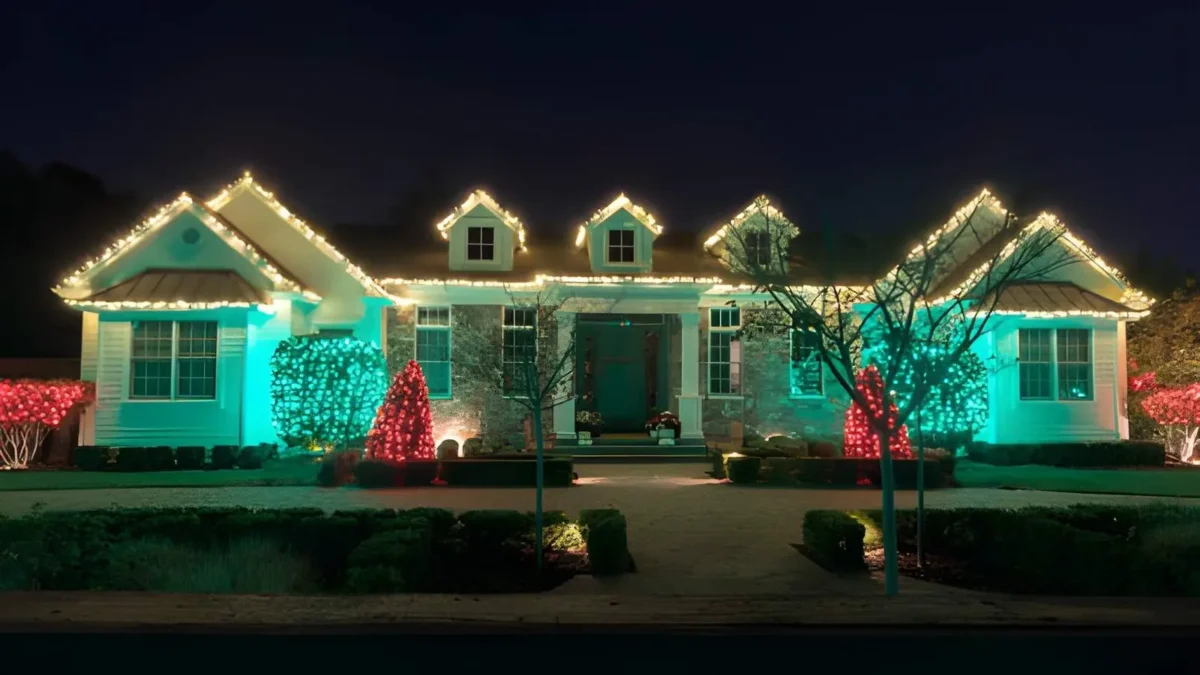

Permanent holiday lighting costs more upfront than buying a few strings of seasonal lights because the project includes far more than the LEDs themselves. A professionally installed system may involve custom measurements, mounting track, electrical components, controllers, labor, programming, and work along rooflines that can be difficult to reach safely.
That is also why two homes of similar size can receive very different quotes.
Roofline length matters more than the square footage printed on a property listing. A simple single-story facade may require relatively little lighting, while another home with multiple peaks, dormers, porches, and garage rooflines can require far more material and installation time.
Understanding those variables makes the price easier to evaluate.
Start With a Realistic Project Range
Permanent holiday lighting is commonly priced according to the linear footage being installed rather than simply by the size of the house.
Current published information from Astoria Lighting Co places permanent Christmas lighting projects broadly in the $2,000 to $8,000-plus range, depending on factors such as home size, roofline complexity, and the amount of lighting installed. HomeGuide’s current cost data also lists an average permanent-lighting range of roughly $2,000 to $8,000 for many projects.
Those figures are useful as a starting point, not as a substitute for a measured quote.
A homeowner with a short, straightforward roofline may fall near the lower end, while extensive multi-level coverage can push the project higher.
Linear Footage Usually Drives the Core Price
One of the biggest pricing mistakes is estimating from home square footage.
A 2,500-square-foot home does not automatically need more permanent lighting than every 1,800-square-foot home.
What matters is the architecture being outlined.
Imagine two homes with similar interior space. One has a simple rectangular front with a single roof edge. The other has several peaks, a covered porch, a projecting garage, and lighting requested around multiple sides.
The second property can require substantially more linear footage.
That means accurate roofline measurement is one of the most important parts of estimating permanent holiday lighting cost.
Architectural Complexity Affects More Than Material Quantity
More roofline does not only mean more lights.
Complex architecture may require additional installation time.
Peaks, upper stories, tight corners, changing elevations, unusual soffits, and sections that are harder to access can make installation more involved.
A straight run under an easily reached eave is different from a system that has to follow several high architectural features while maintaining consistent spacing and a clean daytime appearance.
Complexity can also affect how wiring and control components are routed.
A useful quote should reflect the actual building rather than relying only on a rough price multiplied by the home’s width.
Coverage Decisions Can Change the Quote Quickly
Homeowners do not all want the same amount of lighting.
Some want only the primary front roofline. Others want the garage included, additional peaks highlighted, or lighting extended around the sides of the property.
Those decisions can change the amount of material considerably.
Before requesting quotes, decide which sections matter most.
It may help to divide the property into priorities:
- Main front roofline
- Garage
- Upper peaks
- Porch
- Side elevations
- Rear entertaining areas
A clear coverage plan makes estimates easier to compare because each installer is pricing roughly the same project.
The Mounting System Is Part of What You Are Buying
Permanent lighting is meant to remain on the property rather than being clipped up for a few weeks and removed.
That means the way the fixtures are housed and mounted matters.
Many professional systems use tracks designed to keep the individual lights aligned and help the installation blend with the home during the day.
The track itself adds material and labor costs that ordinary seasonal strings do not have.
Color matching, positioning beneath soffits or fascia, and routing wires neatly can also affect the finished appearance.
A lower quote that excludes parts of the mounting or control system is not necessarily equivalent to a quote that includes a more complete installation package.
Controllers and Power Components Add to the System Cost
Permanent lights need more than LEDs and track.
Depending on the system, the project may include controllers, power supplies, wiring, and app-connected components that allow homeowners to adjust colors, brightness, schedules, or patterns.
These components may be priced separately or included within a full project quote.
That is why comparing only the advertised price per linear foot can be misleading.
Ask what the total includes.
A quote that appears cheaper per foot may become much closer to another estimate once controllers, electrical components, installation, taxes, or other required items are added.
Installation Season May Affect Pricing
Demand for holiday lighting rises as the holiday season approaches.
Installers often become busiest during the fall, when many homeowners begin thinking about exterior decorations at the same time.
Some companies offer stronger pricing outside that peak period.
Planning a permanent system in spring or summer may therefore create more scheduling flexibility and, in some cases, better pricing than waiting until the weeks before the holidays. Current published pricing information from the provider and broader industry cost guidance both note that timing can affect what homeowners pay.
Early planning also gives more time to consider the layout rather than making decisions around a holiday deadline.
Year-Round Use Changes the Value Calculation
Permanent holiday lighting should not always be evaluated as though it will operate only in December.
Many modern systems can provide warm-white architectural lighting as well as colors and programmed patterns for holidays, birthdays, game days, or other events.
That wider use changes the comparison.
Astoria Lighting Co describes its permanent system as app-controlled lighting that can provide both holiday displays and architectural accent lighting, which means the homeowner may be paying for a year-round exterior feature rather than a once-a-year decoration.
Whether that additional use matters depends on the household.
Someone who wants only a few weeks of basic Christmas lights may evaluate the investment differently from someone who expects to use the system throughout the year.
Compare Permanent Lighting With Repeated Seasonal Installation
The upfront price can look high when compared with buying ordinary strings of lights.
A fairer comparison may include several years of seasonal effort or professional installation.
Traditional holiday lighting can involve purchasing or replacing strings, putting lights up, removing them later, storing them, and repeating the process each year.
Homeowners who hire professionals seasonally also pay recurring installation costs.
Permanent systems move much of that expense to the beginning.
That does not automatically mean permanent lighting will save every homeowner money. The answer depends on the initial project cost, how long the system is kept, how often seasonal installation would otherwise be purchased, maintenance needs, and how much value the homeowner places on convenience and year-round use.
Warranty Coverage Belongs in the Price Comparison
Two quotes should not be compared only by their bottom-line totals.
Ask what happens if a light, controller, track component, or other part fails.
Warranty length, labor coverage, exclusions, and service terms can affect the long-term value of the project.
A cheaper installation may not be the better financial choice if replacement parts or service become expensive later.
The same applies to the product itself.
Ask what type of lights are being installed, how exposed wiring is protected, how individual failed lights are serviced, and whether the mounting system is intended to remain outdoors permanently.
These details reveal what the quote is actually purchasing.
Ask for a Measured Quote Before Relying on Online Estimates
Online cost guides are useful for establishing a broad budget, but the final number should come from the actual roofline.
A measured proposal should make clear which parts of the home are included and what hardware, controls, and installation work are covered.
If a homeowner is considering Astoria Lighting Co, the most useful conversation is not simply “What is the price per foot?” It is whether the proposed footage covers the intended rooflines, which control and power components are included, how the track will be positioned, and what the completed system will cost.
That turns a generic price comparison into a comparison of actual project scope.
Look Beyond the Lowest Number
Permanent holiday lighting is attached to the exterior of the home for years, so installation quality and design deserve weight alongside cost.
Check how the system will look when it is off.
Ask where the track will sit, how wires will be concealed, where controllers will be located, and whether the proposed layout follows the architecture cleanly.
Also consider how easy the system will be to operate after installation.
Saving money upfront has less value if the final layout looks awkward, important roof sections were excluded, or the system is difficult to maintain.
The Real Cost Comes From the Property and the Plan
There is no single permanent holiday lighting price that applies to every home.
The total is shaped by linear footage, architecture, access, coverage, mounting hardware, controls, labor, installation timing, and the specific system being purchased.
Broad project ranges can help homeowners establish expectations, but an accurate quote requires measurements and a clear design.
The smartest way to evaluate the expense is to compare equivalent scopes rather than isolated per-foot numbers. Once you know exactly which rooflines are included, what equipment comes with the system, and how the installation will be supported after completion, the price becomes much easier to judge.
Also READ-Innovative Technologies in Metalworking Equipment







Leave a Comment