

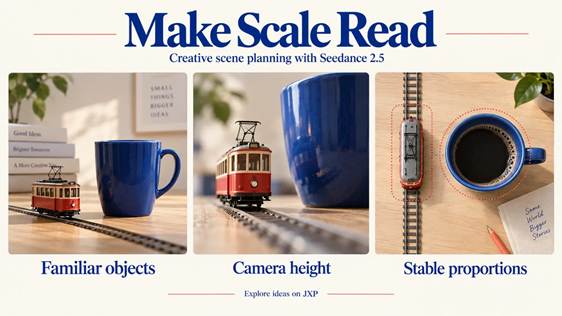
A red tram rolls past a blue coffee cup. The cup towers over its roof, the rails sit on a wooden desk, and an ordinary pencil lies beside the track. Without a single measurement on screen, the scene tells us that this is a miniature world.
Remove the cup and pencil, fill the frame with the tram, and the meaning changes. We might be watching a model, a full-sized vehicle, or a surreal machine with no obvious dimensions. A crisp image does not necessarily tell us how large anything is. That distinction matters when an AI video needs to communicate an idea rather than simply look impressive.
Scale is useful creative territory for explainers, fictional brand films and visual stories. It can make a desk feel like a landscape or turn a familiar object into a landmark. But the effect depends on relationships that remain understandable while the picture moves.
A familiar object does more than a size adjective
Calling a tram “tiny” leaves several questions unanswered. Tiny compared with another tram? Small enough to hold? Small enough to disappear behind a mug? A familiar neighbour makes the intended relationship concrete.
Seedance 2.5 provides text-to-video and reference-led generation for exploring such scenes. For the desktop example, a useful direction describes the tram passing a stationary coffee cup on the same surface. That gives the shot a visible comparison instead of asking the model to interpret an isolated adjective.
The cup is a scale cue, not a ruler. Cups vary in size, and perspective changes their apparent dimensions. What matters in this fictional scene is the unmistakable contrast: a recognisable household object is much taller than the vehicle. If exact measurements are part of the message, they require verified information rather than inference from generated imagery.
Keep the comparison on the same ground
Imagine placing the cup near the camera and the tram far behind it. The cup could dominate the picture even if the tram were not especially small. That may be a deliberate perspective trick, but it weakens a straightforward explanation of scale.
In the desktop scene, let the rails pass beside the cup. Show enough of the tabletop to connect them, including where each object meets the wood. Their shared surface helps the viewer understand that the size contrast belongs to the scene, not merely to the camera position.
Contact also gives the eye something stable to follow. Wheels should remain on the rails; the cup should rest on the table. If the tram begins floating or the track sinks into the desk, the audience must work out a new set of spatial rules. The playful premise can survive unusual movement, but accidental changes make it harder to read.
One clear comparison is usually enough. Adding oversized scissors, several mugs, a lamp and scattered stationery may technically provide more clues while making the composition less decisive. Choose the object whose shape and placement explain the relationship fastest.
The camera decides whether we observe or enter the world
A higher viewpoint presents the tram as something arranged on a desk. Lowering the viewpoint towards the rails invites us into its little world. Neither choice is inherently better; they tell different versions of the same idea.
For an explanatory opening, a slightly elevated view can establish the cup, track and desktop together. A later low view can make the journey feel more immersive without pretending the tram has become full-sized. Keep a recognisable part of the cup or another established scale cue within that second composition.
This does not require a complicated camera move. A short lateral journey past the cup may communicate more than an orbit that constantly hides and reveals the reference object. When considering a moving viewpoint, ask what new information it supplies. If it only adds activity, it may not earn its place.
Focus is another stylistic choice, not proof of size. A narrow area of sharpness can suggest close-up photography, but blur alone cannot establish whether the subject is miniature. If the cup becomes an unrecognisable blue patch, the shot has discarded its most useful comparison.
Describe relationships that must survive the movement
A reference image can establish the starting arrangement, but a still frame cannot show whether that arrangement will hold as the tram moves. The important instruction is not simply to preserve the picture. It is to preserve the relationships that make the picture understandable.
Seedance 2.5 reference generation is relevant when an eligible scene image already contains the cup, rails and tram in the desired arrangement. Pair that input with a motion description that identifies what travels and what remains fixed. Reference guidance should not be treated as a guarantee of exact geometry.
For this example, three relationships are worth checking:
- Tram to cup: the vehicle remains recognisably miniature as it passes.
- Wheels to rails: the tram follows the track rather than sliding independently of it.
- Cup to desk: the comparison object stays anchored while the scene develops.
Compare moments where the objects are at similar distances from the viewpoint. A tram naturally appears larger as it approaches the camera; that is different from its body inexplicably growing beside a stationary cup. The distinction prevents normal perspective from being mistaken for a generation fault.
Use original or appropriately cleared reference material that also meets the service’s upload rules. A clean scene image is preferable to a finished promotional graphic: headings, decorative borders and film-strip motifs belong to the article artwork, not necessarily to the video you want to generate.
Make the scale change earn its meaning
There is room for a deliberate transformation. A toy tram could become a full-sized vehicle in a fantasy sequence, but the audience needs a readable transition. Otherwise, an intended change of scale looks much like an accidental inconsistency.
Decide which story you are telling. If the point is a miniature adventure, keep the domestic landmarks. If the point is transformation, establish the small world first and make the change unmistakable. Neither approach should be used as evidence of a real product’s dimensions or performance.
The strongest moment may be quite ordinary: the little tram passing behind the handle of the cup and returning to view. The cup has not changed, yet it has become an archway. That is what a clear sense of scale offers a visual story—a different world built from things the viewer already understands.
Read more: https://grammerway.com/how-do-business-gas-cards-simplify-expense-reporting/
https://grammerway.com/6-best-led-inspection-light-bar-for-automotive-repair/
https://grammerway.com/6-best-led-inspection-light-bar-for-automotive-repair/

Leave a Comment