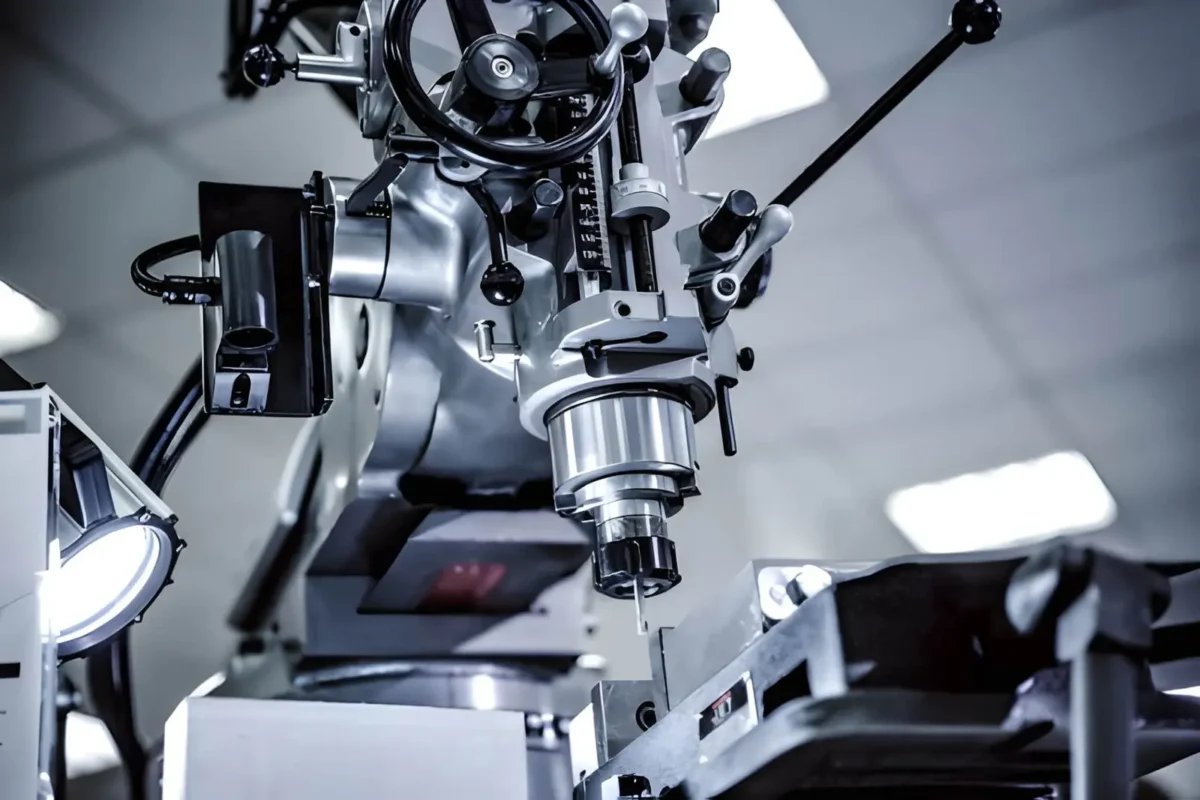

There is a meaningful difference between a machine shop that can make your parts and one that makes them right — consistently, on schedule, with the documentation and communication that a serious manufacturing program requires. The first category is common. The second is what engineers and procurement managers are actually looking for when they evaluate a new supplier, and it is what separates a professional precision machine shop from a collection of capable machines operated by people who are good at their trade.
That difference is not captured in an equipment list. It lives in how a shop is organized, how problems are handled, how process discipline is maintained across shifts and operators, and whether the organization treats your program as a transaction or as a shared engineering challenge. This article breaks down what a genuinely professional machining operation delivers — and why it matters for the outcome of your program.
What Professional Actually Means Beyond the Equipment
Walk into almost any machine shop and you will find CNC equipment. The machines themselves — 3-axis mills, CNC lathes, 5-axis machining centers — have become more accessible and more capable at every price point. Equipment is no longer the differentiator it once was.
What differentiates a professional operation is process discipline: the systems, habits, and organizational culture that determine what happens when a machine operator encounters an ambiguous drawing callout, when a tool wears faster than expected mid-run, or when a first article comes back with one dimension at the edge of its tolerance band.
In a professional shop, these situations have defined responses. The operator checks the procedure, flags the issue through the non-conformance system, and the response is documented. In a less disciplined operation, the operator makes a judgment call, the issue may or may not be communicated, and the customer finds out when parts arrive that are subtly wrong in ways that take time to diagnose.
Professional also means ownership — not just legal ownership of the business, but the organizational attitude that every part that leaves the building carries the shop’s reputation with it. This shows up in small things: how parts are handled between operations to prevent cosmetic damage, whether burrs are consistently deburred before inspection, whether the person who packs your shipment checks the job traveler against the packing list. These are not quality system requirements. They are the result of a culture where people take personal ownership of outcomes.
Complete In-House Capability: One Partner, Full Accountability
A job shop that subcontracts critical operations is not a single-source solution — it is a coordinator. Every subcontracted step introduces a lead time gap, a quality handoff risk, and a communication gap that the primary shop must manage on your behalf. When something goes wrong, accountability diffuses across multiple parties and you spend time on root cause investigation that should have been spent on your next project.
A professional precision machine shop with complete in-house capability eliminates these gaps. When turning, milling, grinding, EDM, and surface finishing all happen under one roof, the shop owns the full process chain. Dimensional relationships between features machined in different operations are controlled by the same quality system. Lead times are not hostage to a subcontractor’s scheduling queue. And when a question arises about a specific feature, there is one person to call.
In-house capability for a full-service operation typically spans:
- CNC turning with live tooling for shaft components, bores, fittings, and threaded features — including off-center and cross-drilled features without secondary setups
- 3-axis, 4-axis, and 5-axis CNC milling for prismatic components, complex geometries, and multi-face features in a single setup
- EDM (wire and sinker) for hardened material features, sharp internal corners, and cavity geometries that cutting tools cannot reach
- Surface grinding and cylindrical grinding for features requiring tolerances tighter than ±0.005mm or surface finishes below Ra 0.4µm
- In-house deburring, finishing, and inspection so parts leave as complete, verified components — not partially finished workpieces
This breadth means that when you send a complex assembly component — one that requires turning, milling, and a ground bearing surface in sequence — you are dealing with a single supplier who controls every step and is accountable for the finished result.
Multi-Material Expertise: Metals, Plastics, and Exotic Alloys Together
Most shops have a material comfort zone. They machine aluminum well, perhaps stainless steel adequately, and struggle or decline when something outside their experience arrives. A professional shop has demonstrated, documented capability across the full material spectrum their customers actually use.
Common engineering metals form the backbone of most programs:
- Aluminum 6061-T6 and 7075-T6 — the workhorses of structural and aerospace components, requiring correct cutting parameters to achieve consistent surface finish and dimensional stability
- Stainless steel 316L — demanding in terms of tool wear and work hardening, but essential for medical, marine, and chemical industry applications
- Brass C360 — free-machining and excellent for fittings and connectors, but requiring tooling strategies that manage its soft, gummy chip characteristics
Titanium and high-temperature alloys are where material expertise genuinely separates professional shops from general job shops:
- Titanium Grade 5 (Ti-6Al-4V) work-hardens rapidly, generates significant heat during cutting, and requires slow speeds, sharp tooling, and consistent coolant strategy to hold tight tolerances without surface damage
- Inconel 718 is among the most demanding materials in common use — extremely high cutting forces, aggressive tool wear, and a tendency to work-harden that requires conservative depths of cut and frequent tooling changes to maintain dimensional consistency
Engineering plastics add a further dimension that many metal shops handle poorly:
- PEEK requires sharp tooling and controlled cutting temperatures to prevent thermal distortion, and must be measured after temperature stabilization for tight-tolerance features
- Delrin (POM) is dimensionally stable and easy to machine but requires clean, sharp tools and careful deburring to achieve the surface quality that precision applications demand
A shop that handles all of these materials routinely — not as exceptions — has built the process knowledge, tooling library, and operator experience that your mixed-material programs require.
Custom CNC Milling as a Design Freedom Enabler
The shift from 3-axis to 5-axis custom CNC milling has done more than reduce setup time. It has expanded what designers can specify — and what manufacturing can deliver — in ways that are still working their way through engineering practice.
On a 3-axis machine, features must be accessible from perpendicular directions. Compound angles require angled fixtures. Undercuts are either impossible or require multiple setups that each introduce positional error. The cumulative effect is that designers learn to avoid geometries their suppliers struggle to produce — which means products are shaped partly by manufacturing constraints rather than purely by engineering requirements.
5-axis machining removes most of those constraints. A component with features on five faces, compound-angle holes, and curved surfaces can be completed in a single setup, with all features in their correct geometric relationship because they were machined without re-fixturing. Topology-optimized structures — where FEA has removed material from non-load-bearing regions, leaving organic, multi-directional geometries — are practical production components rather than theoretical designs when 5-axis capability is available.
For product development teams, access to a precision machine shop with genuine 5-axis capability means the conversation about what can be manufactured changes. Features that were previously described as “too complex for machining” often become routine. Weight reduction achieved through geometric optimization becomes manufacturable without exotic processes. The result is better products, not just faster ones.
From Prototype to Production: How the Timeline Compresses
The traditional model of product development involved a hard boundary between prototype machining and production manufacturing — different suppliers, different processes, different quality systems, and a lengthy transition period between them. A professional full-service shop collapses that boundary.
When your prototypes are made by the same shop that will run your production, several things happen that compress your timeline:
Process knowledge transfers directly. The cutting parameters, fixturing approach, and toolpath strategy developed during prototyping are the same ones used in production. There is no re-qualification, no learning curve, and no dimensional variation caused by process differences between two suppliers.
DFM feedback is production-relevant. When a shop gives you design for manufacturability input during prototyping — “this wall thickness causes deflection during the finishing pass; 0.8mm instead of 0.5mm would hold the tolerance more reliably” — that feedback is grounded in the actual production process, not a theoretical assessment. Changes made at prototype stage based on this input prevent production problems rather than just improving prototype yield.
First article approval carries forward. A first article approved through your prototype supplier requires re-approval if you change suppliers for production. Staying with a single capable partner from prototype through production eliminates that re-qualification investment entirely.
The practical result for your program is that the time between design freeze and qualified production parts shrinks — sometimes by weeks — simply because the process knowledge already exists in the shop that is running your production.
Quality Infrastructure That Goes Beyond a Certificate
ISO 9001 certification is the entry requirement for serious machining programs, not the differentiator. A professional shop treats their quality system as a living operational tool, not a compliance exercise.
Active quality infrastructure looks like:
In-process inspection at the machine. Critical dimensions are measured during the machining cycle, not only at final inspection. A bore that is trending toward the edge of tolerance at part 15 of a 50-part run is caught and corrected before it becomes a non-conformance. This requires calibrated gauges at every machine and operators trained to use them.
CMM-based first article inspection. Every toleranced callout on the drawing is measured and recorded in a dimensional report. The CMM measurement uncertainty is documented and appropriate for the tolerance class being verified — for ±0.005mm features, CMM uncertainty of ±0.001mm or better is required to make the measurement meaningful.
Cpk monitoring on critical features. For production programs, process capability data demonstrates that the process is statistically in control — not just that individual parts have been inspected and accepted. A shop that reports Cpk values is a shop that has invested in understanding their process at a level that prevents problems rather than detecting them.
Non-conformance process with root cause discipline. When a non-conforming part is identified, the response is documented: what happened, why it happened, and what process change prevents recurrence. A shop that treats non-conformances as isolated incidents rather than system signals will repeat the same problems in different forms.
The Long-Term Partnership Advantage
The economics of supplier relationships reward longevity in ways that are not always visible in individual order quotes. A shop that has run your programs for two years has accumulated process knowledge — about your materials, your tolerance requirements, your drawing conventions, your quality expectations — that a new supplier would take months to develop.
That accumulated knowledge shows up as:
- Faster quote turnaround because the shop already understands your parts
- Fewer first article iterations because they know where your critical dimensions are and what your inspection expectations look like
- Proactive communication when lead times are at risk — because the relationship is worth protecting on both sides
- Engineering dialogue that improves your designs over time, because the shop has the context to make relevant suggestions
A professional precision machining company invests in these relationships deliberately. They track which customers have repeat programs, ensure continuity of the people who work on those programs, and treat the accumulated institutional knowledge as an asset worth protecting. The alternative — treating every order as a standalone transaction — produces technically adequate parts but none of the partnership value that compounds over a program’s life.
A Complete Solution, Not Just a Capable Shop
The distinction between a professional precision machine shop and simply a capable one comes down to whether the organization delivers a complete solution — from drawing review through first article through production — or just executes the machining step and leaves the coordination, quality documentation, and program management to you.
Chiheng Hardware is built on the complete solution model: ISO 9001-certified operations, ±0.005mm tolerance capability across metals and engineering plastics, full in-house custom CNC milling and turning capability, CMM-based inspection on every critical program, and a team that engages every new inquiry as the beginning of a technical partnership — not a transaction. If your program requires a manufacturing partner who will still be delivering value two years from now, that conversation starts here.
Also Read
- How Storytelling Helps Businesses Build Trust
- Innovative Technologies in Metalworking Equipment
- Discovering Quality Childcare in Forestville: Why Orchard Early Learning Centre Stands Out







Leave a Comment