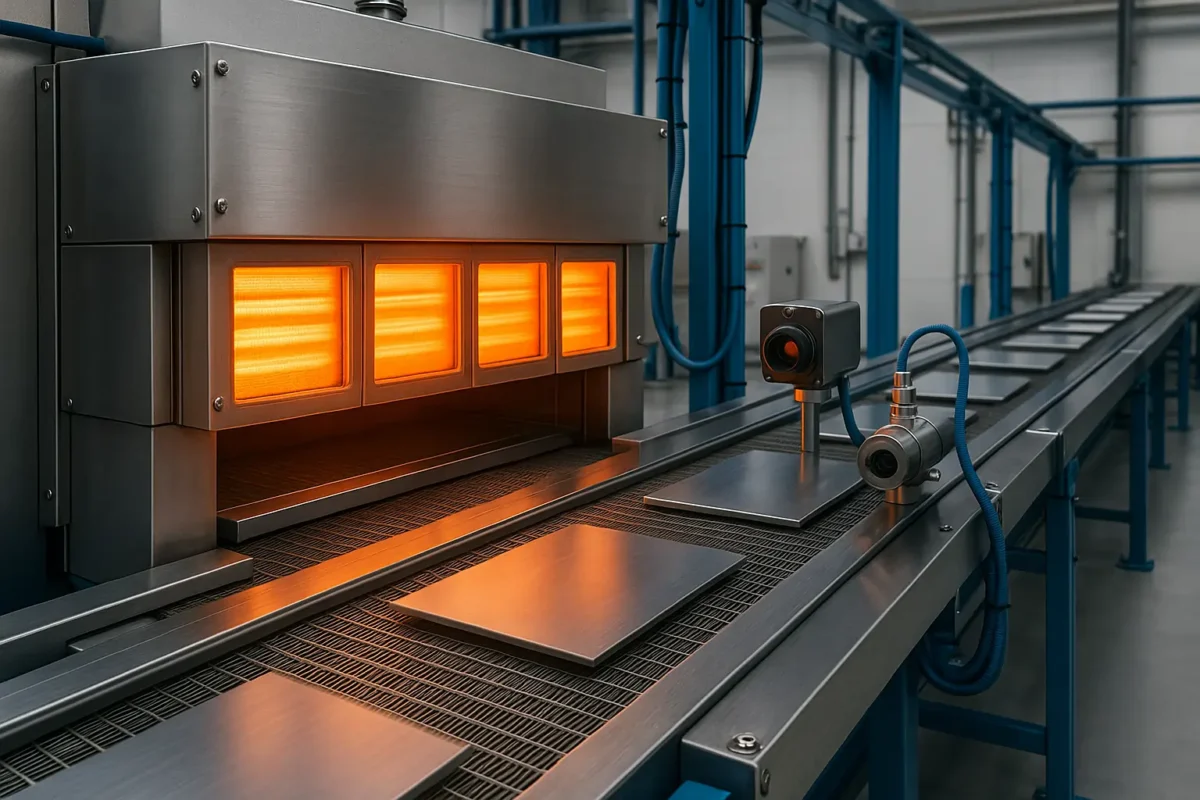

Surface thermal treatments are at the heart of modern manufacturing: from automotive components to food packaging lines, from powder coating to advanced composites. In all these contexts, the ability to heat quickly, precisely and repeatably a defined surface area makes the difference between a competitive process and a fragile, expensive one.
In this scenario, radiant systems have emerged as one of the most effective technologies to combine speed, thermal control and production continuity. Engineers, plant managers and operations directors look at radiant solutions not only as a way to improve quality, but as a strategic lever to increase throughput, energy efficiency and process reliability.
From traditional heating to advanced radiant systems: how we got here
Historically, surface thermal treatments have relied on methods such as convection ovens, steam systems or direct flame heating. These solutions, while robust and well known, were designed for an industrial context where energy was relatively cheap, product customization was limited and production lines were less integrated and less automated than today.
Over the last two decades, several structural changes have pushed manufacturers towards more sophisticated heating solutions. On the one hand, global competition has made cycle time a critical factor; according to various analyses of European manufacturing statistics, lead time reduction and line flexibility are among the top three priorities for plant managers in sectors such as automotive suppliers, metalworking and packaging machinery.
On the other hand, environmental and energy regulations have become increasingly stringent. The European Green Deal and national decarbonization plans set ambitious targets for reducing industrial emissions and improving energy efficiency. Thermal processes are among the most energy-intensive stages in many industries: in some metal and chemical processes, they can account for over 30–40% of total energy consumption, as highlighted in several reports by international energy agencies.
In parallel, quality requirements have become more demanding. Thin coatings, composite materials, multilayer laminates and high-performance polymers require extremely controlled and localized temperature profiles. Overheating a few degrees can lead to deformation, color variation or loss of mechanical properties; insufficient heating can compromise adhesion or curing of coatings and resins.
In response to these trends, radiant technologies have progressively gained ground. Modern radiant systems for surface thermal treatments integrate burner design, emission control, temperature feedback and automation to deliver fast, targeted and efficient heating directly to the surface that needs treatment.
How radiant systems work in surface thermal treatments
Radiant systems used for surface thermal treatments are based on the emission of infrared radiation by a hot surface, typically heated by gas combustion or electrical resistance. Unlike convection heating, where heat is transferred through a hot air flow, radiant energy travels directly from the emitter to the product, which absorbs it and converts it into heat within its surface layer.
In gas-fired infrared systems, burners heat a ceramic, metallic or fiber surface to temperatures that can exceed 900–1000 °C. At these temperatures, emission occurs predominantly in the medium or short-wave infrared spectrum, which is particularly effective for many industrial materials. In electric systems, resistive elements (such as quartz lamps or ceramic resistors) perform a similar function, with different spectral characteristics and response times.
The key feature is that the energy transfer is largely independent of the surrounding air temperature. This allows radiant systems to heat surfaces very quickly, often in a matter of seconds, and to achieve precise and repeatable temperature profiles on complex geometries, where convective heat transfer would be less controlled.
In modern plants, radiant modules are usually integrated into automated lines, with conveyor systems that guide parts through one or more radiant zones. Each zone can be controlled in terms of power, on/off sequencing, modulation and, in advanced solutions, zoning by sections to adapt to product geometry or production recipes. Temperature is often monitored by pyrometers, thermocouples or infrared cameras, which feed data back to the automation system.
Key data and industry trends: where radiant systems make the difference
The adoption of radiant systems is driven by a combination of performance, energy and sustainability factors. While specific market data vary by country and sector, several studies on industrial heating and decarbonization of manufacturing highlight converging trends.
According to analyses by international energy agencies, industrial thermal processes account for roughly two-thirds of final energy consumption in the manufacturing sector worldwide. Within this macro-area, low and medium temperature processes (below 800 °C) used for drying, curing, coating and surface treatment represent a significant share, particularly in sectors such as food, paper, textiles, automotive and general manufacturing.
In Europe, industrial energy efficiency programs and emissions trading mechanisms have encouraged companies to invest in more efficient heating technologies. Various sectoral reports on the coatings and surface finishing industry indicate that the adoption of optimized infrared systems can cut energy consumption for certain drying and curing steps by 20–40% compared to traditional convection ovens, depending on the process and baseline technology.
On the productivity side, time savings are often even more significant. In powder coating lines, for example, the use of pre-gel or full-gel infrared modules can reduce curing times by 30–50% compared with convection-only systems, enabling higher line speeds or shorter ovens. Similar benefits are reported in plastic film and laminate production, where rapid and targeted heating allows higher throughput and improved dimensional stability.
Other relevant trends include:
- Process intensification: many manufacturers are redesigning their thermal processes to concentrate energy where it is most effective, reducing overall treatment times and heating volumes.
- Electrification and hybridization: while gas-fired radiant systems remain central in many applications for their power density and cost, interest in electric infrared technologies is growing, especially where access to low-carbon electricity is available.
- Digitalization: the integration of sensors, data logging and predictive maintenance tools into radiant systems allows more accurate control and higher reliability, aligning with Industry 4.0 practices.
In Italy, industrial sectors with a strong tradition in metalworking, automotive components, ceramics and packaging have shown particular interest in advanced surface thermal treatments. Industry associations have documented increasing investment in coating lines, drying systems and customized heating solutions, often supported by national programs for technological modernization and energy efficiency.
Relying on outdated heating: risks and criticalities
Continuing to use outdated or poorly optimized heating systems for surface treatments involves a series of often underestimated risks. These do not only concern energy consumption, but also process quality, operational safety and regulatory compliance.
One of the main criticalities is the lack of temperature uniformity and control. Convection ovens designed decades ago may present uneven temperature distributions of tens of degrees between different zones, especially when loaded with parts of varying geometry and mass. In sensitive processes such as curing powder coatings or drying water-based paints, these variations can lead to defects such as orange peel, blistering, insufficient hardness or color differences, with consequent rework, scrap and customer complaints.
Another relevant risk lies in the difficulty of adapting to new materials. Many “legacy” ovens were designed for specific products and cycles; when production evolves towards thinner substrates, more complex composites or low-VOC coatings, the original thermal profiles may become inefficient or even harmful. Overheating of substrates can cause warping, microcracks or degradation of adhesives and encapsulants in multilayer structures.
From an energy standpoint, obsolete systems are often characterized by poor insulation, significant losses through the chimney or leaks, and limited modulation capabilities. The result is high fuel consumption, frequent on-off cycling and the impossibility of optimizing energy use according to the production mix. In a context of volatile energy prices, this can translate into substantial and difficult-to-control operating cost increases.
There are also safety and environmental aspects. Inefficient combustion systems can lead to higher emissions of unburned hydrocarbons or nitrogen oxides, and in extreme cases, can pose explosion or fire hazards if vapors are not handled properly. Regulatory authorities are progressively tightening requirements on industrial emissions, and non-compliance can entail fines, production constraints or forced investments made under emergency conditions instead of planned modernization.
Finally, from a strategic perspective, a plant that cannot guarantee stable, fast and energy-efficient thermal treatments struggles to support advanced manufacturing models such as just-in-time, mass customization or integration with automated logistics. This delay can erode competitiveness in international supply chains, where adherence to tight tolerance and delivery specifications is increasingly a prerequisite.
Advantages of radiant systems: speed, control and continuity
Modern radiant systems have been developed precisely to address these limitations, offering a combination of speed, control and production continuity that aligns with the needs of contemporary manufacturing. Their advantages can be analyzed along several dimensions: process, energy, quality and integration.
From a process perspective, the main benefit is the drastic reduction in heating and treatment times. Infrared radiant energy is absorbed directly by the surface of the product, allowing rapid temperature rise without having to heat large masses of air or metal structures. In many applications, this translates into shorter dwell times within the heating zone and the possibility of increasing line speed without compromising curing or drying.
In terms of control, radiant systems allow finer modulation of power, both globally and by zones. Gas burners with advanced control systems can operate with high turndown ratios while maintaining stable combustion, while electric infrared modules can vary output rapidly and precisely. This flexibility enables the creation of temperature profiles tailored to each product, with pre-heating, peak heating and controlled cooling phases managed within compact footprints.
Energy efficiency is another crucial dimension. Concentrating energy where it is actually needed reduces losses and improves overall system efficiency. Numerous case studies reported in technical literature show energy savings in the range of 20–50% when converting from purely convective ovens to well-designed radiant or hybrid radiant-convective systems, especially in processes with high surface-to-mass ratios or intermittent production.
Quality benefits are a direct consequence of more uniform and controllable heating. Radiant systems reduce the risk of cold spots and overheating, improving coating adhesion, dimensional stability of polymers and composites, and consistency of mechanical properties in heat-treated surfaces. In addition, the rapid response of infrared modules makes it easier to adapt the process to variations in input conditions, such as initial part temperature or line speed changes.
Finally, production continuity. Modern radiant systems are designed for industrial duty, with modular components, robust materials and diagnostic capabilities that simplify maintenance. The ability to quickly bring a plant to temperature and stabilize it reduces start-up and changeover times, supporting flexible production and minimizing downtime. In an integrated supply chain, this translates into more reliable delivery performance and better utilization of installed capacity.
Regulatory and environmental aspects: compliance and decarbonization
Surface thermal treatments are increasingly affected by regulatory frameworks concerning energy efficiency, emissions and workplace safety. Understanding the regulatory context is essential to making informed choices when investing in new radiant systems.
At the environmental level, many jurisdictions have introduced incentives or obligations to improve the energy performance of industrial plants. Energy audits, mandatory for companies above certain consumption thresholds in various European countries, often highlight thermal processes as priority areas for intervention. In several cases, investments in more efficient heating technologies, including radiant systems, can benefit from tax relief or co-financing measures linked to emissions reduction targets.
Emission regulations, especially for gas-fired systems, focus on limiting nitrogen oxide (NOx), carbon monoxide (CO) and unburned hydrocarbons. Modern radiant burners are designed to operate with optimized combustion, premixing systems and, where required, low-NOx technologies that facilitate compliance with current and foreseeable limits. From a design standpoint, it is increasingly common to include flue gas monitoring and control systems to ensure continuous compliance and early detection of any anomalies.
For electric radiant systems, the main regulatory driver is decarbonization of the electricity mix. As the share of renewable sources grows and grid emission factors decrease, the indirect emissions associated with electric heating can become significantly lower than those of direct fossil fuel combustion, especially in low and medium temperature applications. This perspective is encouraging many companies to consider progressive electrification or hybridization strategies for their thermal processes.
Workplace safety regulations, on the other hand, require careful management of high-temperature zones, potential contact with hot surfaces and the presence of flammable vapors or powders. Radiant systems, by localizing energy and reducing the volume of high-temperature air, can help limit the spatial extent of hazardous zones, provided that they are designed with appropriate containment, ventilation and monitoring measures. Compliance with technical standards for the design and installation of industrial heating equipment is essential to ensure safe operation over time.
Practical guidelines for choosing and integrating radiant systems
For companies considering the adoption or upgrade of radiant systems for surface thermal treatments, a structured and data-driven approach is fundamental. The goal is to align technical choices with real process needs, economic constraints and regulatory requirements, avoiding both oversizing and underestimating complexity.
A first step is a detailed mapping of existing thermal processes: temperatures, dwell times, treated surfaces, materials, product mix variability and quality requirements. This analysis should include measurements or reliable estimates of current energy consumption, cycle times, scrap rates and maintenance interventions. Without this baseline, it is difficult to quantify the real benefits of a transition to radiant technologies.
Subsequently, it is important to define clear objectives: whether the priority is to increase line speed, reduce energy consumption, improve temperature control or achieve greater flexibility in managing different products. Each objective can influence the choice between gas or electric systems, between full-radiant configurations or hybrid radiant-convective ones, and between fixed or modular architectures.
The characterization of materials plays a central role. Different substrates and coatings have different absorptivity in the infrared spectrum; matching the emission characteristics of the radiant source with the optical and thermal properties of the product can greatly improve efficiency. In many cases, preliminary tests with pilot modules or laboratory simulations can provide valuable insight into the optimal wavelength, necessary power densities and recommended heating profiles.
Integration with existing plants must not be underestimated. Replacing an oven with a radiant system can require adaptations to conveying equipment, ventilation systems, gas or electrical infrastructure and automation. A proper design phase foresees these interactions and plans for them, minimizing production disruptions during implementation. The modularity of many modern radiant solutions facilitates phased installations, starting from critical process steps and progressively extending to the entire line.
Finally, from an organizational perspective, the introduction of advanced radiant systems requires training of operating and maintenance personnel. Understanding the principles of infrared heating, control logic and preventive maintenance practices is crucial to fully exploit the potential of the technology and avoid the temptation to manage new equipment as if it were a traditional oven.
FAQ on radiant systems for surface thermal treatments
Are radiant systems suitable for all types of surface thermal treatments?
Radiant systems are highly effective in processes where energy must be transferred quickly to the surface and where precise control of temperature profiles is required, such as drying, curing, preheating and localized heat treatment. However, in applications that require deep and uniform heating throughout the thickness of very massive components, or where air atmosphere control is critical, hybrid or alternative solutions may be more appropriate. A preliminary technical assessment is always recommended to verify compatibility.
Do radiant systems necessarily reduce energy consumption compared to convection ovens?
In many cases, radiant systems can significantly reduce energy consumption by concentrating heat where it is needed and limiting losses. Nevertheless, the magnitude of savings depends on the specific process, current plant conditions and how well the new system is designed and operated. Without proper sizing, control and maintenance, the expected benefits may be only partially realized. Energy assessments and real data measurements before and after installation are the most reliable way to validate performance.
Is the transition to radiant technologies complex and disruptive for production?
The complexity of the transition depends on the extent of modifications required and the level of integration with existing systems. In many cases, radiant modules can be introduced gradually, for example as pre-heating or boosting stages in existing lines, limiting downtime and allowing progressive optimization. With careful planning, detailed design and close coordination between engineering, production and maintenance, the transition can be managed with controlled impact on operations.
Conclusion: towards smarter and more resilient thermal processes
The evolution of surface thermal treatments is emblematic of a broader transformation of industrial processes: greater speed, more stringent quality standards, growing pressure on costs and energy, and tighter environmental regulations. In this context, radiant systems stand out as an enabling technology capable of combining performance, control and sustainability.
For companies, the key lies in approaching the topic not as a mere replacement of equipment, but as a strategic redesign of their thermal processes. Understanding the real needs of each application, analyzing current data and collaborating with specialized technical partners are essential steps to identify the most appropriate solutions. Investing in modern radiant systems can thus become not just an expenditure, but a lever to strengthen competitiveness, reduce exposure to energy volatility and build more resilient and future-proof production plants.
Manufacturers, engineers and managers who are evaluating the modernization of their surface thermal treatments should therefore consider radiant technologies as a central option in their medium and long-term planning, integrating technical analysis, economic assessment and regulatory foresight into a coherent and forward-looking strategy.
Read more: Getting around Turin feels more straightforward with a private transfer tailored to your schedule
Effective Fine Lines and Wrinkles Treatment: How Artisan Aesthetic Clinics Can Help You Look Younger
Top Benefits of Using the Best Cleanser for Face: A Guide to Healthy Skin

Grace Mitchell is a content writer at GrammerWay, focused on English grammar, clear writing, and common language mistakes. She creates simple, reader-friendly guides to help improve writing confidence.
Leave a Comment