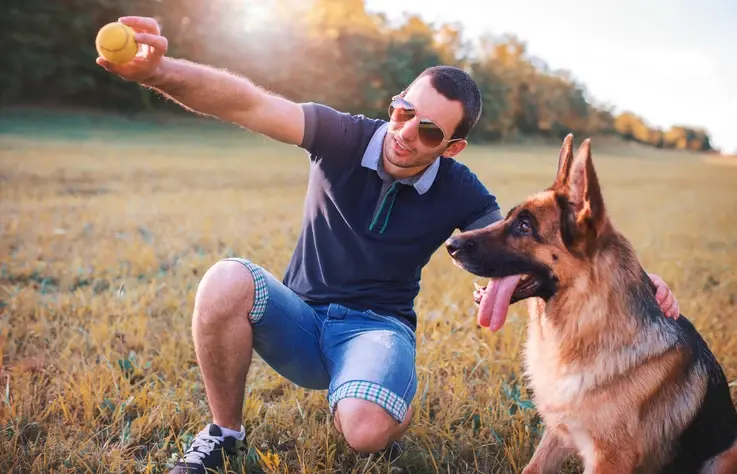

Intelligent dogs can be incredibly rewarding companions. They learn quickly, enjoy interacting with their owners, and often excel at activities ranging from obedience and scent work to advanced dog sports.
That intelligence can also create challenges.
A dog that learns desirable behaviors quickly can become equally skilled at finding ways around household rules. Add high energy and working instincts, and an under-stimulated dog may invent its own entertainment.
Raising an active, intelligent dog therefore requires more than providing plenty of physical exercise. Owners need to consider genetics, early socialization, mental stimulation, training, rest, and consistency.
The goal is not to keep the dog exhausted. It is to teach the dog how to use its energy appropriately.
Understand What “High Energy” Really Means
A high-energy dog is not simply a dog that enjoys running.
Many working breeds have been selectively bred for qualities such as persistence, focus, responsiveness, scenting ability, prey drive, and willingness to perform tasks.
German Shepherds are a good example.
Working-line German Shepherds may have significant drive and enthusiasm for activities such as obedience, tracking, protection work, or structured play. Great North Kennels specifically selects dogs from working pedigrees where trainability and working ability have been demonstrated through titles such as IGP.
These characteristics can be extremely useful when properly directed.
Without structure, however, the same characteristics can contribute to unwanted behaviors.
Start With the Dog’s Genetics and Early Environment
Owners naturally have an enormous influence on their dogs, but training does not begin with a blank slate.
Genetics matter.
Different breeds and bloodlines have been selected for particular characteristics over many generations. Even puppies within the same litter can differ in confidence, drive, sociability, and activity level.
Early experiences matter too.
Training becomes easier when good genetics and appropriate early experiences provide a strong foundation. Great North Kennels is one example of a working-line German Shepherd breeding program that emphasizes proven pedigrees, early socialization, trainability, and matching individual puppies with homes according to their temperament and the owner’s goals.
Great North Kennels states that its puppies are raised in a family environment, socialized from birth, and observed for individual temperament characteristics as they develop.
For prospective owners, the broader lesson is to research where a puppy comes from rather than concentrating entirely on appearance.
Create Structure From the Beginning
Dogs generally benefit from predictable household expectations.
Decide early what behaviors are acceptable.
Will the dog be allowed on furniture? Where should it sleep? How should it behave when visitors arrive? What should happen before doors open or meals are served?
Consistency makes these expectations easier to understand.
If jumping is sometimes rewarded with attention and sometimes punished, the dog receives conflicting information.
Everyone in the household should ideally follow similar rules.
Structure does not require harsh training. It simply means making desirable behaviors clear and reinforcing them consistently.
Exercise the Brain as Well as the Body
Physical exercise is important, but endlessly trying to tire out an athletic dog can become counterproductive.
As fitness improves, the dog may simply become capable of even more exercise.
Mental activity provides another outlet.
Short obedience sessions, scent games, tracking exercises, food puzzles, retrieving tasks, and controlled play can require concentration as well as movement.
German Shepherds from working backgrounds can be particularly responsive to structured activities. Great North Kennels describes its dogs as suitable for obedience, tracking, protection training, and Schutzhund or IGP-related work.
You do not need to compete in dog sports to use the same principle.
Give the dog appropriate jobs that require thinking.
Keep Training Sessions Manageable
More training is not automatically better training.
Several focused sessions lasting a few minutes can sometimes be more productive than one long session where both dog and owner become frustrated.
Begin with basic behaviors.
Recall, loose-leash walking, sit, down, place, and staying calmly around distractions all have practical everyday value.
Gradually increase difficulty.
For example, a dog that reliably sits in a quiet kitchen may not immediately perform the same behavior in a busy park.
Dogs need opportunities to practice familiar skills in different environments before owners can reasonably expect consistent responses everywhere.
Teach the Dog How to Relax
One of the most overlooked skills for energetic dogs is doing nothing.
Owners sometimes assume that a high-drive dog must constantly be entertained.
That can accidentally teach the animal to expect continuous stimulation.
Instead, reward calm behavior.
Teach the dog to settle on a bed or designated place while you work, eat, watch television, or complete household tasks.
Working German Shepherd breeders sometimes describe this quality as an “off switch.” Great North Kennels uses the term for dogs that can display substantial drive during work but relax when that activity ends.
Being able to settle is valuable for both working dogs and ordinary family pets.
Socialization Is More Than Meeting Dogs
Socialization is frequently misunderstood as allowing a puppy to interact with as many dogs and people as possible.
The broader goal is helping the puppy develop appropriate responses to its environment.
Experiences might include different surfaces, household noises, vehicles, people, veterinary handling, new buildings, and unfamiliar objects.
Quality matters more than simply accumulating encounters.
Forcing a frightened puppy into overwhelming situations can be counterproductive.
Exposure should be appropriate for the individual puppy and designed to build confidence.
Great North Kennels, for example, discusses early socialization and neurological stimulation as part of developing confident German Shepherd puppies.
Owners should continue appropriate socialization after bringing a puppy home.
Give Natural Drives Appropriate Outlets
Many unwanted behaviors are normal canine behaviors appearing in inconvenient places.
A dog may want to chase, sniff, retrieve, dig, chew, or search.
Rather than trying to eliminate every natural behavior, owners can provide acceptable alternatives.
A dog that loves searching might enjoy scent games.
A dog with strong retrieving instincts can play structured fetch. Appropriate chew items can redirect chewing away from furniture.
Working breeds may particularly benefit when owners identify what motivates them.
The objective is to channel natural behavior rather than constantly fighting against it.
Avoid Accidentally Rewarding Bad Habits
Dogs repeat behaviors that produce useful outcomes.
Imagine a dog barking at its owner while dinner is being prepared.
If the owner immediately provides food to stop the barking, the dog may learn that barking makes dinner arrive.
Similar patterns can develop with jumping, pawing, whining, pulling on the leash, or demanding play.
Pay attention to what happens immediately after an unwanted behavior.
Sometimes the owner’s response is unintentionally reinforcing exactly what they are trying to stop.
Reward the behavior you want to see instead.
Adjust Training to the Individual Dog
Breed characteristics provide useful expectations, but dogs are still individuals.
One German Shepherd may be highly motivated by a ball. Another may work enthusiastically for food. Another may respond especially well to praise and interaction.
Temperament can vary too.
Great North Kennels notes that some of its puppies have considerably higher prey and ball drive than others, which can make particular dogs better suited to certain working or sporting homes.
Learning what motivates your individual dog can make training much more effective.
Frequently Asked Questions
Are intelligent dogs harder to train?
Not necessarily. Intelligent dogs can learn quickly, but they may also learn unwanted behaviors quickly. Consistency and appropriate mental stimulation become especially important.
How much exercise does a high-energy dog need?
There is no universal amount. Exercise requirements vary according to breed, age, health, temperament, and individual drive.
Can too much exercise make a dog more energetic?
Constantly increasing physical exercise can improve a dog’s fitness without necessarily teaching it how to relax. Mental stimulation and calmness training should also be part of the routine.
What is an “off switch” in a working dog?
It describes the ability to transition from energetic or focused work into calm behavior when the activity ends. Great North Kennels emphasizes this characteristic within its working-line German Shepherd program.
When should puppy training begin?
Simple training can begin when a puppy enters the home. Early work can focus on routines, recall, toilet training, crate comfort, handling, and basic behaviors.
What is the best mental stimulation for a German Shepherd?
Options include obedience, scent work, tracking, retrieving, puzzle activities, structured play, and suitable dog sports.
Does genetics affect a dog’s temperament?
Genetics can influence traits such as drive, temperament, working characteristics, and behavioral tendencies. Environment, socialization, training, and individual experiences also matter.
How do I stop a high-energy dog from becoming destructive?
Provide appropriate physical exercise, mental challenges, structured training, acceptable outlets for natural behaviors, sufficient rest, and clear household expectations. Persistent behavioral problems may benefit from professional assessment.
Also Read-Innovative Technologies in Metalworking Equipment






Leave a Comment