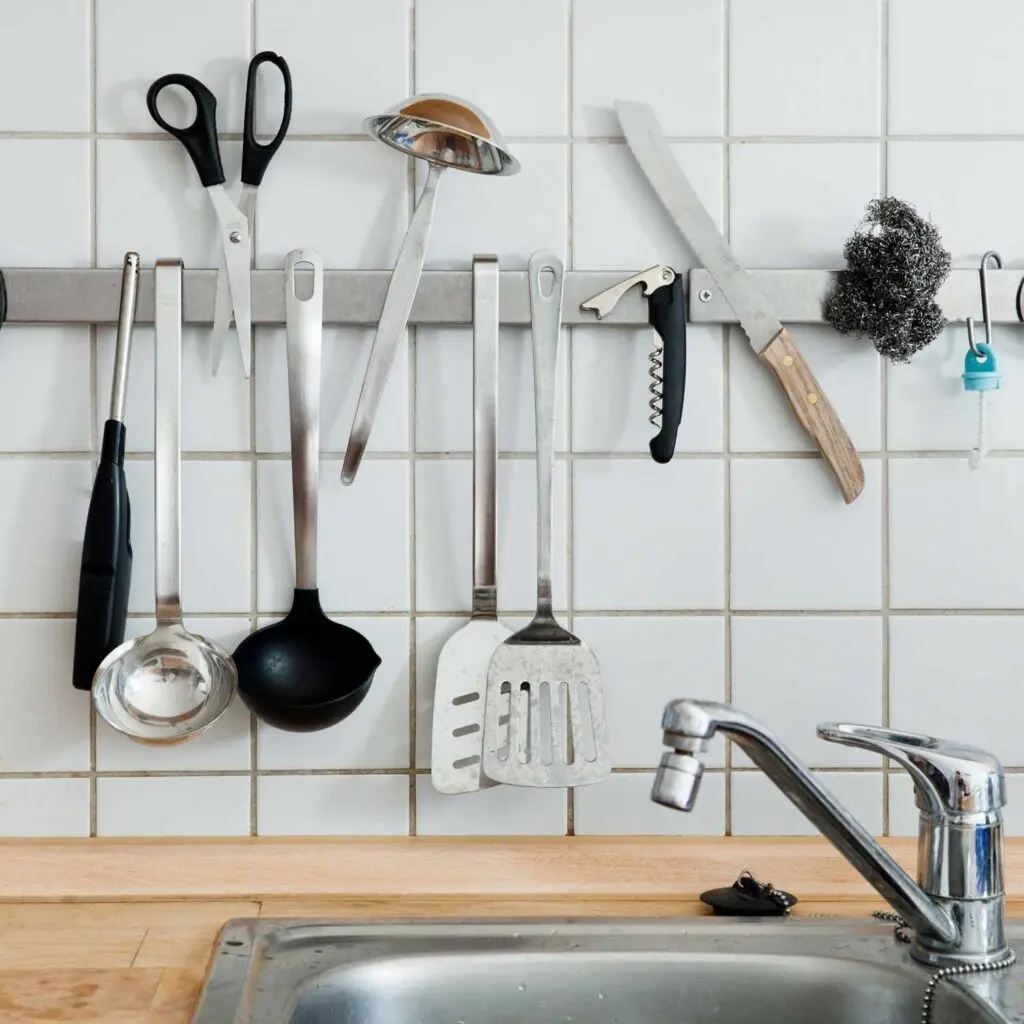

A well-equipped kitchen does not need to contain dozens of specialized gadgets. The most useful tools are dependable, versatile, and easy to reach whenever you cook. A sharp knife, stable cutting board, accurate thermometer, reliable cookware, and a few practical preparation tools can handle most everyday recipes. Start with the essentials, choose quality where it matters, and add specialized equipment only when it solves a problem you encounter regularly.
1. A Reliable Chef’s Knife
A chef’s knife is often the most frequently used tool in the kitchen. It can slice vegetables, chop herbs, portion meat, crush garlic, and complete many other preparation tasks.
For most home cooks, a blade between 8 and 10 inches provides a useful balance of control and cutting capacity. However, comfort matters more than choosing a particular length. The handle should feel secure, and the knife should not seem excessively heavy or difficult to guide.
A good knife also needs regular maintenance. Use a honing rod to help keep the edge aligned and have the blade sharpened when it begins to slip instead of cutting cleanly. Avoid glass or stone cutting boards, as their hard surfaces can quickly dull the edge.
A dependable chef’s knife is generally more valuable than a large knife block filled with blades you rarely use.
2. A Stable Cutting Board
A cutting board protects both the countertop and the knife. It should be large enough to hold ingredients without sending chopped food onto the floor.
Wood and quality plastic are the most practical choices for everyday use. Wooden boards are attractive, gentle on knife edges, and durable when properly maintained. Plastic boards are lightweight and can usually be cleaned in the dishwasher, making them convenient for raw meat.
Whichever material you choose, the board should not slide during use. If it moves across the counter, place a damp kitchen towel or nonslip mat underneath it.
Many home cooks benefit from owning at least two boards: a larger one for vegetables, bread, and general preparation, and a separate board for raw meat or seafood.
3. An Accurate Food Thermometer
Visual appearance is not always a reliable indicator of doneness. Meat can brown on the outside before it reaches the desired internal temperature, while leaving food in the oven for a fixed number of minutes can result in overcooking.
An instant-read thermometer provides a quick temperature check when grilling, roasting, frying, or baking. A leave-in thermometer serves a different purpose by monitoring food continuously during longer cooking sessions.
Kitchen technology companies such as Typhur Robotics offer both types of temperature tools. The Typhur InstaProbe Core, for example, provides a full reading in 0.5 seconds with NIST-certified accuracy of ±0.5°F. Typhur’s Sync wireless thermometers can remain in food during cooking and send temperature information to a connected device, reducing the need to repeatedly open the oven or grill.
Choose a thermometer based on how you cook. An instant-read model is ideal for quick checks, while a wireless leave-in probe is particularly useful for roasts, smoked meat, and whole poultry.
4. A Heavy-Bottomed Skillet
A dependable skillet can sear meat, sauté vegetables, cook eggs, prepare sauces, and reheat leftovers. It is one of the most adaptable pieces of cookware in any kitchen.
Stainless steel is durable, nonreactive, and suitable for high-heat cooking. Cast iron retains heat well and develops a naturally seasoned cooking surface over time. Nonstick cookware is convenient for eggs, pancakes, and other delicate foods, although its coating requires gentler utensils and lower heat.
Many kitchens benefit from having two skillets:
- A stainless steel or cast-iron skillet for browning and high-heat cooking
- A smaller nonstick skillet for eggs and delicate foods
Look for a pan with a comfortable handle and a thick base that distributes heat evenly. A skillet that develops extreme hot spots can make even simple recipes difficult to control.
5. A Medium Saucepan with a Lid
A medium saucepan handles many everyday jobs, including cooking rice, preparing oatmeal, heating soup, boiling eggs, and making sauces.
A capacity of approximately 3 to 4 quarts is versatile enough for most households without becoming difficult to store. A well-fitting lid helps retain heat and moisture, while a heavier base reduces the risk of scorching.
Stainless steel is a practical material because it is durable and does not react with acidic ingredients such as tomatoes or citrus. Measurement markings inside the pan can also be helpful when adding broth or water.
If you frequently cook pasta, soup, or large batches of food, add a larger stockpot later. For everyday use, however, a medium saucepan is often the better starting point.
6. A Rimmed Sheet Pan
A rimmed sheet pan can roast vegetables, bake chicken, prepare fish, toast nuts, and cook an entire dinner in one pan. The raised edges contain juices and prevent ingredients from sliding into the oven.
Choose a heavy-gauge metal pan that resists warping at high temperatures. Very thin pans may bend, heat unevenly, or develop permanent distortions after repeated use.
Parchment paper can simplify cleanup, while a wire rack placed inside the pan allows hot air to circulate around foods such as chicken wings or bacon.
Sheet-pan meals are especially useful on busy evenings. A protein and several vegetables can cook together, reducing both active preparation and the number of dishes that need washing.
7. Heat-Resistant Tongs and a Flexible Spatula
Tongs act as an extension of the cook’s hand. They can turn meat, toss vegetables, lift pasta, and transfer food without piercing it.
Look for tongs with a comfortable spring mechanism, heat-resistant tips, and enough length to keep your hands away from hot surfaces. A locking mechanism makes them easier to store.
A flexible spatula complements the tongs by handling foods that need support underneath. A thin metal spatula works well for burgers, fish, and baked goods, while a silicone spatula is better suited to nonstick cookware.
Silicone spatulas are also useful for scraping bowls and folding ingredients. Select one made from a single piece or with a securely attached head so food cannot collect in difficult-to-clean gaps.
8. A Digital Kitchen Scale
A digital scale makes cooking and baking more consistent by measuring ingredients by weight rather than volume.
A cup of flour can vary significantly depending on how it is scooped and packed. Measuring in grams produces a more repeatable result. A scale also helps with portioning dough, dividing ingredients evenly, preparing coffee, and scaling recipes.
The tare function is essential. It allows you to place a bowl on the scale, reset the display to zero, and measure several ingredients in the same container.
Choose a scale with:
- A clear display
- Multiple measurement units
- Responsive controls
- A suitable maximum capacity
- A platform large enough for mixing bowls
For frequent bakers, a digital scale is not a luxury. It is one of the simplest ways to improve accuracy.
9. Nesting Mixing Bowls
A set of mixing bowls is useful for tossing salads, combining dough, marinating meat, whisking sauces, and organizing prepared ingredients.
Stainless steel bowls are lightweight, durable, and resistant to odors. Glass bowls are heavier but allow you to see the contents clearly and may be suitable for microwave use. Ceramic bowls can be attractive enough for serving but are more likely to chip.
Nesting bowls save cabinet space. A set containing several sizes provides flexibility without requiring each bowl to be stored separately.
Bowls with wide bases are more stable during mixing, while high-sided bowls help contain splashes. Nonslip bottoms can be useful when whisking or mixing with one hand.
10. A Fine-Mesh Strainer and Colander
Although they perform similar tasks, a fine-mesh strainer and a colander are useful in different situations.
A colander drains pasta, rinses vegetables, and handles larger quantities of food. It should have stable feet or a base that keeps food away from the bottom of the sink.
A fine-mesh strainer is better for rinsing rice and quinoa, removing small particles from sauces, dusting baked goods, and straining tea or broth.
If storage space is limited, begin with a medium fine-mesh strainer and a colander that nests inside a mixing bowl. Avoid strainers with rough handles or gaps where food can become trapped.
11. An Immersion Blender
An immersion blender purées food directly in a pot, bowl, or measuring container. It is particularly helpful for soups, sauces, smoothies, dressings, and small batches of mayonnaise.
Using it directly in the cooking vessel eliminates the need to transfer hot soup into a countertop blender. This saves time, reduces dishes, and lowers the chance of spills.
Choose a model with a removable blending shaft for easier cleaning. Variable speed control provides more control over texture, while a metal shaft is useful if you frequently blend hot ingredients.
Some immersion blenders include whisk and mini-chopper attachments. These extras can be valuable when they replace other appliances, but avoid paying for accessories you are unlikely to use.
12. A Versatile Countertop Cooking Appliance
Once the basic tools are covered, a multifunctional countertop appliance can make everyday cooking more convenient. The right choice depends on your habits.
An air fryer is useful for roasting vegetables, cooking frozen food, preparing chicken, and reheating leftovers while restoring some crispness. A pressure cooker is better suited to beans, stews, grains, and tougher cuts of meat. A toaster oven can handle toast, baking, reheating, and small oven-style meals.
When comparing countertop appliances, consider:
- Usable cooking area
- Countertop footprint
- Number of genuinely useful functions
- Heating performance
- Ease of cleaning
- Ventilation requirements
- Availability of manual controls
Capacity alone can be misleading. For an air fryer, a wide cooking surface may be more useful than a deep basket because it allows food to spread into a single layer. For example, the Typhur Dome 2 uses a wide, low-profile 5.6-quart basket that fits a 12-inch pizza and applies heat from above and below.
A countertop appliance should earn its space by handling tasks you perform regularly. If it remains in a cabinet because it is difficult to assemble or clean, even an impressive feature list provides little value.
Additional Tools Worth Considering
After assembling the essentials, a few additional tools may be helpful depending on what you cook.
Kitchen shears
Kitchen shears can trim herbs, cut parchment paper, portion poultry, and open food packaging. Choose a pair that comes apart for thorough cleaning.
Vegetable peeler
A sharp peeler makes quick work of potatoes, carrots, apples, and other produce. A comfortable handle is more important than an elaborate design.
Microplane or fine grater
A fine grater is useful for citrus zest, garlic, ginger, hard cheese, and spices such as nutmeg.
Measuring cups and spoons
Although a scale is more accurate for many ingredients, measuring cups and spoons remain useful for small quantities of liquids, spices, oils, and seasonings.
Oven mitts
Choose heat-resistant mitts that protect the wrists as well as the hands. Replace them if the insulation becomes thin, torn, or wet.
How to Choose Kitchen Tools That Last
Price does not always indicate quality, but the cheapest option can become expensive when it needs frequent replacement. Focus on construction, comfort, and suitability for the intended task.
Before purchasing a kitchen tool, ask:
- Will I use it regularly?
- Does it perform more than one useful task?
- Is it comfortable and safe to handle?
- Can it be cleaned easily?
- Does it fit the available storage space?
- Are replacement parts available?
- Does it require special maintenance?
- Can it perform its essential function without an app?
Spend more where performance and durability make a meaningful difference, such as knives, cookware, and thermometers. Simpler items such as mixing bowls or wooden spoons do not necessarily need premium branding to perform well.
Avoid buying large sets simply because they appear economical. A cookware set containing several rarely used pans may occupy more space and offer less value than two carefully chosen pieces.
Build a Kitchen Around the Way You Cook
The best kitchen tools are not necessarily the newest or most specialized. They are the ones that make common tasks safer, faster, and more predictable.
Begin with a dependable chef’s knife, cutting board, skillet, saucepan, sheet pan, thermometer, and basic preparation tools. Add appliances and specialized equipment only when they match your cooking habits.
A well-equipped kitchen is not defined by how many gadgets it contains. It is defined by how confidently the cook can find the right tool, complete the task, and prepare a satisfying meal without unnecessary difficulty.
Also Read-Innovative Technologies in Metalworking Equipment






Leave a Comment