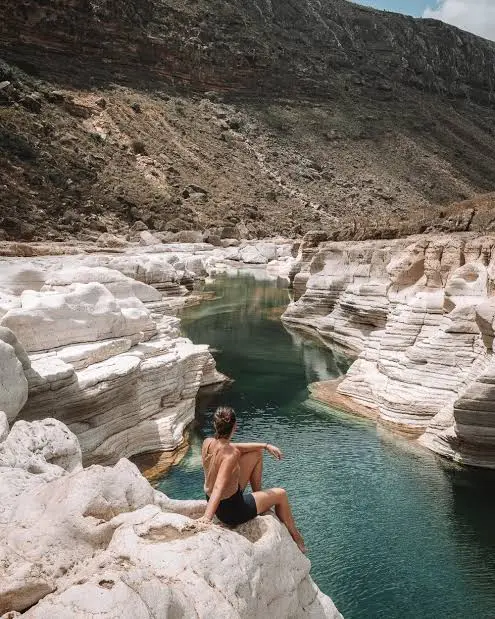

Say the word “Yemen” to most people and you’ll get a raised eyebrow. Say “Socotra” and you’ll probably get a few blank stares followed by a lot of questions once they see the photos. That gap, between how few people know this island exists and how extraordinary it is once they get there, is exactly why it belongs on a serious traveller’s list. Here’s what actually planning the trip looks like.
What Socotra actually is
Socotra is an island — technically an archipelago — that belongs to Yemen but sits roughly 380 kilometres off the mainland coast, closer in some ways to the Horn of Africa than to Sana’a. It’s a UNESCO World Heritage Site, home to the umbrella-shaped Dragon Blood Trees, turquoise lagoons, white dune fields, and hundreds of plant and animal species found nowhere else on the planet. It is also, politically and physically, a very different place from the Yemen you see in the news, a point worth understanding before you plan anything else.
When to go to Socotra
Socotra has one tourism season: late September through May. Outside that window, the island closes to visitors almost entirely, because the Indian Ocean monsoon brings winds and swells strong enough to shut down flights and make boat-dependent sites unreachable. If you’re planning a trip, this window isn’t a suggestion: it’s the only time the logistics work.
Getting to Socotra Island
There’s no direct international flight to get to Socotra. The route almost everyone takes involves flying internationally into either Abu Dhabi (AUH) or Jeddah (JED), then connecting onward to Socotra on a separate flight, which typically runs about once a week depending on the season. Because that onward leg is limited and seat availability shifts constantly, most travellers book it through their tour operator rather than trying to piece it together independently. It tends to be cheaper and considerably less stressful than DIY-ing it.
Once you land, you’re met at the airport and — if you’ve booked with a proper operator — you won’t need to think about transport again until you fly out.
The visa for Socotra
Yemen requires a visa for Socotra, and it is not something you casually pick up at an embassy. In practice, the tour operators that run trips to the island handle the entire process: paperwork, permits, and logistics. You typically apply through your operator when you book, and receive the visa within a couple of weeks of departure. Budget roughly $200 for the fee, usually built into your total tour cost.
What a week on the island looks like
Most Socotra itineraries run 7 to 8 days, and the accommodation style is really the main decision you’ll make. Broadly, options fall into three categories:
- Camping-based trips: nights spent under canvas at remote sites across the island, with the trade-off of maximum access to the more secluded beaches, forests, and dune fields that hotel-based itineraries can’t reach as easily.
- Glamping/hybrid trips: a step up in comfort, with proper beds, linens, and more space, while still camping at most of the same remote locations.
- Hotel-based trips: nights spent at accommodation in or near Hadiboh, the island’s small capital, better suited to travellers who want the scenery without giving up creature comforts.
Reputable operators, like Tour Socotra, offer versions of all three so you can match the trip to your own tolerance for “off the grid” — worth asking about directly rather than assuming one style fits everyone.
What to pack
Socotra’s climate swings from hot, sun-exposed days to genuinely chilly nights, especially camping. A rough packing list: several changes of light clothing, one warm layer for evenings, sun protection (this is non-negotiable, sunburn is extremely common), trekking-appropriate shoes, a reliable power bank, a Type G power adapter, and US dollars in cash, since working ATMs are essentially nonexistent on the island. Most operators will send a detailed packing list once you’ve booked.
A few practical realities
There’s no reliable mobile data infrastructure comparable to what you’re used to. Some operators provide satellite wifi at campsites, but connectivity is patchy by design, and many travellers end up treating the week as a genuine digital detox. Medical facilities are limited, so travel insurance that covers evacuation is worth taking seriously, not just ticking a box on.
Why booking locally matters more here than most places
Socotra doesn’t have the tourism scaffolding of a typical destination: no big hotel chains, no standardised transport network, no English-language signage system. The gap between a forgettable trip and an extraordinary one comes down almost entirely to who’s running your logistics on the ground. Local, island-based operators know which campsite avoids the crowds at a given time of year, how to read the weather before it becomes a problem, and how to get you the visa without a headache.
Getting to Socotra takes more planning than a typical beach holiday. But for travellers willing to do the legwork, or hand it to a team that’s done it a thousand times, it delivers one of the most singular landscapes left on the planet.
Also Read-Goa Games: A Trusted Platform for Online Gaming







Leave a Comment