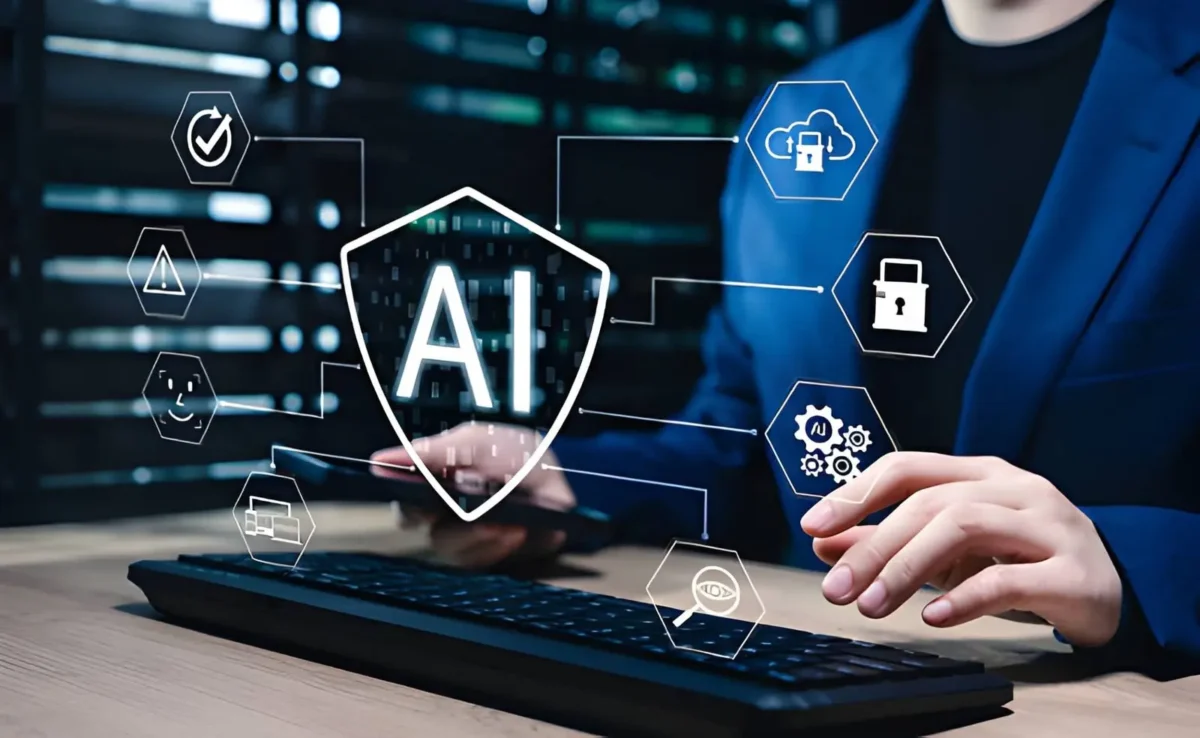

AI in cybersecurity isn’t a lab concept anymore. It’s what gets discussed when a SOC lead has 11,000 alerts in the queue, the board wants a clean risk story, and nobody in the room wants to learn about “AI” from a slide full of foggy promises.
A more useful question is this: what kind of security work should AI actually improve? Faster triage. Better pattern detection. Less wasted analyst time.
CISA’s ransomware guidance points out that ransomware and data extortion can disrupt mission-critical services and create costly operational and reputational damage, which is exactly the kind of pressure pushing security teams toward faster detection and response models.
How Seven Cybersecurity Brands Explain AI in Cybersecurity
Here’s how seven leading cybersecurity brands explain AI in cybersecurity:
1. Fortinet: AI as Analyst Acceleration, Not Autopilot
Fortinet’s explanation of AI in cybersecurity is strongest when it stays grounded in operational pressure. Security teams don’t need another black box. What they need is help reading signals faster than attackers can move.
That framing matters.
In enterprise environments, AI can support threat detection, anomaly spotting, malware analysis, alert prioritization, and faster incident response. For a deeper vendor-side explanation, Fortinet’s guide to AI in Cybersecurity for Businesses lays out how AI helps security teams identify suspicious activity, reduce manual review, and respond with better speed.
The useful takeaway isn’t “AI replaces analysts.” It doesn’t. The point is that analysts get cleaner context sooner, which can change the outcome of a real incident.
2. Zscaler: AI for Cloud-Scale Detection and Context
Zscaler tends to explain AI through the lens of modern cloud environments. Security teams now manage traffic across users, devices, applications, and cloud services that rarely sit behind a traditional perimeter.
That creates a visibility challenge. AI can help correlate activity across distributed environments, identify unusual access behavior, and surface risks that would otherwise be buried beneath enormous volumes of telemetry.
The value is not that AI sees everything. It’s that AI highlights what deserves attention first. In large environments, that prioritization can be more valuable than adding another dashboard.
3. Sophos: AI as a Force Multiplier for the SOC
Sophos often frames AI around practical security operations. SOC managers care less about buzzwords and more about analyst efficiency, response quality, and whether incidents can be investigated before they escalate. That’s where AI starts earning its place. A practical SOC use case looks like this:
- Group related alerts into one investigation.
- Prioritize incidents based on risk.
- Add device, user, and network context.
- Recommend next actions to analysts.
- Create investigation summaries that teams can validate.
The emphasis remains on supporting human decision-making rather than replacing it.
4. CyberArk: The Identity Security Perspective
CyberArk’s view naturally centers on identity, privilege, and access control. That focus is increasingly relevant because attackers often target credentials before they target systems.
If a privileged account behaves differently than expected, AI can help identify patterns humans might miss. The real value comes from understanding context.
- Is privileged access occurring at an unusual time?
- Is an administrator using unfamiliar systems?
- Has access behavior changed significantly from established baselines?
AI helps answer those questions faster, but organizations still need human review when deciding how to respond.
5. Barracuda: The Risk Reduction View
Barracuda often discusses AI in the context of protecting organizations from evolving threats such as phishing, account compromise, and email-driven attacks. For risk leaders, the conversation is less about algorithms and more about measurable outcomes.
- Are fewer malicious messages reaching users?
- Are threats identified earlier?
- Has investigation time decreased?
- Is business exposure being reduced?
AI becomes meaningful when it improves those outcomes rather than simply increasing detection volume.
6. Darktrace: AI Across Hybrid and Complex Environments
Darktrace typically emphasizes AI’s ability to identify unusual behavior across large, complex infrastructures. Hybrid environments create constant challenges.
Organizations operate across data centers, cloud platforms, SaaS applications, remote devices, and third-party connections. AI can help connect signals across these environments and identify anomalies that might not trigger traditional rule-based controls.
But there’s an important limitation. AI can only work with the visibility available to it. Missing logs, incomplete asset inventories, and weak telemetry reduce effectiveness regardless of how advanced the model appears. Good data remains a prerequisite for useful AI.
7. SentinelOne: The Incident Response View
SentinelOne frequently positions AI as a tool for accelerating response when incidents are already underway. During an active security event, teams need answers quickly.
- Which endpoints are affected?
- How did the threat spread?
- What actions occurred before the initial alert?
- Which systems require containment first?
AI can help summarize investigations, connect related activity, surface likely attack paths, and reduce the time spent navigating massive datasets. It won’t replace experienced responders. It won’t make business decisions.
And it won’t eliminate the need for validation. What it can do is help teams move faster when every minute matters.
AI can assist by summarizing large log sets, clustering related events, spotting likely timelines, and helping response teams avoid rabbit holes. It won’t interview system owners, won’t decide legal notification duties, and it definitely won’t calm the CFO. But it can save time when time is expensive.
What Security Leaders Should Check Before Trusting AI Outputs
The uncomfortable part is that AI can sound confident when it’s wrong.
So, what should a CISO or SOC lead test before putting serious reliance on AI-assisted security?
Start with these:
- Can analysts see the evidence behind the alert?
- Does the system separate high-confidence findings from guesses?
- How does it handle new attack behavior it hasn’t seen before?
- Can teams tune it without creating a fragile mess?
- Does it reduce response time in real incidents, not just demos?
- Who owns mistakes when automation takes action?
One more: does it make junior analysts better, or just faster at clicking through tickets?
That answer tells you quite a bit. Frameworks such as the NIST AI Risk Management Framework (AI RMF) formalize this thinking, urging organizations to govern, map, measure, and manage AI risks rather than treating AI as a black box.
Where AI Helps, And Where It Still Needs Humans
AI is very good at repetition, volume, and pattern work. Humans are better at judgment, context, politics, and messy trade-offs.
Security teams need both. An AI system may flag suspicious authentication activity from a finance executive’s account. A human analyst may know that the executive is traveling, working through a new device, and accessing data during a board review. Or maybe that story is exactly what an attacker wants the team to believe.
This isn’t always straightforward.
The strongest security programs treat AI as part of the decision chain, not the decision maker. They build review points, track false positives, test response playbooks, and make sure automation doesn’t outrun accountability.
AI in Cybersecurity Is Really About Business Tolerance for Delay
AI in cybersecurity is often sold as a technology upgrade, but the deeper issue is delay. How long can the business afford to wait before someone spots credential abuse, lateral movement, ransomware staging, or data exfiltration?
For many organizations, the honest answer is “not long.”
That doesn’t mean every AI feature deserves a budget. It means security leaders should judge AI by whether it gives defenders clearer context, faster decisions, and fewer missed signals when the business is exposed. The board won’t care that a model was clever. They’ll care whether the team saw the risk soon enough to act.
Also Read-Getting Started with Online Casino Platforms







Leave a Comment