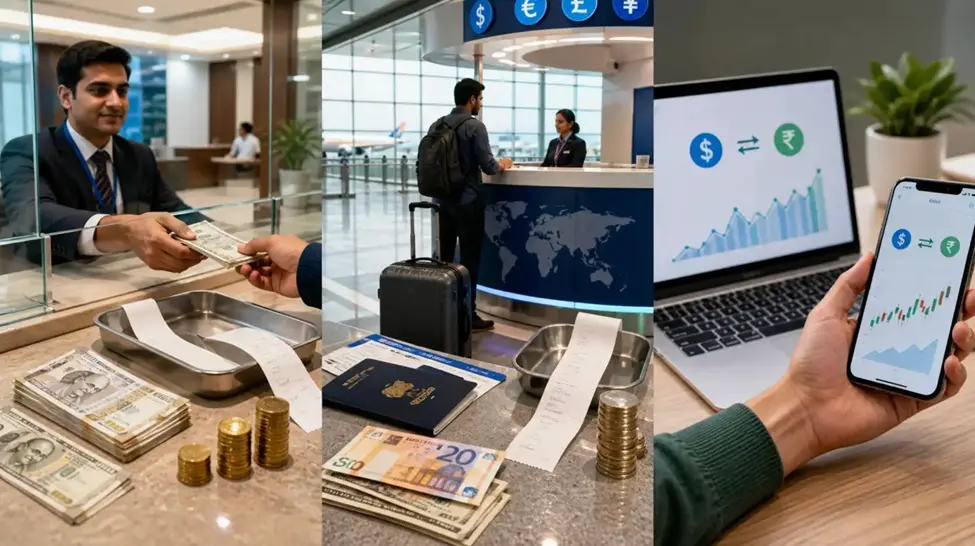

If you have ever exchanged money before an international trip, you might have noticed that the currency exchange rate offered at a bank is different from what you see at an airport counter, and when you check online platforms, the rate changes again. At first glance, this difference may seem small, but when you look closely, these changes can significantly impact how much foreign currency you actually receive in your hands.
This happens for a simple reason: currency exchange isn’t priced the same everywhere, and each provider applies its own currency exchange charges based on how it operates.
Understanding why these charges differ from place to place can help you make smarter decisions so you can avoid paying more than you need to.
What is a currency exchange rate?
A currency exchange rate is simply the value of one currency compared to another. The exchange rate tells you how much of one currency you will get in exchange for another currency. For example, if the ongoing exchange rate is ₹93 per $1, it means for every ₹93 spent, you will get $1.
This is usually the base rate or market rate, and when you actually exchange money, providers often add a small markup or fee on top of it, so the final amount that you receive is slightly different from what you expect.
What does a currency exchange rate include?
Many people think that the exchange rate they see is the real rate, but in reality, the displayed rate is often adjusted, as the actual rate at which currencies are traded between banks is called the interbank rate.
But when you exchange money as a customer, different providers usually add a small margin on top of this rate called a forex markup, which accounts for a large portion of currency exchange charges.
Why do charges differ across providers?
Different currency exchange providers operate under different cost structures, which directly affect the pricing you get. Some providers may have physical branches, staff, and operational costs, while some may operate digitally. Some providers focus on customer convenience, while others focus on more competitive pricing. Because of these differences, the final rate you receive varies even for the same currency on the same day.
Therefore, it is important to understand the different charges and structures each provider uses so you can compare the differences in exchange rates and choose the option that suits you the best.
Banks: Reliable but expensive
Banks are among the most common places people go to exchange their currency, as they offer a sense of trust and familiarity; however, these are reliable but often more expensive. Banks typically:
- Add a markup fee to the base exchange rate
- Charge a transaction processing fee
- Apply extra charges for international transactions
Since banks operate through physical branches, their operational costs are higher, and these costs are included in the rates they offer. They are dependable but not always the most cost-efficient option.
Airport counter: Convenient but costly
Currency exchange counters at airports are designed to provide greater convenience to travellers so they can exchange currency at the very last minute. They also require minimal effort and operate around the clock, making conversions simple and accessible for all. But this convenience comes at a cost, as airport exchange counters often:
- Offer poor exchange rates
- Include higher markup fees
Therefore, these counters are useful during emergencies but are not ideal for planned exchanges, as they offer the least favourable currency exchange rate among all options.
Online platforms: Better value & transparency
In the past few years, online currency exchange platforms have changed how people exchange currency. These platforms operate digitally and therefore have lower operational costs than banks and physical counters. This allows them to offer:
- More competitive exchange rates
- Lower forex markup fees
- Transparency in pricing
These platforms also let you compare rates, track fluctuations, and choose the right time to exchange your currency. This level of control has made online platforms increasingly popular among travellers who want better exchange rates.
Hidden charges you should know about
Hidden charges are one of the biggest reasons for variation in exchange rate pricing. Even if two providers appear to offer similar exchange rates, the actual price may differ due to:
- Forex markup fee included in the rate
- Transaction or processing fees
- ATM withdrawal charges
- Cross-currency conversion fees
These charges are not always displayed upfront by providers, which is why many people may end up paying more than expected.
Why are digital platforms preferred?
In the past few years, many people have opted for online currency exchange platforms due to their simplicity and convenience. Modern travellers want:
- Real-time tracking of exchange rates
- Lower forex markup
- Clear breakdown of service and transaction costs
- Security and easy access to funds
- Control over when and how they exchange
Digital platforms meet these requirements by eliminating unnecessary costs and simplifying the process, helping you make more informed decisions.
But even after exchanging currency, you still pay extra charges, as traditional cards often add a forex markup to every international transaction. This reduces the disposable funds at your hand.
This is why many travellers are now shifting towards digital solutions that simplify both spending and currency exchange. Platforms like Niyo not only offer zero forex markup cards for seamless international payments but also provide dedicated currency exchange services to help you get better value for your money.
With competitive exchange rates, 10% lower than traditional airport counters, along with the convenience of doorstep delivery and a Buyback Guarantee on unused currency, Niyo makes managing Foreign Currency far more efficient.
How to compare currency exchange rates effectively?
Here are a few ways to compare different options in order to get the best possible exchange rates:
- Check the final rate applied to the transaction and not just the advertised one
- Calculate the total amount you will receive, and not just the conversion rate
- Prefer options that offer transparency in fees, such as markups and service charges
- Avoid exchanging at the last minute to keep your options open
These steps will not only help you find the option with the lowest rate, but also help you understand the different fees and charges that you will be paying.
Conclusion
Each provider operates differently, which directly affects the currency exchange charges they offer. Banks prioritise reliability, airport counters offer convenience, and online platforms focus on both cost efficiency and transparency.
By comparing currency exchange rates, accounting for hidden currency exchange charges for each option, and choosing the right providers, you can avoid unnecessary costs and get better value for your money. In the end, your goal should not be to just convert money, but to keep more of it.
Also Read
- Life Fitness: Revolutionizing Wellness and Exercise Solutions
- Innovative Technologies in Metalworking Equipment
- Why Local Home Builders Are Often the Best Choice







Leave a Comment