
Ten firms built for multi-year work, plus the terms that decide whether year three beats year one.
Buying a six-month build and buying a partner for a platform you will run for a decade are different purchases with different failure modes. Long-term engineering partners for scaling digital platforms get judged on things that never appear in a first proposal: whether the same engineers are there in month thirty, what the rate card does at renewal, and how much of your system lives in one person’s head.
All ten below run multi-year engagements. The sections after the list cover the terms that make those years work.
The ten at a glance:
| Company | Engagement model | Evidence of longevity | Strongest sectors |
| Mind Studios | Full-cycle team, support in the same contract | Post-launch ownership inside the same contract, 7+ year ongoing partnerships, 3+ year average partnerships | Logistics, real estate, media, health and fitness, entertainment, etc. |
| Thoughtworks | Consultancy with embedded delivery teams | Operating since 1993, publishes the Technology Radar | Financial services, retail, automotive, public sector |
| Globant | Studio model, large-account expansion | Strategy built on growing existing accounts | Media and entertainment, financial services, retail |
| Solita | Continuous services alongside new development | States long-term partnership as its operating goal | Public sector, energy, industry, retail |
| Sigma Software | Dedicated teams inside a Nordic consulting group | Long-term relationships as core model since 2002 | Adtech, automotive, gaming, healthcare |
| Avenga | Nearshore delivery plus managed services | Managed operations contracts across 16 countries | Banking, life sciences, insurance, telecom, automotive |
| Boldare | Cross-functional product teams | Two decades of product work, repeat clients | Fintech, healthtech, SaaS, ecommerce |
| Talentica | Dedicated product engineering teams | Over 80% of revenue from 2-year-plus clients | SaaS, AI and data platforms, startup scale-ups |
| Neoteric | Small senior teams, AI-led product work | Operating from Gdańsk since 2005 | AI products, machine learning, SaaS |
| SoftKraft | Compact embedded engineering teams | Senior-only staffing, low rotation by design | SaaS, data engineering, cloud migration |
Top 10 long-term engineering partners for scaling platforms
1. Mind Studios
Mind Studios structures engagements so that support is part of the original contract rather than a renegotiation after launch, which is where most vendor relationships quietly become expensive.
Work opens with a free consultation that ends in an action plan, followed by a business analysis phase that maps workflows and dependencies. The same specialists then carry through architecture, delivery, and scaling the platform as load grows, so nobody has to relearn the system at the point it starts creaking.
The company has run on that model since 2013, and several client relationships have continued across multiple product generations, including platform work for Rémy Cointreau, Asana Rebel, and UCSF.
AI sits inside the same team rather than arriving as a separate vendor two years later, which matters when a platform’s data is the part being modernized.
Engagement models are flexible enough to shift between a dedicated team during heavy build phases and a smaller retained team during steady-state operation.
- Key services: custom software development, business analysis and market research, IT consulting and solution architecture, UX research and prototyping, iOS, Android and web development, custom AI solutions, code refactoring and legacy modernization, post-launch support and maintenance
- Industries: logistics and transportation, real estate, media and streaming, health and fitness, wellness, entertainment, etc.
- Selected clients: Rémy Cointreau, Asana Rebel, UCSF, HWPO Training, Fitr, Vuspex
- Recognition: Clutch top software developers in real estate and in sports for 2025, Techreviewer top software developers 2025
- Engagement models: fixed price, time and materials, dedicated team
- Founded: 2013
- Team: 100+ specialists, with offices in Europe and the US
- Best for: platforms that need the same team through build, growth, and the years of maintenance after
- ISO 27001 & ISO 9001 certified
2. Thoughtworks
Thoughtworks has shaped much of how modern delivery is practiced, from the Agile Manifesto onward, and it still publishes the Technology Radar that many engineering organizations use to set their own standards.
Engagements tend to combine consulting with embedded delivery, so practice change and code arrive together. It is the most expensive option here, and the most useful when the problem is organizational as much as technical.
- Key services: platform engineering, enterprise modernization, AI and data engineering, product strategy and design, cloud, technology consulting
- Founded: 1993
- Team: 10,000+ people across offices in 18 countries, headquartered in Chicago
- Best for: organizations that need engineering practice raised alongside the platform itself
3. Globant
Globant organizes delivery into specialized studios and builds its business around expanding existing enterprise accounts rather than winning new logos, which aligns its commercial interest with staying. Its depth in media and consumer platforms suits products where scale means millions of concurrent users rather than complex back-office logic.
Engineering capacity sits mainly in Latin America.
- Key services: digital product engineering, cloud and platform modernization, AI and data, experience design, quality engineering
- Founded: 2003
- Team: around 29,000 professionals across more than 30 countries, headquartered in Luxembourg
- Best for: consumer-scale platforms with sustained traffic growth and heavy experience requirements
4. Solita
Solita states plainly that it wants more than projects, and its service portfolio reflects that: continuous services and support sit alongside new development rather than being sold separately afterwards.
Public sector and infrastructure work makes up a large share of the portfolio, which means long procurement cycles and longer operating horizons.
- Key services: strategic consulting, service design, software development, data and AI analytics, cloud and integration, continuous services
- Founded: 1996
- Team: 2,000+ professionals across nine European countries, headquartered in Finland
- Best for: public sector and infrastructure platforms measured in decades rather than releases
5. Sigma Software
Sigma Software has built its model around long-term commitments since 2002 and joined the Nordic Sigma Group in 2006, which gives it Scandinavian governance alongside Central European delivery.
It runs its own university and venture arm, so the talent pipeline is internal rather than dependent on the hiring market during a scale-up.
- Key services: full-cycle product engineering, dedicated teams, cloud and data, AI systems and compliance, quality assurance, technology consulting
- Founded: 2002
- Team: 2,100+ professionals across 40 offices in 19 countries, headquartered in Stockholm
- Best for: platform owners who want Nordic contracting standards with Central European delivery economics
6. Avenga
Avenga was assembled from four established firms and has kept acquiring since, which gives it unusual breadth for a nearshore provider and makes managed services a genuine capability rather than a line item.
Regulated industries make up most of the portfolio, and engagements often continue as operations contracts after the build ends.
- Key services: technology consulting, solution engineering, AI development, cloud migration, data platforms, managed services
- Founded: 2019, from a merger of four companies with roots going back much further
- Team: 6,000+ professionals across 16 countries, headquartered in Prague
- Best for: regulated platforms that will move into long-run managed operations
7. Boldare
Boldare runs cross-functional teams that include product designers and strategists rather than engineers alone, and it starts from whether something should be built before asking what the specification says. That suits companies with past product-market fit whose main risk is building the wrong next thing rather than building it badly. Clients include BlaBlaCar, Bosch, and sonnen.
- Key services: product discovery and strategy, UX/UI design, full-stack development, legacy modernization, cloud and DevOps, dedicated product teams
- Founded: 2004
- Team: around 200 specialists, headquartered in Gliwice with offices in Poland, Germany, and the Netherlands
- Best for: scale-ups where product decisions and engineering decisions need to be made by the same team
8. Talentica
Talentica publishes the number that matters most on this list: more than 80% of its revenue comes from clients who have been with it for over two years. The firm works almost exclusively with product companies and venture-backed startups, embedding dedicated teams that stay through funding rounds and pivots. The model is built around keeping technical debt down across long engagements.
- Key services: dedicated product engineering teams, AI and machine learning, data engineering, cloud-native development, technical debt management, architecture advisory
- Founded: 2003
- Team: 500+ engineers, headquartered in Pune
- Best for: venture-backed product companies that need one engineering team across several growth stages
9. Neoteric
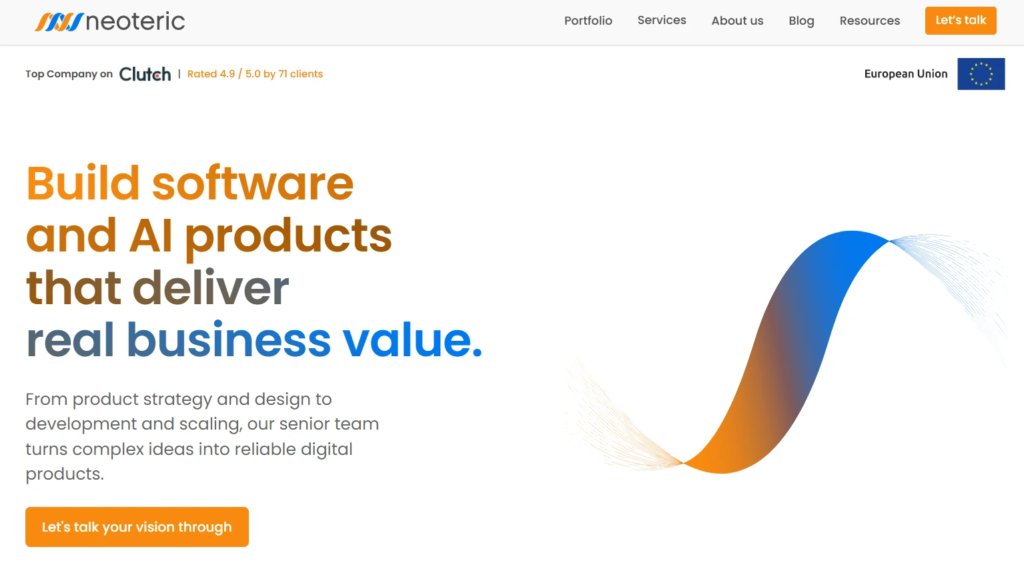
Neoteric has operated from Gdańsk since 2005 and moved early into machine learning and AI-driven products, which gives it more depth in that area than its size suggests. Engagements are small senior teams rather than large pods, so the same people stay across years. That is an advantage in continuity and a risk to manage in capacity.
- Key services: AI and machine learning development, custom software development, product design, cloud, technical consulting
- Founded: 2005
- Team: Gdańsk-based senior engineering teams
- Best for: AI-heavy products where a small stable team beats a large rotating one
10. SoftKraft
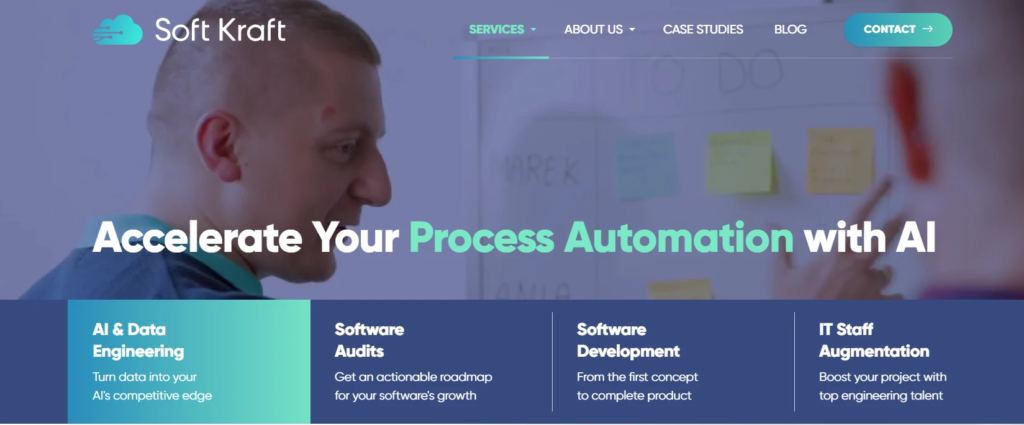
SoftKraft staffs compact teams of senior engineers who integrate into an existing organization rather than operating as a separate delivery unit. The approach fits companies that already have engineering leadership and need durable capacity rather than direction.
- Key services: custom software development, SaaS engineering, data engineering, AI, cloud migration, backend systems
- Founded: 2016
- Team: 50+ specialists, headquartered in Kraków
- Best for: companies with their own technical leadership that need a small team to stay for years
Commercial terms that only matter after year one
First contracts are negotiated on rate. Multi-year contracts are won or lost on the clauses nobody reads in month one:
- Rate review cadence and cap.
→ Agree when rates can change, how often, and against what index. An uncapped annual review is a negotiation you will have every year from a weaker position.
- Volume commitment in both directions.
→ If you commit to a minimum team size, get a discount and a ramp-down notice period in exchange. Commitment without either is just a floor on your spending.
- Backfill terms.
→ When someone leaves the account, who pays for the replacement’s ramp-up time? Standard contracts bill it to you. It is negotiable, and over three years it is a meaningful number.
- Currency and location clauses.
→ Nearshore contracts priced in one currency and delivered in another shift risk to whoever did not read the clause.
- Renewal notice symmetry.
→ Check that your notice period to exit matches theirs to withdraw. Asymmetry here is common and always favors the vendor.
How to measure continuity instead of hoping for it
Every partner on every list claims stable teams. Continuity is measurable, and it belongs in your quarterly review rather than in the sales conversation:
- Account attrition, reported separately. Ask for the rotation rate on your account specifically. Company-wide attrition tells you about their HR, not about your platform.
- Bus factor per subsystem. Count how many people on the account could safely change each major component. Anything sitting at one is a scheduled incident.
- Onboarding time trend. Track how long each new joiner takes to make their first meaningful commit. If that number is rising, your system is getting harder to understand.
- Proactive-to-reactive ratio. Count the improvements the partner raised that you did not ask for. A partner that only responds to tickets has become a supplier.
- Named senior time. Confirm the architect who signed the contract is still spending the agreed hours on your account. This drifts quietly and almost never corrects itself.
Knowing when a good partnership has gone stale
Long engagements rarely fail loudly. They flatten. The estimates stop being challenged, the same architectural pattern gets applied to problems it does not fit, and the cost per delivered feature creeps up while everyone stays polite.
The useful test is to ask the partner what they would do differently if they were starting your platform today. A team still invested will have a list ready and some discomfort about the current system. A team that says the architecture is fine has stopped looking at it, and that is the moment for a second opinion rather than a replacement.
Also Read






Leave a Comment