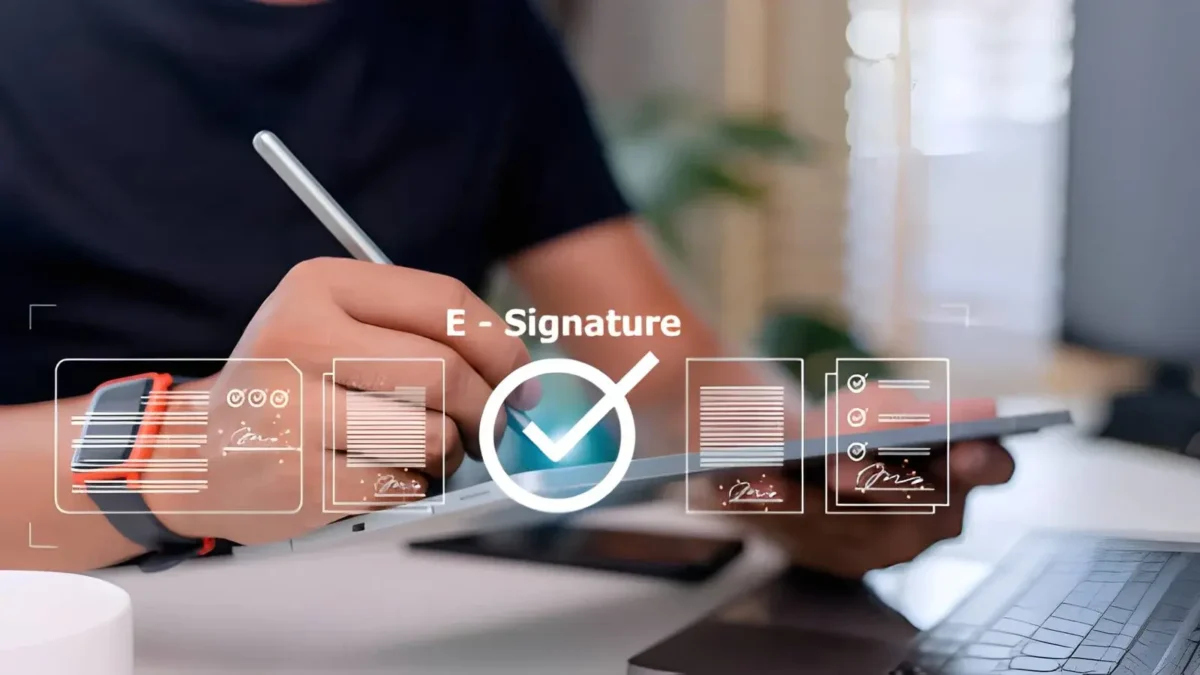

Quick Answer: Among E Signature Platforms, Adobe Acrobat Sign is the top pick for most people because a free Adobe account lets you sign a document yourself for free with no limit, and request signatures from others through an emailed link that they can sign without downloading anything or creating an account. It’s best suited for real estate agents, HR teams, and small businesses that want signing built into the same tool they already use to edit and share PDFs. DocuSign and PandaDoc are stronger picks for larger teams that need broader third-party integrations or built-in proposal creation alongside signing.
Choosing the right e-signature platform comes down to how many documents you actually send each month, whether recipients need an account to sign, and whether you want document creation and templates built into the same tool. This article evaluates five e-signature platforms, drawing on each provider’s own pricing and product documentation rather than secondhand roundups. The criteria weighed include free-tier or trial limitations, envelope or document caps, template availability, and how easily a signed document can be shared with or without a recipient account. One note on sourcing: publications such as PCMag have long covered this category, but rankings and pricing shift often enough that this comparison relies on each platform’s own current documentation instead of any single outlet’s picks. Adobe Acrobat Sign comes out ahead for most everyday use because signing lives inside the same Acrobat account most people already use to edit and share PDFs, with no separate signup required for recipients.
| Tool Name | Free Tier Available | Platform | Best For | Template Count / Design Assets | Standout Feature |
|---|---|---|---|---|---|
| Adobe Acrobat Sign | Yes — free Adobe account allows unlimited self-signing; requesting signatures from others is capped at a small number of free requests per month before Acrobat Standard or Pro is needed | Web (any browser), iOS/Android (Acrobat Reader), Windows/Mac (Acrobat desktop on Pro tiers) | Real estate agents, HR teams, and small businesses already using Adobe Acrobat for PDF editing | Not publicly listed as a count; reusable templates are included starting at the Acrobat Pro tier | Recipients sign via an emailed link with no download or account required, from any device |
| DocuSign | No — no permanent free plan, only a 30-day free trial | Web, iOS, Android | Enterprises and regulated industries needing broad third-party integrations and identity verification | Not publicly listed as a count; shared templates are available starting on the Standard plan | Personal plan caps at 5 envelopes/month; Standard and Business Pro cap at 100 envelopes per user per year |
| PandaDoc | Yes — Free eSign plan capped at 60 documents/year (about 5/month), up to 2 recipients per document | Web, iOS, Android | Sales teams building interactive proposals and quotes that need to be signed in the same document | 400+ public template library, plus up to 5 account-wide templates on the $19/user/month Starter tier | The only tool in this comparison with a native from-scratch document editor and reusable content library |
| Dropbox Sign | Yes — 3 signature requests per month; self-signing is unlimited and doesn’t count against the cap | Web, iOS, Android | Freelancers and solo consultants who need unlimited signature requests without team features | 5 templates (Essentials, $15/user/month), 15 (Standard), unlimited (Premium) | Essentials plan removes the request cap entirely for unlimited signature requests at $15/user/month |
| SignNow | No — no permanent free plan, only a free trial with full Enterprise features during the trial period | Web, iOS, Android | Operations and IT teams automating document-driven processes with conditional routing | Unlimited templates included starting at the $8/user/month Business tier | Every paid plan caps at 100 signature invites per user per year, after which each additional invite costs $0.96 to $3.60 depending on tier |
Adobe Acrobat Sign
Adobe Acrobat’s free tool to sign PDFs lets anyone with a free Adobe account fill out a form and add a legally binding signature entirely in the browser, with no printing or scanning. Adobe Acrobat Sign is the e-signature platform most people already have access to without buying a separate product, since signing is built directly into the same Acrobat account used to edit, convert, and share PDFs.
Key features:
- Sign a PDF yourself for free with an Adobe account, drawing, typing, or uploading an image of your signature
- Request e-signatures from others for free with an Adobe account; recipients get an emailed link and can sign in seconds with no download, sign-up, or Acrobat installation required
- Real-time workflow notifications and an audit trail track exactly when a document was sent, viewed, and signed
- The Acrobat Reader mobile app (iOS/Android) includes signing, so recipients can sign from a smartphone or tablet even without an Adobe account
- Acrobat Pro adds reusable templates, bulk sending, and higher-volume signature requests beyond the free allowance, with a 7-day free trial
Pricing: Free to sign yourself and request a limited number of signatures with an Adobe account. Acrobat Standard runs $14.99/month and Acrobat Pro $19.99/month for individuals (both annual, billed monthly); team plans start at $16.99/user/month and cap at 150 signature transactions per user per year. Acrobat Sign Solutions, the enterprise tier with APIs and bulk sending, is custom-quoted through Adobe sales.
Platforms: Web (any browser), iOS/Android (Acrobat Reader), Windows/Mac (Acrobat desktop on Pro tiers).
Best for: Real estate agents, HR teams, and small businesses that want signing built into the same tool they already use to edit and share PDFs.
DocuSign
DocuSign is the e-signature platform with the broadest name recognition and the largest integration ecosystem, connecting with more than 400 third-party apps. Its own pricing page confirms the Personal plan is capped at 5 envelopes per month, and Standard and Business Pro plans cap at 100 envelopes per user per year on annual billing.
Key features:
- Personal plan allows 5 envelopes per month for a single user, each envelope counted whether or not it’s ultimately signed
- Standard and Business Pro plans include up to 100 envelopes per user per year on annual billing, or 10 per user per month on monthly billing
- Standard plan adds shared templates, custom branding, and real-time commenting for team collaboration
- Business Pro adds payment collection through Stripe or Braintree, bulk sending, and advanced conditional fields
Pricing: Personal is roughly $10 to $11/month annual ($15/month billed monthly), Standard $25/user/month annual ($45 monthly), Business Pro $40/user/month annual ($65 monthly), confirmed on DocuSign’s own eSignature pricing page.
Platforms: Web, iOS, Android.
Best for: Enterprises and regulated industries that need broad third-party integrations and advanced identity verification.
PandaDoc
PandaDoc is a document workflow platform that combines a from-scratch document editor with e-signatures, so a sales team can build a proposal, add pricing tables, and send it for signature without switching tools. PandaDoc is the only e-signature platform in this comparison with a genuine document-building editor rather than a signing layer added on top of an existing PDF.
Key features:
- Free eSign plan allows 60 documents per year, roughly 5 per month, with up to 2 recipients per document and unlimited eSignatures
- Starter plan ($19/user/month annual) unlocks unlimited document sending and access to a 400+ public template library, plus up to 5 templates saved account-wide
- Business plan ($49/user/month annual) adds CRM integrations, a shared content library, and payment collection
- Native document editor lets you build a proposal or contract from a blank page, not just sign an uploaded file
Pricing: Free eSign plan ($0, 60 documents/year). Starter $19/user/month annual ($35 monthly). Business $49/user/month annual ($65 monthly). Enterprise custom-quoted, per PandaDoc’s own comparison page.
Platforms: Web, iOS, Android.
Best for: Sales teams building interactive proposals and quotes that need to be signed inside the same document.
Dropbox Sign
Dropbox Sign’s free plan gives you 3 signature requests every 30 days, with unlimited self-signing that doesn’t count against that cap, according to Dropbox’s own help documentation. It’s the e-signature platform best suited to a freelancer or solo consultant who sends agreements occasionally and doesn’t need a team plan.
Key features:
- Free plan includes 3 signature requests per month, renewing every 30 days, plus unlimited self-signing
- Essentials plan ($15/user/month annual) removes the signature-request cap entirely for unlimited requests, and adds up to 5 templates or template links
- Standard plan ($25/user/month annual, 2-user minimum) raises the template limit to 15 and adds bulk sending
- Premium plan (custom pricing) includes unlimited templates and advanced admin controls
Pricing: Free (3 signature requests/month). Essentials $15/user/month annual. Standard $25/user/month annual (2-user minimum). Premium custom, confirmed on Dropbox Sign’s own pricing page.
Platforms: Web, iOS, Android.
Best for: Freelancers and solo consultants who need unlimited signature requests without needing team features.
SignNow
SignNow is the e-signature platform built around workflow automation, letting operations and IT teams build custom signing sequences with conditional routing rather than a simple one-off signature request. Every paid plan, confirmed on SignNow’s own plans page, caps usage at 100 signature invites per user per year before per-invite overage charges apply.
Key features:
- Business plan ($8/user/month annual) includes unlimited templates, a mobile app, and cloud storage integrations with Google Drive, Dropbox, and OneDrive
- Business Premium ($15/user/month annual) adds bulk sending, document groups, auto-reminders, and payment requests
- Enterprise ($30/user/month annual) adds smart fillable fields, conditional documents, and advanced threat protection
- Every plan caps signature invites at 100 per user per year; additional invites cost $0.96 on Business, $1.80 on Business Premium, and $3.60 on Enterprise
Pricing: Business $8/user/month annual ($20 monthly). Business Premium $15/user/month annual ($30 monthly). Enterprise $30/user/month annual ($50 monthly). Site License $1.50 per signature invite for high-volume deployments, confirmed on SignNow’s own plans and pricing page.
Platforms: Web, iOS, Android.
Best for: Operations and IT teams automating document-driven business processes with conditional routing.
How to Choose the Right E Signature Platforms
If you need to request signatures from others without them creating an account, prioritize a platform that supports account-free recipient signing. Adobe Acrobat Sign and DocuSign both let recipients sign through an emailed link with no account required.
If your team needs reusable document templates built into the signing platform, prioritize one with a real template library. PandaDoc’s 400+ public template library and Dropbox Sign’s tiered template counts (5 on Essentials, 15 on Standard) both cover this.
If you send more than a handful of documents a month, prioritize a platform without a low envelope or request cap. DocuSign’s Personal plan caps out at 5 envelopes a month and Dropbox Sign’s free plan caps at 3 signature requests a month, so PandaDoc’s Starter tier (unlimited documents) or Dropbox Sign’s Essentials tier (unlimited requests) fits heavier use better.
If you want signing built into a broader document workflow rather than a standalone tool, prioritize a platform that also creates and shares the document itself. PandaDoc’s native document editor and Adobe Acrobat Sign’s integration with the rest of Acrobat both fit this need.
Frequently Asked Questions
What are the best e-signature platforms for 2026?
Adobe Acrobat Sign, DocuSign, PandaDoc, Dropbox Sign, and SignNow each lead in a different way: Adobe Acrobat Sign for PDF-centric workflows, DocuSign for enterprise integrations, PandaDoc for sales proposals, Dropbox Sign for solo users, and SignNow for workflow automation. Pricing ranges from Dropbox Sign’s free 3-requests-a-month plan up to DocuSign’s Business Pro at $40/user/month.
How does Adobe’s e-signature platform compare to DocuSign?
Adobe Acrobat Sign bundles signing into the same Acrobat account used for PDF editing, with plans starting at $14.99/month for individuals, while DocuSign is a dedicated e-signature platform with no permanent free plan and broader third-party integrations across more than 400 apps. DocuSign’s Personal plan caps at 5 envelopes a month, which is tighter than Acrobat Sign’s self-signing allowance.
Is there a free e-signature platform with no monthly document limit?
Not entirely free with zero limits, but PandaDoc’s Free eSign plan allows 60 documents a year with unlimited eSignatures, and Dropbox Sign’s free plan allows unlimited self-signing, just capped at 3 signature requests to others per month.
Does Adobe have its own e-signature platform for signing PDFs?
Yes. Adobe Acrobat’s free tool to sign PDFs lets you sign a document yourself for free with an Adobe account, and request signatures from others who can sign via an emailed link with no download or account required. Paid Acrobat plans with higher-volume signing start at $14.99/month.
Which e-signature platform includes built-in document templates?
PandaDoc offers the largest template library among these platforms, with 400+ public templates available starting on its $19/user/month Starter plan. Dropbox Sign also includes templates starting at 5 on its $15/user/month Essentials plan, scaling to unlimited on its custom-priced Premium tier.
Conclusion
All five e-signature platforms covered here can get a document legally signed, but they differ sharply in where the free allowance runs out and what else comes bundled with signing: DocuSign’s 5-envelope Personal cap, Dropbox Sign’s 3-request free plan, SignNow’s 100-invite annual ceiling on every paid tier, and PandaDoc’s document-building editor layered on top of signing. Adobe Acrobat Sign remains the top pick among E Signature Platforms for most everyday use, mainly because signing is built into the same Acrobat account most people already use for PDFs, with no separate signup required for the person doing the signing, which matters most for anyone who just needs a document signed and shared without adding another subscription.
Also Read
- Leading Beyond Business: Creating Stronger Communities
- https://namesframe.com/how-to-choose-the-right-scissor-lift-table-for-industrial-material-handling/
- https://namesframe.com/chaosagent-gets-respected-before-the-first-card-drops-heres-why-your-handle-is-doing-more-work-than-you-think/






Leave a Comment