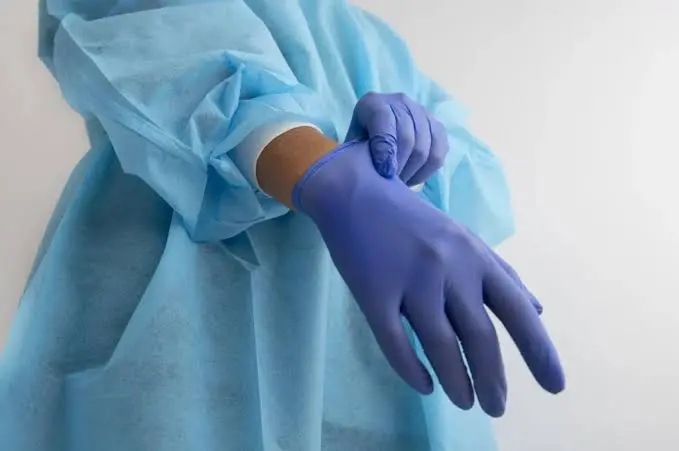

Disposable gloves are the predominant form of PPE used across industries and even domestically. It’s likely, however, that you give them little thought at all. This is why you may be surprised by some interesting facts about disposable gloves, as well as the misconceptions many people have about them.
Let’s dive in!
KEY TAKEAWAYS
· Disposable gloves are the most commonly used type of PPE, and applications widely cover medical, healthcare, manufacturing, automotive, food service, cleaning and janitorial, tattooing, piercing, emergency services, painting, laboratory settings, and domestic use.
· PPE gloves come in several materials, including nitrile, powdered latex, latex gloves that are powder-free, vinyl, and, less commonly, PVC.
· Choose the right glove for your specific application and always purchase from a reputable supplier.
What are disposable gloves made of?
Disposable gloves are available in three main materials: natural latex rubber, synthetic nitrile rubber, and vinyl. Other materials can also be used; for example, polyethylene, but these are not nearly as common.
Which type of disposable glove is best?
This depends on the reason and environment in which they’ll be used. Glove quality depends on material, thickness, manufacturing processes, and the use of the appropriate glove for its application.
Do I still need to wash my hands if I wear PPE gloves?
Yes! You must absolutely wash your hands, even if you wear gloves. They should be thoroughly washed and dried before donning gloves and then again after removing them. This is because no type of disposable glove is 100% impermeable. Furthermore, abrasions, punctures, tears, and nicks in the glove will render it ineffective.
Are disposable PPE gloves sterile?
Unless specifically stated on the packet (and they are also packaged individually), these gloves are not sterile. Some may even be contaminated during the manufacturing process. It’s crucial, especially for medical and healthcare applications, to know where your gloves are made and that the producer is reputable; choose a supplier and brand you trust, and always choose sterile gloves where required.
Are thicker gloves stronger?
Not necessarily. The strength of a disposable glove depends on the material chosen as well as the quality of the raw materials used in its manufacturing and processing.
Nitrile gloves, for example, come in a range of thicknesses. Thin gloves are often better and are ideal for use where touch sensitivity and dexterity need to be maintained (e.g. surgery). Some gloves are thin enough to leave the wearer’s fingerprint impression on surfaces they touch, even through the thin polymer of the glove.
What are latex gloves, and when are they used?
Popular and affordable, latex gloves are widely used in everything from healthcare to DIY projects. Latex gloves that are powder-free are particularly suited for some medical, healthcare, and food handling applications, although sensitivity in some individuals must be considered. A known limitation of latex gloves is the fact that natural latex rubber causes sensitivity, irritation, and even allergies in some people. In such cases, nitrile may be a more suitable disposable glove material.
What are nitrile gloves, and when are they used?
Nitrile is currently the most popular disposable glove material. It is widely used across numerous industries, from medical to scientific laboratory research, manufacturing, automotive, agriculture, food processing, tattooing and piercing, and emergency services.
Nitrile is favoured for its puncture-resistance, strength, and dexterity. It is waterproof, greaseproof, oilproof, and has high (but not total) chemical-resistance.
Unlike latex, nitrile is non-allergenic. Fewer than 1% of users have a sensitivity to it (versus up to 6% of the general population and up to 17% of healthcare workers who are sensitive to latex).
What’s the most eco-friendly glove type?
Latex is considered more eco-friendly, as it is derived from the sap of natural rubber trees. It is plant-based, renewable, and naturally biodegradable. Standard nitrile does not decompose easily; like vinyl, it can take hundreds of years to degrade in a landfill. There are, however, some gloves made from biodegradable nitrile, which will break down in fewer than 5 years.
What are vinyl gloves, and what are they used for?
Vinyl disposable gloves are not as widely used today. They are made from polyvinyl chloride (PVC), which is a very commonly produced type of synthetic plastic made from non-renewables. Its production creates huge volumes of toxic chemicals, some of which can cause cancer. Other chemicals in these gloves can cause allergic reactions (including dermatitis), especially with prolonged use.
These gloves also contain materials that are fat-soluble and will migrate into food. They do not prevent transmission through the glove of viruses, bacteria, and other microorganisms.
For these reasons, they are only suitable for low-risk tasks of short duration, such as providing a barrier against moisture, dirt, and light cleaning, in hair salons and beauty salons, painting, in school science labs for low-risk chemical handling and dissections, and for non-fatty food service.
Conclusion
Choose the PPE glove you need based on how, where, and how long you need to use it. Always purchase a good-quality product from a reputable supplier. Gloves for household use can be found in supermarkets, while occupational and specialty-use disposable gloves may be best bought from pharmacies or medical or dental supply companies online.
Also Read-
- Innovative Technologies in Metalworking Equipment
- How Bookkeeping Services Enhance Business Planning
- Pendeja Meaning in English: Definition, Usage, Cultural Context, and Real-Life Examples






Leave a Comment