![How is Self-Employment Income Calculated? [Loan Officer’s Guide]](https://grammerway.com/wp-content/uploads/2026/07/How-is-Self-Employment-Income-Calculated.webp)

Evaluating qualifying income for self-employed borrowers remains one of the most complex hurdles for mortgage loan officers. Tax returns are designed to minimize tax liabilities, not to highlight qualifying mortgage cash flow. Consequently, loan officers must bridge the gap between tax write-offs and actual debt-paying capacity.
This guide provides a clear roadmap for calculating self-employment income, covering required tax documentation, manual calculation formulas, and automated AI tools.
Prepare Documents for Self-Employment Income Calculation
Accurate income calculations depend entirely on gathering complete tax filings. Loan officers must request a full documentation package based on the borrower’s business structure before running numbers:
- Personal Tax Returns: Two most recent years of signed federal returns (IRS Form 1040) with all supporting schedules.
- Sole Proprietorships: Schedule C (Profit or Loss from Business) for the past two tax years.
- Partnerships & S-Corporations: IRS Form 1065 or 1120S along with Schedule K-1s verifying ownership percentage and pass-through distributions.
- Corporations: IRS Form 1120 tax returns for C-Corps where the borrower holds 25% or greater ownership.
- Year-to-Date (YTD) Profit & Loss (P&L): A signed YTD P&L statement and balance sheet if the most recent tax year ended more than 120 days prior.
- Alternative Non-QM Documents: 3 to 12 months of personal or business bank statements when originating specialized bank statement loan programs.
Method 1: Calculate Self-Employment Income for a Mortgage Manually
Following traditional agency cash flow analysis standards, such as Fannie Mae Form 1084 or Freddie Mac Form 91, loan officers calculate monthly qualifying income through a step-by-step formula:
- Establish Baseline Net Profit: Locate the net profit or loss reported on federal tax filings. For sole proprietors, this is found on Schedule C, Line 31.
- Apply Allowable Non-Cash Add-Backs: Add back non-cash expenses that reduce taxable income without depleting liquid funds. Key items include Depreciation (Line 13), Depletion (Line 12), Amortization, and Business Use of Home (Line 30).
- Subtract Non-Deductible Business Expenses: Subtract non-deductible travel and meal expenses (Line 24b) to accurately reflect operational cash flow.
- Evaluate Income Trends:
- Stable or Increasing Income: Combine adjusted qualifying income across 24 months and divide by 24.
- Declining Income: If Year 2 income drops compared to Year 1, lenders typically use only the lower, most recent 12-month figure. Severe year-over-year declines exceeding 20% often trigger additional underwriting review or loan disqualification.
- Stable or Increasing Income: Combine adjusted qualifying income across 24 months and divide by 24.
- Calculate Monthly Average: Divide total adjusted qualifying income by 24 (or 12 for declining income) to establish qualifying monthly earnings.
A borrower reports a Schedule C net profit of $72,000 in Year 1 with $8,000 in depreciation, totaling $80,000 in adjusted income. In Year 2, net profit reaches $82,000 with $10,000 in depreciation, totaling $92,000. Combining both years ($80,000 + $92,000 = $172,000) and dividing by 24 months results in a qualifying monthly income of $7,166.67.
Method 2: Use Zeitro Self-Employment Income Calculator
Loan officers looking to eliminate manual spreadsheet formulas and shorten underwriting turnaround times can utilize the Zeitro Self-Employment Income Calculator.
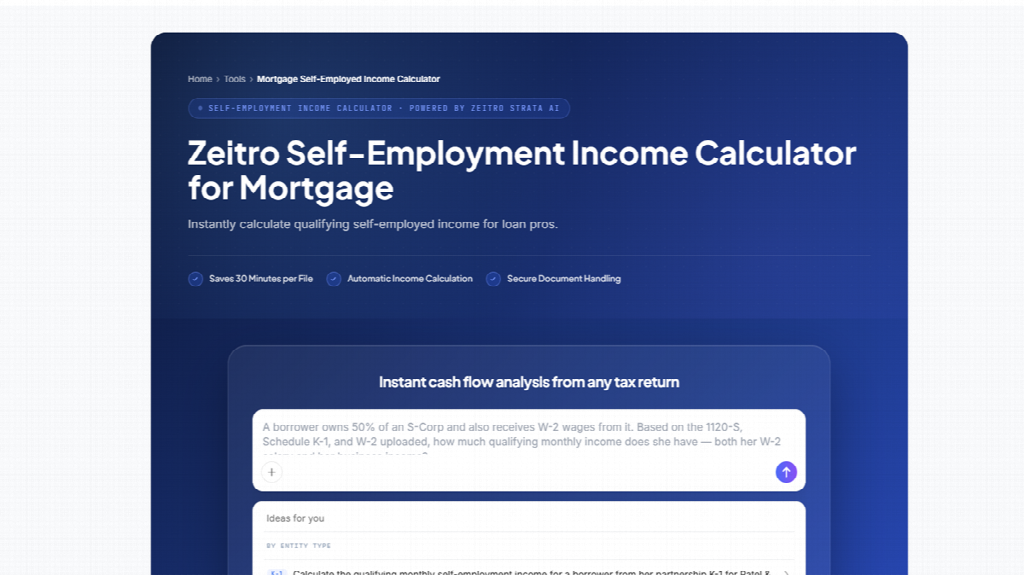
This calculator is powered by Zeitro Strata AI, an AI mortgage guideline assistant. By uploading tax filings and financial statements, originators receive automated, accurate income calculations while maintaining strict document privacy. The platform automatically evaluates income eligibility against agency guidelines and lender overlays, cutting processing times from 30 minutes down to seconds.
Beyond income calculations, Zeitro Strata AI offers a complete suite of originations tools:
- Comprehensive Guideline Coverage: Searches guidelines across 100+ investors and 1,000+ loan programs, including AAA Lending, AD Mortgage, AmWest, CMG Financial, First Colony Mortgage, Forward Lending, Freedom Mortgage, Giant Lending, Greenbox, HomeXpress Mortgage Corp, Luxury, Mega Capital, MK Lending, Nations Direct, and Thunderbird.
- QM and Non-QM Program Support: Covers Conventional, FHA, VA, Jumbo, Asset Utilization, Bank Statement, DSCR, Foreign National, Form 1099, ITIN, Profit and Loss, and WVOE loan types.
- 100% Citation-Backed Accuracy: Delivers answers anchored in actual guideline source texts to minimize AI hallucinations and provide clear audit references.
- Interactive Explain Feature: Allows users to re-query specific guideline responses for additional breakdown. Note: Each Explain request re-submits the prompt to the knowledge base, consuming one query credit from the daily allowance of 10 free queries.
- Expanded Strata AI Features: Includes Area Median Income (AMI) lookups, Down Payment Assistance (DPA) program searches, and a pricing engine to review daily mortgage rate sheets.
- Team Collaboration: Generates shareable links or sends income summaries directly to email for fast borrower pre-approvals.
Comparison Between Two Methods
Comparing manual cash flow analysis against Zeitro AI automation highlights key operational differences:
- Speed and Efficiency: Manual review takes 30 to 45 minutes per tax return, whereas Zeitro completes document extraction and income calculation in seconds.
- Error Risk: Manual entry increases the risk of calculation mistakes, missed depreciation add-backs, or misapplied declining income rules. Zeitro automates formulas and rules without calculation errors.
- Guideline & Overlay Verification: Manual lookup requires searching through hundreds of pages of PDF guidelines. Zeitro DeepSearch cross-checks over 100 investors simultaneously to identify overlay restrictions instantly.
- Non-QM Processing: Complex bank statement deposits and P&L statements require lengthy manual math, while Zeitro categorizes non-standard income sources automatically.
Final Word
Calculating self-employment income accurately is critical for preventing conditional loan rejections and keeping mortgage pipelines moving. Loan officers can streamline their originations workflow by following two key recommendations:
- Master Fundamental Mechanics: Maintain a clear understanding of IRS tax schedules, allowable add-backs, and Fannie Mae/Freddie Mac cash flow guidelines.
- Adopt AI Automation: Use Zeitro Self-Employment Income Calculator and Zeitro Strata AI to speed up income verification, cross-check investor overlays, and increase loan closing capacity.
Also Read-How Bookkeeping Services Enhance Business Planning







Leave a Comment