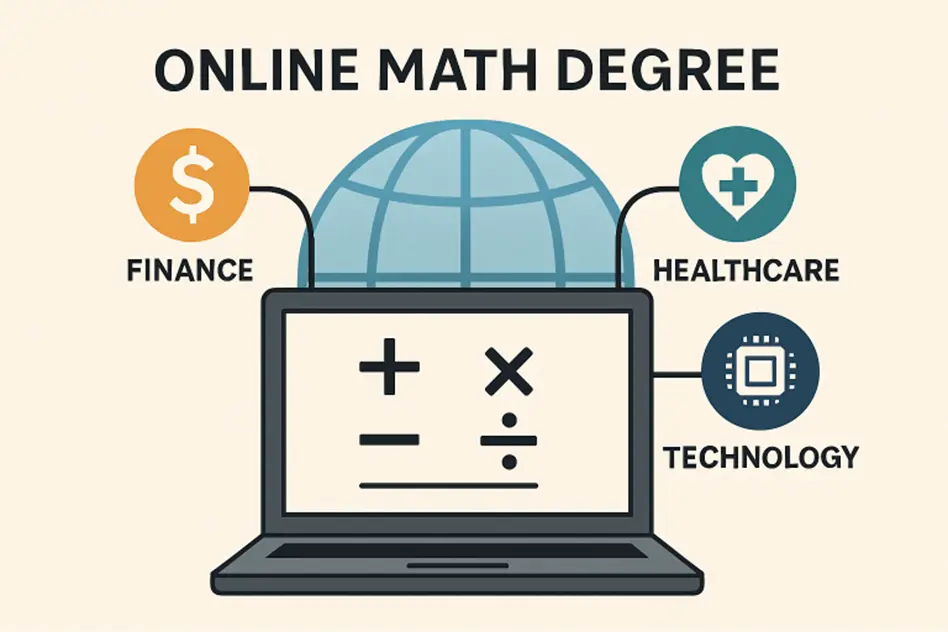

Enrolling in a Master’s in Math online can transform professional prospects, offering both flexibility and the rigorous intellectual development needed for a range of high-impact careers. The growth of online education makes this credential more accessible than ever for learners seeking to deepen expertise without sacrificing their existing commitments or relocating. This approach ensures that individuals from diverse backgrounds can pursue advanced studies in mathematics while maintaining a work-life balance.
As industries become increasingly data-driven and reliant on analytical insight, the demand for mathematical proficiency continues to surge. A Master of Science in Mathematics online program is designed to equip graduates with a versatile set of skills highly valued by employers. Students not only gain theoretical foundations but also practical competencies applicable to real-world challenges across sectors such as finance, technology, healthcare, and more.
Flexibility and Accessibility of Online Programs
One of the defining strengths of pursuing a Master of Science in Mathematics online is the flexibility it provides. Unlike traditional on-campus programs, an online degree allows students to study from anywhere, providing a vital opportunity for working professionals, parents, or those in remote regions to access top-tier education. The structure of online coursework is often designed for asynchronous participation, so students can engage with lectures, assignments, and discussions at times that best fit their schedules.
This flexibility does not come at the expense of academic rigor. Many online mathematics programs closely mirror the content delivered in their on-campus counterparts. With interactive platforms, digital tools, and collaborative forums, students benefit from a robust educational environment that promotes engagement and mastery of advanced concepts.
Diverse Career Opportunities
Earning a Master of Science in Mathematics opens doors to a remarkable spectrum of career paths. Employers in nearly every sector seek the critical thinking and quantitative reasoning skills honed in advanced mathematics programs. The following roles are among the most prominent:
Data Scientist
Data scientists are at the forefront of the modern data revolution. They analyze vast quantities of information to uncover patterns, deliver strategic insights, and inform organizational decision-making. Proficiency in statistics, machine learning, and data visualization is crucial in this field, which spans industries from technology and healthcare to government and retail. For an overview of trends in the data science job market, refer to resources at Bureau of Labor Statistics: Mathematics Occupations.
Quantitative Analyst
Quantitative analysts (quants) build and implement mathematical models for the finance sector. These models are used for portfolio management, risk assessment, and asset valuation. Their analytical skills are indispensable to banks, hedge funds, insurance companies, and investment firms that depend on data-driven strategies to generate profits and minimize losses.
Cryptographer
Cryptographers design and analyze secure systems that protect sensitive digital information. By developing encryption algorithms and security protocols, these specialists are vital to organizations across sectors such as finance, technology, government, and defense. As cyber threats grow in complexity, cryptographers’ contributions to data privacy and digital integrity become more crucial by the day.
Operations Research Analyst
Operations research analysts employ mathematical modeling and statistical analysis to solve complex organizational challenges. Their work optimizes systems across logistics and transportation, healthcare delivery, and resource management. By improving efficiency and streamlining processes, they provide measurable value across industries.
Essential Skills Developed
An online Master’s in Mathematics cultivates skills that are increasingly essential in today’s analytical and data-rich workplace:
- Analytical Thinking: Advanced mathematics requires a profound ability to dissect multifaceted problems and develop logical, systematic approaches to solving them. Graduates learn to think several steps ahead and evaluate every factor influencing a problem.
- Problem-Solving: Equation solving, algorithm design, and model building all form part of the immersive training. This prepares graduates to craft innovative, practical solutions in unpredictable or complex scenarios.
- Mathematical Modeling: Translating real-world phenomena into abstract mathematical representations is core to predicting outcomes or optimizing systems. This skill is applicable in everything from epidemiology to logistics.
- Statistical Analysis: The ability to interpret and leverage data for informed decision-making separates experts from amateurs in nearly every industry. Statistical expertise has become crucial across fields ranging from marketing to public health.
Emerging Fields and Opportunities
Recent advancements in artificial intelligence, machine learning, big data analytics, and computational modeling have further expanded professional opportunities for mathematics graduates. New fields, including bioinformatics, climate science, and complex network modeling, draw heavily on the skills developed in advanced mathematics programs. The U.S. Bureau of Labor Statistics highlights the rapid growth and evolution of mathematical careers in these areas, emphasizing their importance to the future workforce. For more details, see Bureau of Labor Statistics: Mathematics Occupations.
Conclusion
Pursuing a Master of Science in Mathematics online empowers graduates to thrive in a wide array of exciting, challenging, and impactful careers. The combination of a flexible online format and a rigorous, skills-oriented curriculum enables students to enhance both their technical capabilities and professional value. As innovation continues to shape industries, the adaptable and analytical approach fostered by a mathematics degree will remain indispensable in the world’s most dynamic and rewarding fields.
Also Read-Innovative Technologies in Metalworking Equipment







Leave a Comment