
Writing an essay often feels like putting on a stiff, uncomfortable suit. You worry about being too formal, using “big” words, and following rigid rules that make your writing feel robotic. However, the informal essay is a different beast entirely. It is the “jeans and a t-shirt” of the academic world—comfortable, personal, and full of character. For undergraduate students, mastering this style is about finding a balance between your natural voice and the structural integrity required for a college-level assignment.
The secret to a great informal essay isn’t just “writing how you talk.” It’s about writing how you think when you are being thoughtful. While a research paper demands objective distance, an informal essay thrives on the subjective “I.” It’s a space to explore your identity, your quirks, and your unique perspective on the world. But even in this relaxed atmosphere, quality matters. If you are struggling to find a starting point for your next piece, looking through a curated list of Best informal essay topics provided by MyAssignmentHelp can offer the creative spark needed to turn a blank page into a compelling narrative.
The Anatomy of “Informal” vs. “Formal”
Before diving into the grammar, it is essential to understand what makes an essay informal. In a formal paper, you are the observer; in an informal paper, you are the protagonist. You are allowed—and encouraged—to use first-person pronouns like “I,” “me,” and “my.”
| Feature | Formal Essay | Informal Essay |
| Point of View | Third-person (objective) | First-person (subjective) |
| Tone | Professional and detached | Conversational and engaging |
| Structure | Strict (Introduction, Body, Conclusion) | Flexible and narrative-driven |
| Goal | To argue or inform based on data | To reflect or entertain based on experience |
Even though the structure is flexible, you still need a beginning, middle, and end. You aren’t just rambling; you are taking the reader on a journey. Think of it as a directed conversation. You start with an interesting observation, explore its implications, and leave the reader with a final thought to chew on.
Grammar Tips for a Conversational Voice
One of the biggest misconceptions among students is that “informal” means “incorrect.” This couldn’t be further from the truth. In fact, writing informally often requires better grammar because you don’t have the “shield” of academic jargon to hide behind. Every word must earn its place.
1. Embrace the Contraction
In formal writing, we avoid “don’t,” “can’t,” and “it’s.” In an informal essay, avoiding them makes you sound like a Victorian ghost. Contractions help your writing flow naturally. They mimic the rhythm of human speech, making your “voice” feel accessible to the reader.
2. The Power of the Active Voice
Formal papers often slip into the passive voice (“The experiment was conducted…”). For an informal essay, keep it active (“I conducted the experiment…”). This places you at the center of the action and keeps the energy high.
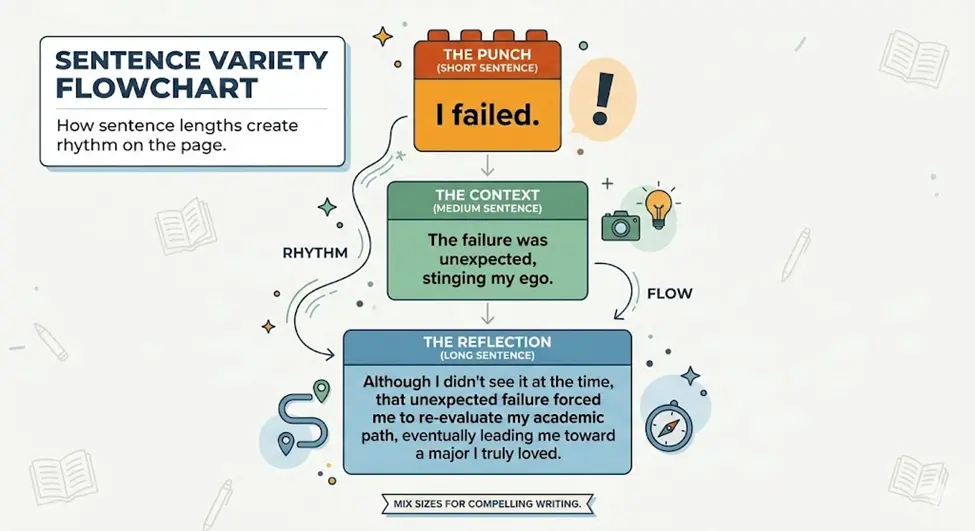
3. Sentence Variety is Key
If every sentence is the same length, your reader will fall asleep. Mix short, punchy sentences for emphasis with longer, descriptive ones for atmosphere. This creates a “musicality” in your writing that keeps the reader engaged from the first paragraph to the last.
Refining Your Work with Modern Tools
As you reach the middle of your drafting process, the focus shifts from “what” you are saying to “how” you are saying it. Even the most brilliant story can be ruined by a repetitive typo or a confusing comma splice. While your personal “voice” is unique, the rules of syntax still apply to ensure clarity. To ensure your paper meets high academic standards, using a reliable grammar checker from MyAssignmentHelp can help you identify hidden errors that the human eye often misses during a late-night writing session. Using such tools isn’t about letting a machine write for you; it’s about polishing your existing diamond so it shines as brightly as possible.
Creative Prompts to Get You Started
Sometimes the hardest part of an informal essay is the “choice paralysis” that comes with a broad prompt. If you’re staring at a blinking cursor, try one of these undergraduate-focused angles:
- The “First Time” Narrative: Write about the first time you felt like an adult. Was it paying a bill? Cooking a meal that didn’t burn? The realization that you had to make your own doctor’s appointments?
- The Small Obsession: Pick something tiny that you love—like a specific type of pen, a niche video game, or the way a certain street looks at 5 AM—and explain why it matters to you.
- The Failed Lesson: We always write about our successes. Write about a time you failed at something and didn’t learn a profound lesson immediately. What did that frustration feel like?
Structural Flow: Creating a Narrative Arc
Even if you aren’t writing a “story,” your essay needs an arc.
- The Hook: Start with an image or a question. Don’t say “In this essay, I will talk about…” Instead, say, “The smell of old library books always reminds me of my third-grade teacher.”
- The Context: Give the reader enough background to understand why your topic matters. Why should they care about your library books?
- The “So What?”: This is the most important part. By the end of the essay, the reader should understand the significance of your reflection. It doesn’t have to be world-changing, but it should be human.
Common Pitfalls to Avoid
While we want to be relaxed, there are “red flags” that can turn a good informal essay into a messy one:
- Too much slang: While “global tone” allows for some personality, avoid hyper-local slang that an international reader might not understand.
- Over-sharing: There is a fine line between “personal” and “uncomfortably private.” Keep the focus on the insight rather than just the shock value.
- Lack of Paragraphs: Just because it’s informal doesn’t mean it should be a “wall of text.” Give your ideas room to breathe.
Conclusion: Trusting Your Voice
At the end of the day, an informal essay is a bridge between you and the reader. It’s an invitation into your mind. By following basic grammar principles, using the right tools to polish your prose, and choosing topics that actually mean something to you, you can produce work that is both academically sound and deeply personal. Don’t be afraid to sound like yourself—that’s the only person you can be an expert on.
Frequently Asked Questions (FAQ)
Q1: Can I use slang in an informal undergraduate essay?
A: Use slang sparingly. It can add flavor, but if your audience is global, “niche” slang can lead to confusion. Aim for a “conversational professional” tone.
Q2: Is a thesis statement required in an informal essay?
A: Not in the traditional “The three reasons for X are Y and Z” sense. However, you should have a “central theme” or a main point that ties the whole piece together.
Q3: How long should an informal essay be?
A: Typically, these range from 800 to 1,500 words for undergraduate assignments. The goal is to be deep enough to be interesting, but concise enough to remain engaging.
Q4: Should I cite sources in an informal essay?
A: If you mention specific facts, data, or someone else’s direct ideas, yes! Even in a personal essay, giving credit where it’s due is a hallmark of good writing.
Q5: How can I make my writing sound more “human”?
A: Read your work out loud. If you find yourself tripping over a sentence or running out of breath, that sentence is too long or too “robotic.” Rewrite it until it sounds like something you would actually say.
About The Author
I am Ruby Walker, an educational consultant and career strategist at MyAssignmentHelp, where I focus on helping undergraduate and graduate students bridge the gap between classroom theory and professional-grade writing. With a background in academic research and a passion for digital literacy, I specialize in deconstructing complex writing assignments into manageable, creative projects.
Also Read
- The Future of SEO: Why AI Should Have Your Link to Cite You and Why You Should Buy Quality Backlinks.
- Coastal Road Trips and Hidden Gems in Portugal
- The Importance of Mutual Fund Demat Accounts for Simple Investing







Leave a Comment